I've been watching @arc mainnet since launch, and one thing surprised me.
The first wave of activity doesn't look exactly like the financial ecosystem most people expected.
It looks much more like crypto.
Meme coins.
Launchpads.
Speculation.
Trading.
And one of the biggest sources of activity has been Argus.
On Arc's first day, the network processed hundreds of millions of dollars in DEX volume, with meme-coin launchpads accounting for the majority of that activity.
Argus generated more than $200M in volume.
At first, that might seem completely disconnected from Arc's original thesis.
Arc is being built around stablecoin payments, FX, tokenized assets, financial markets and institutional use.
So why are meme coins suddenly one of the biggest sources of activity?
Because this is actually what happens when a new permissionless financial network goes live.
People don't wait for the perfect institutional use case.
They start trading.
They launch tokens.
They experiment.
They provide liquidity.
They look for opportunities.
And honestly, I think that's useful to watch.
A mainnet needs economic activity before it can become an economy.
The important question isn't whether meme coins are "the future of Arc."
They aren't the reason Arc was built.
The interesting question is whether this initial speculative activity becomes a gateway to something broader.
Do traders stay?
Does liquidity deepen?
Do serious applications start using that liquidity?
Do stablecoins become the base layer for more sophisticated financial activity?
Can the infrastructure that handles speculative trading today eventually support payments, FX, lending and tokenized assets tomorrow?
That's what I'll be watching.
Because the first few days of a new blockchain rarely look like its final form.
They show where users go when they're given an empty canvas.
And right now, a lot of users on Arc are clearly choosing to trade.
Argus is one of the clearest examples of that.
The interesting part will be seeing what gets built once the initial excitement settles down.
Mainnet has only been live for a few days.
We're still very early.
Arc mainnet is live.
After months of exploring the testnet, this feels like more than another blockchain launch.
It's the moment when the thesis behind Arc finally starts getting tested in the real world.
The idea has always been fairly different from the usual L1 narrative.
Not:
"How do we build a faster blockchain?"
But:
"What would financial infrastructure look like if it were designed around internet-native money from the beginning?"
That's why so much of Arc's architecture revolves around stablecoins.
USDC is native.
Gas is paid in USDC.
Settlement is designed to be fast and deterministic.
And the network is being built around payments, FX, financial markets, tokenized assets and increasingly autonomous economic activity.
But technology alone isn't enough.
What makes today's launch interesting is everything arriving around the network.
Arc goes live with more than 100 applications and more than 100 institutional and ecosystem builders.
That's a very different starting point from an empty chain waiting for its first users.
Now the difficult part begins.
Can developers turn the infrastructure into products people actually use?
Can stablecoin-native settlement make financial applications meaningfully better?
Can institutions use public blockchain infrastructure without inheriting unnecessary crypto complexity?
Can liquidity, payments, tokenized assets and autonomous agents develop into real economic activity?
Those questions can't be answered by a testnet.
They require a live network.
I've spent a lot of time testing Arc before this moment.
And that's probably what makes the launch feel different to me.
I've already seen the transactions.
I've used the infrastructure.
I've watched the ecosystem gradually come together.
Now I want to see what happens when all of those pieces are connected to an actual economy.
Mainnet isn't the conclusion of the Arc experiment.
It's the beginning of the much more interesting part.
**The testnet showed what Arc could build.
Mainnet will show what people can build with Arc.**
@arc
Tomorrow, Arc mainnet.
After months of testing, quests, experimenting and watching the network evolve, we finally get to see what Arc looks like in production.
The interesting part starts now.
Mainnet is where the real users, apps, liquidity and builders arrive. Let’s see if Arc can deliver on the vision of an economic OS built around stablecoins.
Ready for day one. 🟠
@arc
Two days until Arc mainnet.
I've spent months using the testnet, and there's one thing I'm more interested in now than the launch itself:
What happens after the launch?
Arc already has the infrastructure:
native USDC gas,
predictable fees,
deterministic settlement,
crosschain liquidity,
and an ecosystem being built around real financial use cases.
But infrastructure only matters if people actually use it.
Mainnet changes the game.
Developers can start building for real users.
Apps can start generating real economic activity.
Payments, FX, lending, tokenized assets and agentic transactions can move from demos and testnet experiments toward production.
That's the part I'm watching.
Not how many wallets connect on day one.
Not how much noise the launch generates.
But whether Arc can turn its stablecoin-native design into an actual financial network.
Two days left.
The testnet showed what Arc can do.
Mainnet will show what people actually want to do with it.
@arc
Four days until Arc mainnet.
After spending months exploring the testnet, this is the point where I'm starting to look at Arc a little differently.
A testnet can answer one question:
Does the infrastructure work?
Mainnet introduces a much harder one:
Can people actually build an economy on top of it?
That's a completely different challenge.
Arc is entering mainnet with a very specific thesis.
Stablecoins shouldn't just be assets that happen to exist on a blockchain.
They can become the foundation for payments, FX, treasury management, lending, tokenized assets and financial markets.
And Arc is building the underlying settlement layer around that idea.
The interesting part is how many pieces are now coming together.
USDC is native.
Transaction fees are denominated in USDC.
Transactions are designed for deterministic sub-second settlement.
Circle's infrastructure provides access to crosschain USDC liquidity.
Uniswap brings a major liquidity primitive.
Chainlink provides data and interoperability infrastructure.
Hardware wallet support is being added.
And institutional validators are part of the network's foundation.
None of these things guarantees success.
That's important to keep in mind.
A blockchain can have excellent technology and still fail to attract meaningful economic activity.
But that's also why the next four days feel different from everything we've been testing until now.
The question is no longer whether Arc has an interesting architecture.
We've had plenty of time to explore that.
The question is whether developers can turn these primitives into products that people actually want to use.
Can stablecoin payments become simpler?
Can onchain FX become genuinely useful?
Can tokenized assets find real liquidity?
Can institutions use public blockchain infrastructure without accepting unnecessary operational complexity?
Can autonomous agents actually transact economically?
Those are the questions mainnet will start answering.
And there's something I particularly like about this transition.
Arc isn't trying to convince everyone that they need to move their entire financial life onto one new blockchain.
The vision is closer to becoming a settlement layer underneath an increasingly multichain financial system.
That makes much more sense to me.
If Arc succeeds, users probably won't spend their time thinking about Arc.
They'll just send money.
Trade assets.
Manage treasury.
Settle transactions.
Use financial applications.
And maybe let software agents do some of those things automatically.
The blockchain underneath will simply make it possible.
Four days left.
The testnet was the experiment.
Mainnet is where the thesis finally meets reality.
One of the less flashy developments around @arc might actually be one of the more important ones for everyday users.
Ledger support is coming to Arc.
At first glance, this might not sound as significant as a new DeFi protocol or another infrastructure integration.
But there's a simple reason I think it matters:
Infrastructure only becomes useful when people can actually trust it with their money.
Arc is being built around stablecoin-native finance, with USDC at the center of the network.
That makes wallet infrastructure particularly important.
A financial network can have great technology underneath it, but users still need secure ways to hold assets and sign transactions.
Hardware wallets solve a very specific problem:
They keep the private key isolated from the computer or phone being used to interact with applications.
And with Ledger support, users will be able to send and receive USDC and supported assets on Arc while verifying transactions directly on their Ledger device.
This might seem like a small integration.
I don't think it is.
Look at what Arc is gradually assembling.
Stablecoin-native payments.
Uniswap liquidity.
Chainlink data and interoperability.
Institutional validators.
Developer tooling.
And now hardware-backed wallet support.
None of these pieces alone makes a financial ecosystem.
But together, they start to form the infrastructure that applications actually need.
That's something I've been watching closely as Arc moves toward mainnet.
During the testnet phase, it was easy to focus on what Arc could theoretically become.
Now the more interesting question is whether the ecosystem around it is becoming complete enough to support real users and real financial activity.
Security is part of that equation.
Liquidity is part of it.
Reliable data is part of it.
Payments and settlement are part of it.
Developer tooling is part of it.
The strongest networks won't necessarily be the ones with the most impressive individual features.
They'll be the ones where all these pieces work together without forcing users to think about the infrastructure underneath.
Arc's mainnet is getting closer.
And the list of pieces coming together is getting longer.
A blockchain can have stablecoins, liquidity and fast settlement.
But financial applications still need something else:
Reliable data.
That's why Chainlink becoming available on the @arc testnet is more important than it might look at first.
Blockchains are very good at verifying what happens onchain.
They aren't naturally good at knowing what's happening outside of them.
What's the price of an asset?
What's the value of collateral?
What is the current FX rate?
Did a reserve actually exist?
What happened in another blockchain?
Financial applications need answers to these questions before they can safely execute transactions.
A lending protocol can't calculate liquidations without reliable price data.
A derivatives market can't settle without accurate market information.
A tokenized asset platform may need proof that the underlying asset or reserve actually exists.
And cross-chain applications need a secure way to communicate with other networks.
That's where oracle infrastructure becomes fundamental.
Chainlink's integration brings Data Feeds, Data Streams, CCIP and Proof of Reserve to Arc builders.
And I think this is an important step in Arc's evolution.
We've already talked about liquidity arriving through Uniswap.
We've talked about native USDC.
We've talked about institutional validators.
Now another piece of the financial stack is becoming available.
That's how an ecosystem starts to become more interesting.
Not because one feature suddenly changes everything.
But because developers gradually get the primitives they need to build complete financial applications.
This is also why I'm watching Arc differently now than I did during the early testnet.
At first, the question was whether the underlying infrastructure worked.
Now the more interesting question is:
Are enough pieces of the financial stack coming together for developers to build something genuinely useful?
Chainlink on testnet is another step in that direction.
Mainnet is getting closer.
And the ecosystem is starting to look less like a blockchain test and more like an attempt to assemble an actual financial platform.
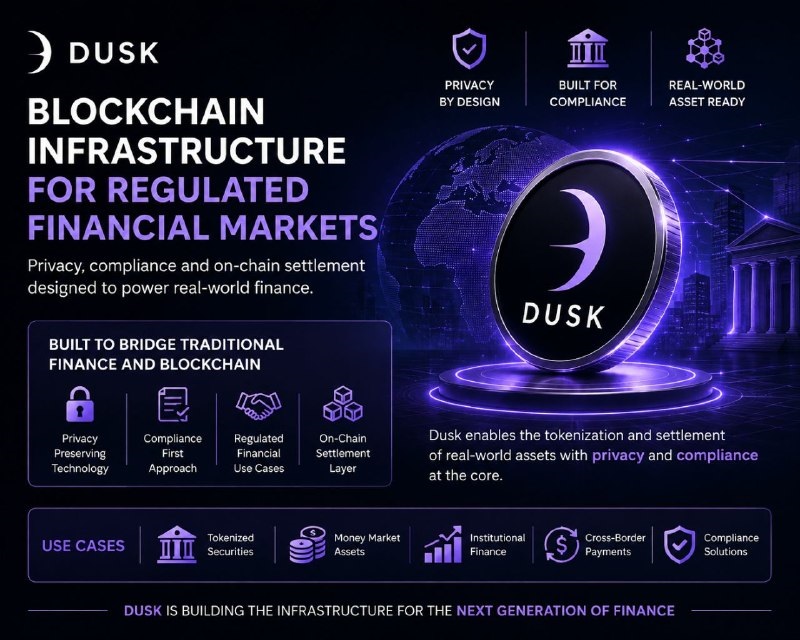
The biggest RWA opportunity might not be tokenization itself. It might be rebuilding the infrastructure around financial assets.
That's the part of @Dusk I find most interesting.
A regulated security needs much more than a token contract. It needs investor eligibility, transfer rules, privacy, compliance, corporate actions and predictable settlement.
Dusk is trying to bring these requirements closer to the blockchain itself.
What stands out to me is the balance between privacy and verifiability.
Financial institutions don't necessarily need everything to be public. They need the right information to be verifiable by the right participants.
That's where selective disclosure and privacy-preserving transactions become important.
Add deterministic settlement and EVM compatibility, and Dusk is building around a very specific thesis:
Financial markets can move on-chain without having to abandon the rules and privacy requirements that make them work.
Whether Dusk can turn that architecture into real institutional adoption is the big question.
But the infrastructure problem is real — and that's why $DUSK remains on my radar.
#dusk $DUSK @Dusk@DuskFoundation
One thing I've started to appreciate while following @arc is that good blockchain infrastructure is only half of the equation.
The other half is liquidity.
You can build a chain with predictable fees, fast finality and a strong developer experience.
But financial applications still need somewhere to trade, borrow, lend and move capital.
That's why Uniswap coming to Arc is more significant to me than simply adding another familiar DeFi protocol.
Liquidity is a network effect.
A lending market needs reliable liquidity.
Tokenized assets need somewhere to trade.
Stablecoin FX needs deep markets.
Structured products need capital to flow in and out efficiently.
And developers need these primitives to be available before they can build more sophisticated financial applications.
This is where the difference between a blockchain and an ecosystem becomes important.
A blockchain can provide the infrastructure.
But the ecosystem determines what that infrastructure is actually capable of doing.
Arc is trying to build around stablecoin-native finance from the beginning.
Now we're starting to see the other pieces arrive around that foundation.
Uniswap brings a major piece of onchain liquidity.
Circle brings native USDC infrastructure.
Institutional validators bring another layer of financial infrastructure and credibility.
And developers can start composing these pieces into applications rather than building everything from scratch.
Of course, none of this guarantees success.
Liquidity has to be used.
Applications need users.
Capital needs to move.
And ultimately, Arc has to prove that its architecture creates a meaningful advantage for financial applications.
But that's exactly why the transition from testnet to mainnet is so interesting.
We're moving from asking:
"Can Arc process transactions?"
to asking:
"Can Arc support an actual financial economy?"
Those are two very different questions.
And I think the second one is the question worth watching now.
The RWA narrative is entering a more interesting phase.
The question is no longer just whether real-world assets can be tokenized.
The harder question is whether they can actually operate on-chain while preserving the requirements of regulated finance.
That’s the problem @Dusk is trying to tackle.
Investor eligibility, transfer restrictions, privacy, selective disclosure and deterministic settlement aren't optional details when you're dealing with securities and institutional capital. They are part of the financial infrastructure itself.
What I find interesting about Dusk is that these requirements aren't treated as an afterthought.
The network is being designed around them.
That creates a different vision for RWAs:
Not simply putting TradFi assets on a blockchain, but building blockchain infrastructure where regulated assets can actually function.
Of course, architecture alone doesn't guarantee adoption. The real test will be whether developers, issuers and investors ultimately choose to use it.
But if institutional finance really moves on-chain, infrastructure built specifically for that environment could become extremely valuable.
That's why $DUSK remains on my radar.
#dusk $DUSK @Dusk@DuskFoundation
One of the most interesting things I've seen around @arc recently isn't another benchmark.
It's the idea of machines actually paying each other.
In a recent Arc Builder Spotlight, TLAY demonstrated two physical devices negotiating and settling USDC payments on Arc autonomously.
No human approving every transaction.
No manual transfer.
Just machine-to-machine payments happening automatically.
That might sound like a niche experiment.
I don't think it is.
We've spent years talking about the "agentic economy" as if it simply means AI agents using chatbots and APIs.
But autonomous economic activity requires something much more fundamental:
machines need to be able to move value.
An AI agent can find the best price.
A software agent can negotiate a service.
A machine can consume electricity.
A device can provide computing power.
A network of autonomous systems can coordinate resources.
But eventually, someone—or something—has to pay.
And that's where programmable money becomes much more interesting.
Traditional payment systems were designed primarily around humans initiating transactions.
Machines operate differently.
They may need to make thousands of small payments.
They may need to react to changing prices in real time.
They may need to transact 24/7.
They can't rely on a person manually approving every payment.
This is why infrastructure with predictable fees, fast settlement and stable units of account becomes important.
You don't want an autonomous machine making an economic decision and then discovering that the cost of the transaction itself is unpredictable.
You want the payment layer to behave more like infrastructure.
Invisible.
Programmable.
Reliable.
That's one of the reasons I'm becoming more interested in Arc's "Economic OS" thesis.
It isn't only about moving money between people.
It's about creating infrastructure where software, machines and eventually autonomous agents can participate in economic activity themselves.
We're still very early.
A demo between two devices obviously isn't proof that a machine economy is about to arrive.
But it demonstrates something important:
The technical pieces are starting to move from theory into actual experiments.
And if autonomous systems become a meaningful part of the economy, they will need something humans have always needed:
a simple way to exchange value.
Maybe the next generation of payments won't be designed primarily for people.
Maybe they'll be designed for the machines working on our behalf.
That is a future worth watching.
The real test for an RWA blockchain isn't how many assets it can tokenize. It's whether those assets can actually function as financial instruments.
That's where I think @Dusk has an interesting thesis.
A regulated security needs more than an on-chain representation. It needs rules for eligibility, transfers, privacy, disclosure and settlement — and those rules need to work together.
Dusk is building this infrastructure at the protocol level, rather than treating compliance as something every application has to recreate separately.
What I particularly like is the idea of controlled transparency.
Financial markets need verifiable activity, but investors and institutions don't necessarily want every piece of sensitive information exposed publicly.
With privacy-preserving transactions and selective disclosure, Dusk aims to make information verifiable without making everything visible.
That could be a critical requirement if tokenized securities move from crypto experiments into serious institutional markets.
The future of RWA isn't just putting TradFi assets on-chain. It's making them usable on-chain without removing the rules that make financial markets work.
That's the Dusk thesis I'm watching.
#dusk $DUSK @Dusk@DuskFoundation
The more I look into the RWA sector, the more I think privacy is going to become one of its biggest challenges.
Putting a real-world asset onchain is relatively easy.
Building a system where regulated institutions can actually use that infrastructure is much harder.
Financial markets can't operate with the assumption that every piece of information should be publicly visible.
Investor data can be sensitive.
Transaction details can be commercially sensitive.
Institutions need compliance without exposing unnecessary information.
And regulators need visibility without turning every financial activity into a completely transparent public record.
This is where Dusk's approach becomes interesting to me.
The goal isn't simply to put stocks, bonds or other financial assets on a blockchain.
It's about creating infrastructure where these assets can benefit from blockchain settlement while still preserving the privacy and compliance requirements of traditional finance.
That's a very different challenge from simply creating an ERC-20 representation of an asset.
Tokenization only becomes truly useful when the entire financial lifecycle can move onchain:
issuance → ownership → transfers → compliance → settlement.
If any one of those steps still depends on fragmented infrastructure, the blockchain is only solving part of the problem.
That's why I think the next phase of the RWA narrative will be less about "what can we tokenize?"
and more about:
"Can we actually build financial markets onchain?"
That's the question I'll be watching Dusk try to answer.
#DUSK $DUSK @DuskFoundation
The more I look into the RWA sector, the more I think privacy is going to become one of its biggest challenges.
Putting a real-world asset onchain is relatively easy.
Building a system where regulated institutions can actually use that infrastructure is much harder.
Financial markets can't operate with the assumption that every piece of information should be publicly visible.
Investor data can be sensitive.
Transaction details can be commercially sensitive.
Institutions need compliance without exposing unnecessary information.
And regulators need visibility without turning every financial activity into a completely transparent public record.
This is where Dusk's approach becomes interesting to me.
The goal isn't simply to put stocks, bonds or other financial assets on a blockchain.
It's about creating infrastructure where these assets can benefit from blockchain settlement while still preserving the privacy and compliance requirements of traditional finance.
That's a very different challenge from simply creating an ERC-20 representation of an asset.
Tokenization only becomes truly useful when the entire financial lifecycle can move onchain:
issuance → ownership → transfers → compliance → settlement.
If any one of those steps still depends on fragmented infrastructure, the blockchain is only solving part of the problem.
That's why I think the next phase of the RWA narrative will be less about "what can we tokenize?"
and more about:
"Can we actually build financial markets onchain?"
That's the question I'll be watching Dusk try to answer.
#DUSK $DUSK @DuskFoundation
A blockchain can have great technology, low fees and fast finality.
But without liquidity, none of that matters very much.
That's why the upcoming Uniswap deployment on @arc is one of the more important ecosystem developments I've seen recently.
When I first started exploring Arc, most of the conversation was about the infrastructure itself.
Stablecoin-native design.
Predictable fees.
Fast finality.
Unified balances.
An Economic OS for the internet.
All of those ideas are interesting.
But eventually every financial network reaches the same question:
Where does the liquidity come from?
A payments application may need to convert assets.
A treasury product may need to rebalance.
A lending protocol needs markets.
A tokenized asset needs somewhere to trade.
Even a simple wallet needs reliable routes between assets.
Financial applications don't exist in isolation.
They depend on other financial primitives.
That's why having Uniswap come to Arc matters.
It isn't just another familiar DeFi name being added to an ecosystem.
It's a piece of infrastructure that other applications can build around.
And that's the part I find most interesting.
The value of an ecosystem isn't determined only by how good its base layer is.
It's determined by what developers can actually compose on top of it.
If Arc wants to become infrastructure for payments, FX, treasury operations, lending and tokenized assets, then deep and reliable liquidity isn't optional.
It's foundational.
Of course, a deployment announcement doesn't automatically mean Arc will have deep liquidity on day one.
Liquidity has to be earned.
Users have to come.
Market makers have to participate.
Applications have to create real demand.
But this is exactly the kind of development I want to see before mainnet.
Not just another benchmark.
Not just another technical upgrade.
Actual financial primitives arriving around the network.
Arc is getting closer to the point where we can stop asking:
"Can this blockchain work?"
and start asking a much more interesting question:
"What can people actually build when the pieces of a financial ecosystem begin fitting together?"
Mainnet will be the real test.
And with Uniswap joining the stack, that test is becoming a lot more interesting.
If RWAs are going to become a serious part of crypto, privacy can't be an afterthought.
Financial markets need transparency, but they also handle information that shouldn't be visible to everyone.
That's where @Dusk takes an interesting approach.
Instead of choosing between a completely transparent blockchain and a completely private system, Dusk uses selective disclosure to create a middle ground.
A participant can prove that they meet a requirement without necessarily exposing all the underlying information.
Think about a regulated security:
An issuer may need to verify that an investor is eligible.
A regulator may need access to specific records.
Another market participant may only need confirmation that the transaction is valid.
They don't all need to see the same data.
Dusk combines this approach with privacy-preserving transactions, access controls and deterministic settlement — all aimed at making blockchain infrastructure more compatible with regulated financial markets.
That's what makes the Dusk thesis interesting to me.
The future of on-chain finance probably isn't “everything public” or “everything private.”
It may be verifiable finance with controlled visibility.
If institutional capital really moves on-chain, that distinction could become extremely important.
#dusk $DUSK @Dusk@DuskFoundation
I think one of the biggest mistakes in the RWA narrative is treating tokenization as the finish line.
Putting a bond, fund or security on-chain is only useful if the infrastructure around it can handle the rules that come with the asset.
Who is eligible to buy it?
Can it be transferred to another wallet?
Which information should be public?
What needs to remain confidential?
How does settlement happen?
These are the problems @Dusk is trying to address at the protocol level.
Its architecture combines access controls, privacy-preserving transactions, selective disclosure and deterministic settlement — a combination designed specifically for financial workflows where transparency alone isn't enough.
And I think selective disclosure is particularly important.
Traditional finance doesn't require every participant to see everything. A regulator may need to verify one piece of information without gaining access to an investor's entire financial history. A counterparty may need proof of eligibility without seeing unnecessary personal data.
Zero-knowledge technology makes this kind of model possible: prove what needs to be proven without revealing everything behind the proof.
That's a much more realistic direction for institutional blockchain adoption than simply saying “put everything on a public ledger.”
If tokenized assets become a serious part of global finance, I expect privacy and compliance infrastructure to become just as important as scalability and liquidity.
That's why Dusk remains one of the projects I'm watching in the RWA space.
#dusk $DUSK @Dusk@DuskFoundation
What happens when financial markets move on-chain, but the rules of traditional finance don't disappear?
That's the problem I find interesting about @DuskFoundation .
A regulated asset needs more than a token contract. It needs investor eligibility, transfer restrictions, privacy, compliance and reliable settlement — all working together.
Dusk is building these requirements directly into its infrastructure rather than treating them as external services.
The selective disclosure approach is particularly interesting: sensitive financial information can remain private while authorized parties can still verify what they need.
Add deterministic settlement and EVM compatibility, and Dusk starts looking less like a generic L1 chasing every narrative and more like infrastructure built around a specific market:
regulated finance on-chain.
If RWAs eventually become a major part of crypto, I think the networks solving the compliance and privacy problem will be just as important as the ones providing scalability.
That's why I'm keeping an eye on $DUSK.
#dusk @Dusk@DuskFoundation