#letsendtoxicity
A radiology resident at NHL Municipal Medical College, Ahmedabad attempts suicide after consuming 30 clonazepam tablets — pushed to the edge by 36-hour duties, harassment, and exploitation.
👉 On paper: 13 residents
👉 Reality: Half posted elsewhere → double workload for those left behind
And what follows is not training — it’s slavery:
•Reports written in seniors’ names → punishment of rewriting them 10–50 times for errors
•Personal errands: daily breakfast & food for seniors
•Forced work at professor’s private imaging center
•Lunch >20 minutes? Threats
•Panic attacks? Dismissed as “malingering”
And the lowest of lows 👇
The professor allegedly asked him to produce a psychiatric certificate — so THEY can shift the blame to “mental illness” instead of their brutality.
If this doesn’t shake National Medical Commission and Gujarat authorities into action, then what will?
How many more residents need to break before this system is held accountable?
#NHLMMC #MedicoLivesMatter #StopResidentAbuse #MedicalToxicity #DoctorsAreNotSlaves #ReformMedicalTraining
Lee Kuan Yew chose NOT to remove Sir Stamford Raffles' statue from Singapore despite pressure from many leaders in 1965.
His rationale was simple - Singapore cannot enter a new future with anger towards the past. Instead, reconciliation with history was necessary to even imagine a new era. This belief also aligned with his decision to attract investments from the West.
India is still in a phase where it has a lot of anger about its own history. Our reconciliation phase is at least a generation away, if not more.
While popular politicking will take its own course, well-meaning, patriotic Indians should move on quickly from anger to reconciliation. The world is what it is. History is what has happened. Anger is a waste of energy, a killer of imagination and a drag on our future potential.
In medical school, we are taught a golden rule: "When you hear hoofbeats, think horses, not zebras." It is a reminder to look for the common explanation before the exotic one. But after decades in cardiology, I’ve learned that if a patient is still suffering after the "horses" have been ruled out, a doctor must have the courage—and the curiosity—to go hunting for the zebra.
Sarah was a thirty-four-year-old marathon runner and a devoted mother who came to me after six months of being told she was "fine." She had been bounced from one specialist to another, each one pointing to her normal EKG and standard blood tests as proof that her crushing fatigue and racing heart were simply the result of "new mom stress." By the time she reached my office, she didn't just look tired; she looked invisible, as if the medical system had stopped seeing the woman and only saw the data.
Instead of re-reading the normal test results that had already failed her, I asked Sarah to walk me through her life. We talked about her training and her family, eventually landing on a backpacking trip she took to the Mendoza province of rural Argentina. She described staying in a charming, rustic cottage made of sun-dried mud bricks. She mentioned waking up one morning with a strangely swollen, purple eyelid that she assumed was a simple spider bite.
As she spoke, a memory surfaced from a biography I had read years ago about Charles Darwin. Most people know Darwin for his theories on evolution, but medical historians have long puzzled over the mysterious, debilitating illness that plagued him for decades after he returned from his voyage on the HMS Beagle. Darwin had written in his journals about being bitten by the "great black bug of the Pampas" while sleeping in mud-walled huts in South America. He spent the rest of his life suffering from heart palpitations and exhaustion that the Victorian doctors of his time could never explain.
I realized then that Sarah wasn't suffering from stress; she was likely hosting the same "silent killer" that may have haunted Darwin: Chagas Disease.
The "Kissing Bug" lives in the cracks of those mud-brick walls. It bites its victims—often near the eyes or mouth—while they sleep, passing a parasite called Trypanosoma cruzi into the blood. The danger of Chagas is that the initial symptoms disappear quickly, but the parasite can hide in the body for years, slowly weaving itself into the muscle and electrical "wiring" of the heart.
To confirm this, I moved beyond the standard tests. I ordered a specialized "Strain Rate" ultrasound, which doesn't just look at whether the heart is pumping, but at how the individual muscle fibers are stretching. We saw that while her heart looked strong to the naked eye, the fibers were "stuttering," a sign of early parasite-induced scarring. A specific blood test for the parasite's antibodies confirmed the diagnosis.
Treatment required a difficult, sixty-day course of anti-parasitic medication to stop the infection, paired with a protective heart regimen to keep her electrical system stable while the inflammation settled. Because we caught it before her heart was physically damaged or enlarged, the recovery was a success.
Months later, Sarah returned to my office, her vibrant energy restored. She brought me a leather-bound copy of The Voyage of the Beagle with a note tucked inside. She wrote that while other doctors had looked at her charts, I had looked at her. This case remains a vital reminder for my memoir: in a world of high-tech scans and AI, the most sophisticated diagnostic tool we possess is still the human story. When we truly listen, we don't just find the disease—we find the patient.
Good morning.
Now that everyone is an expert on curing pancreatic cancer in mice, not rats - I want to add some context that goes beyond the headline.
You will want to read this.
Cancer is cured in mice all the time.
Thousands of times. ~90% of those “cures” fail in humans.
Why?
Because mice are:
Genetically simpler.
Treated earlier.
Short-lived.
Not humans.
Mice are a filter - not a finish line.
Yes, this study matters. It comes from the Spanish National Cancer Research Centre.
Yes, it’s pancreatic cancer - one of the deadliest there is. Yes, full tumor regression is impressive.
But here’s what it actually means:
“This approach is now good enough to risk years, trials, and millions of euros on.”
Not:
“Cancer is solved.”
What happens next?
More animal work.
Toxicology.
Phase I (safety).
Phase II (maybe works).
Phase III (beats standard care?).
Maybe 8-10 years if everything goes right.
The real damage isn’t failed drugs.
It’s failed expectations.
Every “cured cancer in mice” headline trains the public to believe:
Cures are being hidden.
Progress should be fast.
Scientists are lying when reality hits.
That’s how trust erodes.
Bottom line:
This is how real cancer progress looks.
Messy. Slow. Risky. Incremental.
Not miracles.
Not conspiracies.
Just science - doing the hard work.
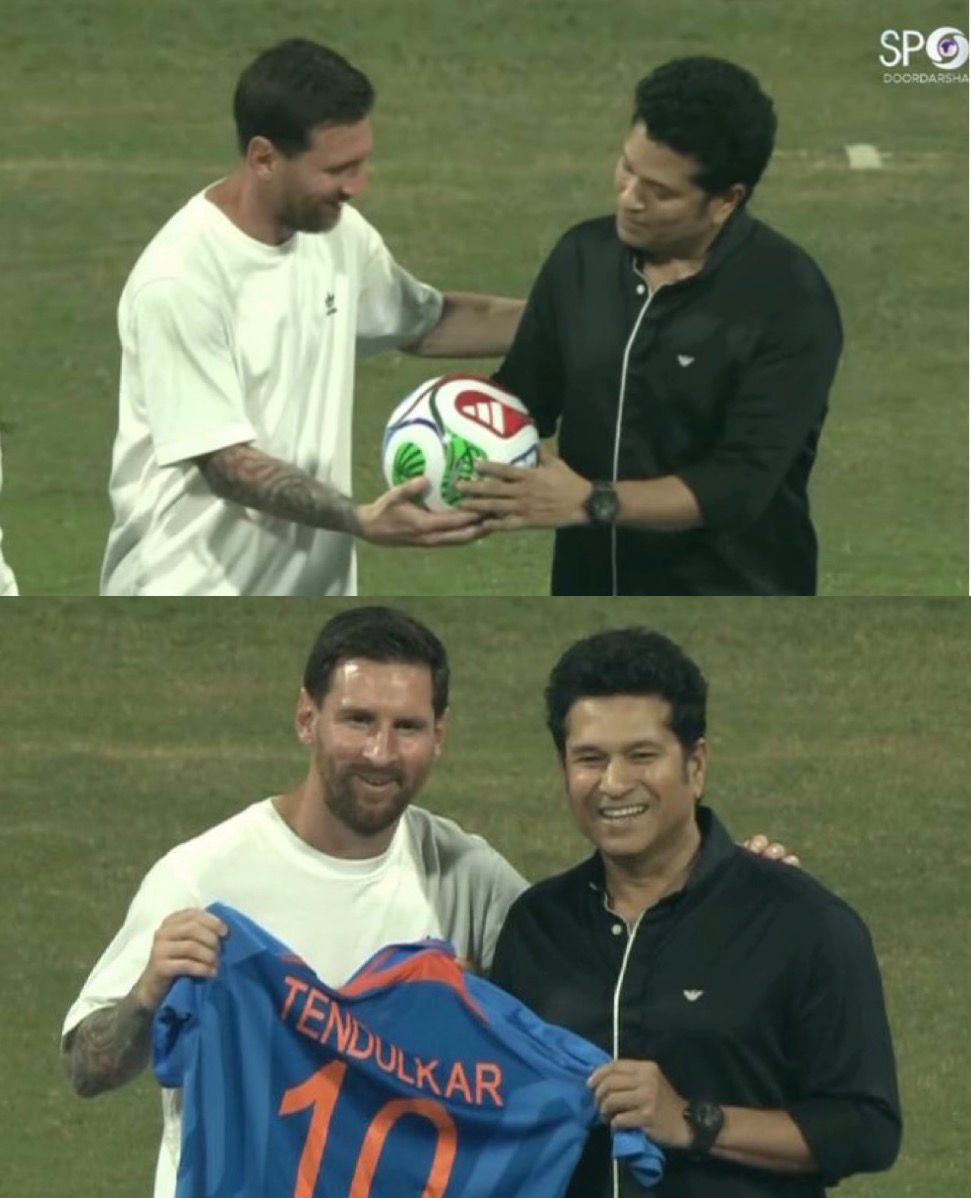
Two players who once carried their nations on their backs at the height of their powers, bound by a single dream of winning the World Cup, finally lifted it at the twilight of their careers alongside a bunch that grew up watching them play.
Kolkata shamed. India shamed. Fans taken for granted. Had asked him this question a million times for we remember Chinnaswamy. Yet it happened.
Fan experience was to define it. It was worst.
Watch 5pm @RevSportzGlobal with fans and reporters.
No way that’s it? The fans didn’t even get the proper glimpse of Leo for even a sec.
Whole Paps and VIPs had gathered him, he was not there even for half hour?
Fans are furious and ripping off the hoardings and throwing bottles.
For the money fans have spent this is not what they deserve.
All we could see was a barage of tmcp gundas led by arup biswas suffocating messi and co.
We are ashamed as bengalis. We are ashamed to be bengalis. Shatadru Dutta, you should be behind bars.
All the fans, we did not expect much. People paid their entire salary of a month, just with the hope to see messi waving at them at the holy ground where he made his captaincy debut.
@DrVish355 Result of the studies are against twice daily oral iron tablet. But, I think both once daily or alternate daily dosing are fine. I personally prefer alternate daily due to reduced gastric irritation.
@nihardesai89 sir, your opinion please.
Immense planning and technical precision was required for this absolutely preposterous (but real) view: I captured my friend @BlackGryph0n transiting the sun during a skydive.
This might be the first photo of it's kind in existence. See a video of this moment in the reply 👇