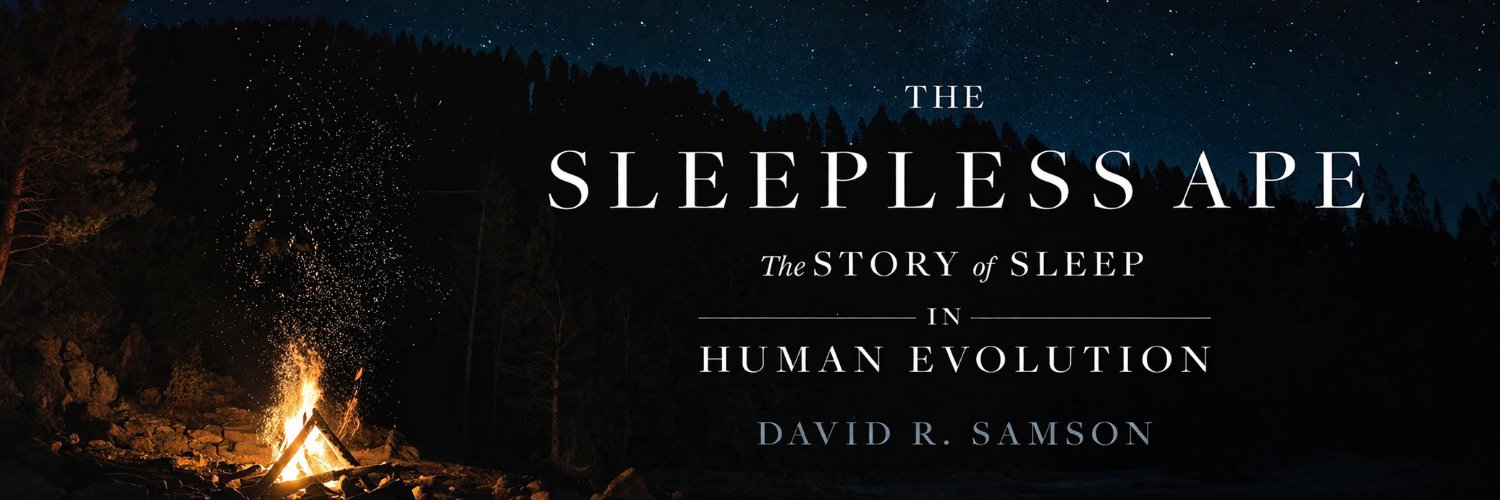
The Sleepless Ape: The Story of Sleep in Human Evolution is officially out today!
To celebrate, here are some of my favorite clips and images from the fieldwork and research that shaped it — chimp nests, hunter-gatherer sleep camps, and the evolutionary puzzle of why humans became the “sleepless ape.”
I had a terrific conversation with Katie Hunt at @CNN about The Sleepless Ape and what human evolution can teach us about sleep.
One of the big ideas in the book is that humans are evolutionary outliers: we sleep less than other primates, but we get an unusually high proportion of REM sleep. That pattern only makes sense when we look at sleep not as an isolated individual performance metric, but as something shaped by fire, shelter, social groups, safety, light, timing, and the body clock.
Modern sleep advice often tells us to perfect the bedroom. That matters, of course. But our ancestors also slept in dynamic social environments, with powerful daily cues from sunlight, darkness, food timing, and community. My hope is that evolutionary sleep science can help us move from “Am I sleeping perfectly?” toward a better question: “Am I living in sync with the biology that makes good sleep possible?”
Read the interview here: https://t.co/bS2HDomfEx
"Humans went through a radical evolutionary experiment. We are the primates that sleep the least."
This "human sleep paradox" sits at the heart of my new book *The Sleepless Ape*. Grateful to @elpaisinenglish for the feature and to @PaleoAnthropology for sharing it!
From climbing 70+ chimpanzee nests to living with Hadza and BaYaka communities, this is the science I’ve been chasing. The full story is out now from Princeton University Press — link in the original post.
Are we truly the ultimate sleep-deprived primates?
#TheSleeplessApe #HumanEvolution #SleepParadox
David Samson, anthropologist: ‘Humans went through a radical evolutionary experiment. We are the primates that sleep the least’ @Primalprimate@elpaisinenglish
https://t.co/nOG22hkb29
Huge thanks to @seize_podcast for having me on Episode 258!
We dove deep into the human sleep paradox, why we misunderstand “sleep optimization,” the wellness industry’s blind spots, communal SHELL sleep sites, ancestral vs. modern sleep, and how all of this ties into mental health.
Full episode is live:
YouTube: https://t.co/Wm2njMxzMD: [link from their post]
On ep 258, we welcome @Primalprimate to discuss sleep hygiene and the wellness industry, how we misunderstand the optimization of sleep, glorifying and idealizing ancestral societies, communal shells, and sleep’s relationship with mental health.
Full ep: https://t.co/l9al7k7Ns9
Apple: https://t.co/F7c0SlKsqe
Just dropped a visual thread on publication day for The Sleepless Ape — chimp nests, orangutan REM sleep, Hadza camps, SHELL, Paleo Gear vs Optimal Gear, and why humans became the sleepless ape.
Huge thanks to @sleepdiplomat — he’s been a major inspiration to me since graduate school. His work on the importance of sleep for health and cognition has shaped so much of how I think about this topic.
Thread below 👇
The Sleepless Ape: The Story of Sleep in Human Evolution is officially out today!
To celebrate, here are some of my favorite clips and images from the fieldwork and research that shaped it — chimp nests, hunter-gatherer sleep camps, and the evolutionary puzzle of why humans became the “sleepless ape.”
Humans require sleep for all the reasons that make us who we are — but we sleep the least of any primate on the planet ever measured.
The Sleepless Ape shows how the SHELL exophenotype, Paleo Gear, and our innate flexibility turned that paradox into our greatest evolutionary advantage — and how Optimal Gear can help us thrive today.
Grab the book — out now:
US / Amazon: https://t.co/UN82RZMRPh Direct from Princeton University Press: https://t.co/6qhNJJfHuI
@Nature just called it “lively and ambitious… an agenda-setting narrative that will shape sleep research for years to come.”
Happy reading — and sweet (but efficient) dreams! 🦍🔥
#TheSleeplessApe #SleepScience #HumanEvolution #Anthropology @PrincetonUPress
The Sleepless Ape: The Story of Sleep in Human Evolution is officially out today!
To celebrate, here are some of my favorite clips and images from the fieldwork and research that shaped it — chimp nests, hunter-gatherer sleep camps, and the evolutionary puzzle of why humans became the “sleepless ape.”
Optimal Gear is how we best support sleep and circadian health in modern environments: living a highly disciplined life — like a monk or the incredible @bryanjohnson — that combines ancestral cues (morning light exposure, social regularity, reduced nighttime light) with modern technologies and environmental buffering.
Huge respect to @MatthewWalkerPhD — his work shows how vital high-quality sleep is for health, cognition, and wellbeing. Optimal Gear adds to our peak healthspan. (as a sidebar, Walker's epic sleep science is one of the reason's I got interested in sleep in graduate school).
But....I believe there are things from an evolutionary standpoint worth losing sleep over!
I’m delighted to share that @Nature has reviewed The Sleepless Ape.
Nathaniel Dominy describes the book as “lively and ambitious” and calls it “an agenda-setting narrative that will shape sleep research for years to come.”
He also writes that The Sleepless Ape offers “a vision of sleep that is both scientifically rigorous and socially relevant.”
I’m grateful for such a thoughtful and generous review—especially from a scholar whose work I admire. The book asks why humans sleep less than our closest primate relatives, and whether our unusual sleep evolved not as a flaw, but as one of the great adaptive features of our species.
The Sleepless Ape is available now / available for preorder from Princeton University Press.
https://t.co/C027GlY2UU