Every new vault shouldn’t mean another policy to rewrite.
⚡️ Introducing Groups on PrimeVault ⚡️
As teams scale, they keep adding vaults and counterparties. Managing controls one vault and one contact at a time slows teams down, and every manual update is another chance for a gap.
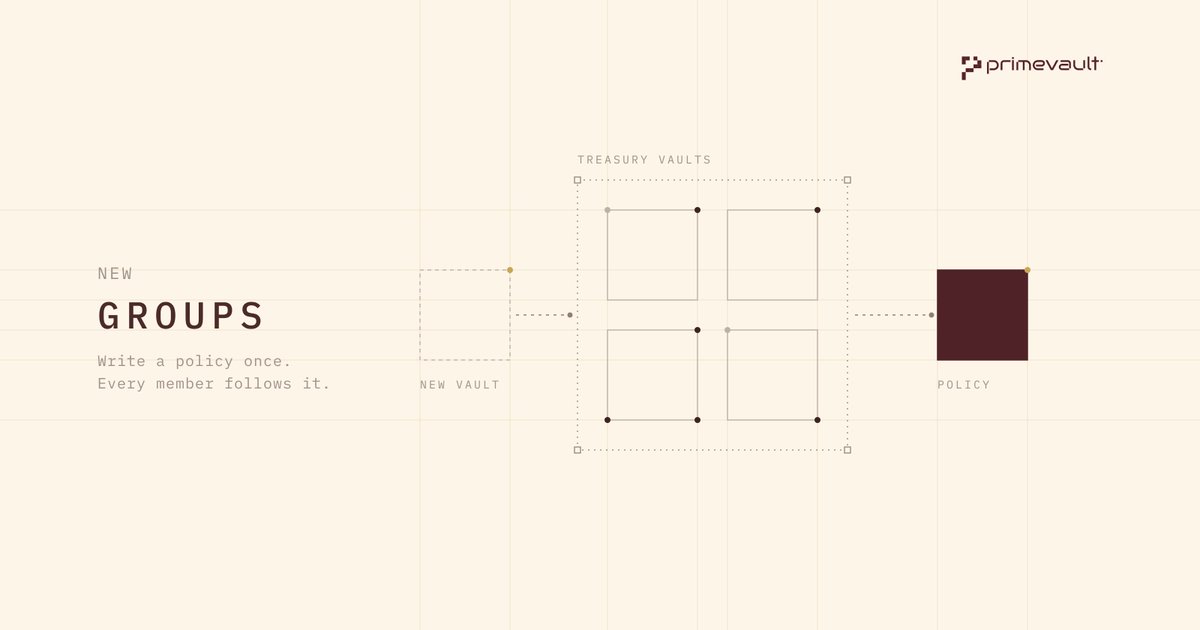
Groups fix that. Name a set of vaults or contacts, like “Treasury vaults” or “Exchange counterparties.” Write the policy once, and every member follows it.
One policy. Every vault. Even the ones you haven’t created yet.
Every workspace comes with two built-in groups, “All vaults” and “All contacts.”
Policies are the first place Groups show up. The same building block is built to extend to any workflow where one action repeats across many vaults, contacts or people, from monthly payouts to team-level access.
Set controls once. Scale without rework.
What should you look for in stablecoin payments infrastructure?
Jonathan Cumberlidge, co-founder and CEO of Sentvia, breaks it down with @akanshj31, drawing on the evaluation that led them to PrimeVault.
Sentvia is a stablecoin payment platform for global businesses, running a payment gateway for merchants across FX, e-commerce, import/export and luxury goods.
In our full conversation, we cover:
→ What to evaluate before choosing payments infrastructure, from security to commercial alignment
→ Why stablecoins work brilliantly for some payment flows and not for others
→ What customers are asking for next
Watch the full interview here👇
https://t.co/Zo9iq18MZb
Sentvia tried three partners before landing on @primevaultHQ
1 year later: $1B+ processed, and now on track to double.
As Jonathan (Jonny to us) puts it best: “It changed how fast we could grow.”
My favourite memory from our conversation: we spoke on a Friday, and by Monday they were set up and processing volume. All in 48 hours.
Don’t hear it from me.
Hear it from Jonny himself on how Sentvia looks at stablecoin payments, why they chose PrimeVault, and what they think the future holds.
$1B+ processed. 100+ merchants. Onboarded to production in 48 hours.
Sentvia powers payments for FX brokers, luxury retailers and importers.
As its merchant base grew, so did the complexity behind every new account. Each merchant needed its own wallets, permissions and treasury controls. Building and maintaining that infrastructure one merchant at a time wasn’t going to scale.
With @primevaultHQ, Sentvia can give every merchant its own sub-organization, complete with dedicated vaults, policies and controls, without building the underlying infrastructure from scratch.
Full case study 👇
I’ll be speaking on a panel at Meet Las Vegas during @money2020 next week on the topic of stablecoins in cross-border payments and remittances.
5pm. Tuesday, 10/20.
Organized by our friends at @MerkleScience
Join us if you’re around: https://t.co/7SyGmtv3GH
@token2049 used to be mostly token talk. This year it was payments.
I’ve been going for a few years, and the same themes came up whether teams were building in Latin America, Africa or anywhere else. Is it reliable? Is it regulated? Can we build compliant from day one?
The reason is simple. Every market has its own rails, regulators and quirks. Handle each one separately and you rebuild reliability and compliance every time you expand. It’s the work everyone postpones until volume forces the issue.
The answer is one integration, not one build per market. Reliability and compliance from day one, new markets without starting over. That’s the approach we took with @primevaultHQ 2.0.
Singapore was covered in haze, but the conversations were the clearest thing there.
Payments finally have the stage. Plenty left to build.
It's our yearly visit to @money2020, and a lot has changed since last year.
We launched PrimeVault 2.0, a stablecoin-native global money movement platform for fintechs, PSPs and global corporations.
@prashantupd and @jeapostrophe will be in Vegas from October 18 to 21, meeting teams and speaking at events around Money20/20.
DM us to schedule a meeting, and bring your hardest payment problems.⚡️
Our September update makes it easier to stay in control as your PrimeVault workspace grows.
Here’s what’s new on PrimeVault:
🔒 Groups let teams apply a policy across sets of vaults and contacts.
✨ The Activity Log gives admins a searchable record of what happened across the organization, who took the action, and when.
We’ve also continued improving reliability across the platform, from the underlying infrastructure to transaction flows.
More is on the way across corridors, payments, and the platform.
Read the full September update 👇
https://t.co/8SuPXsp7U3
A question that comes up in almost every partner security review:
Do you have a SOC 2 Type II report?
Yes. And we’ve just renewed ours.
The independent audit covers all five Trust Services Criteria: Security, Availability, Confidentiality, Privacy, and Processing Integrity.
For institutions evaluating infrastructure and third-party risk, this provides assurance that the controls supporting PrimeVault are designed, implemented, and operating as intended.
Read more about what the renewal covers 👇
Fresh off the launch of PrimeVault 2.0, we’re taking it on the road.
We are a stablecoin-native global money movement platform for fintechs, payment companies and financial institutions.
Our founders @akanshj31 and @prashantupd will be meeting teams building on stablecoins and in cross border payments.
Come talk to us about the corridors you’re building, the payment flows you’re rethinking, and where stablecoins fit.
DM us to book a meeting. See you around ⚡️
Today we’re launching PrimeVault 2.0 @primevaultHQ
A stablecoin-native global money movement platform that helps fintechs, PSPs and global corporations move money across their corridors better, faster and cheaper.
Stablecoins’ impact on cross-border money movement is no longer theoretical. They are quickly – and very organically – weaving themselves into global money flows across the full spectrum – from consumer payments and dollar access to instruments of institutional efficiency.
We’ve witnessed this transformation first hand at PrimeVault. Over the last three years, PrimeVault’s stablecoin and blockchain infrastructure has powered $200B+ in stablecoin flows for some of the largest payment institutions and fintechs globally.
Serving those same customers gave us a front-row seat to how impossibly hard it remains to rebuild your cross-border flows over stablecoin rail.
Here’s what it actually takes..
👉 Understanding blockchain mechanism and risks: MPC/TEE key management, L1 vs L2, gas, transaction policy, maker-checker, admin quorums
👉 AML checks and transaction monitoring
👉 A legal and regulatory read on every country you touch, with frameworks rewriting themselves in real time and no two jurisdictions alike
👉 The right regulated rails partner in every geography
👉 Settlement and liquidity that hold up on a bad day
And after all that, you still need the economics to work out to justify switching.
So companies do the one thing they can. They hire blockchain devs.
We’ve spent the last 12 months absorbing every layer of that complexity ourselves, on top of the enterprise-grade security, control and compliance foundation we’ve been hardening for years.
Today all of it ships as one platform, with intelligence built into the routing, reconciliation, and compliance.
And here’s what our customers see:
Same flows. Same workflows. Same counterparties. Routed differently underneath.
One API. 2-5 days to integrate.
Broader global access, faster payouts, same day repatriation out of corridors that used to be a two-week phone-call exercise.
So here’s what we’re killing today: the idea that you need to hire blockchain engineers to move money better.
To our customers and partners: thank you. This launch is yours as much as ours.
To global CFOs, treasurers and payment companies: bring us your hardest payment problems. We'll show you how they can run better, and what it takes to get there.
Check out our new website and corridor coverage in comments 👇
The next phase of stablecoin adoption won’t be defined by throughput or settlement speed. It will be defined by infrastructure that connects institutional stablecoin flows into local financial systems, corridor by corridor.
→ FX execution
→ Liquidity routing
→ Compliance
→ On/off-ramps
→ Local payout rails
The plumbing that makes stablecoins usable without users needing to think about stablecoins at all.
That’s what we’re building at @primevaultHQ
Now the challenge is making money actually move locally, reliably, and invisibly.
Stablecoin Dispatch by @primevaultHQ
When @Meta announced stablecoin payouts to creators in Colombia and the Philippines back in March, most people saw a payments story.
It’s actually an infrastructure story.
Stablecoins have already solved a major part of cross-border movement between institutions: fast settlement, lower costs, global interoperability.
That part works.
What hasn’t been solved is everything after settlement.
A creator in Bogotá receiving USDC still runs into the same local realities: off-ramps, FX spreads, card integrations, banking rails, merchant acceptance, and fragmented liquidity.
The blockchain transaction may settle instantly.
The money experience still doesn’t.
That’s the real bottleneck in emerging markets.
For anyone building payments or treasury operations, the implication is practical. The on-ramp and off-ramp layer is increasingly a solved problem at scale. The complexity that remains: corridor routing, FX optimization, compliance across jurisdictions, settlement reliability in markets where traditional rails underperform.
That's where operational differentiation will compound over the next few years.
Two companies embedded stablecoins into their core products this week. 🚀
@SoFi launched SoFiUSD directly inside its banking app. @CashApp began rolling USDC into Cash App. In both cases the stablecoin is the settlement layer underneath a product users already had. Announced publicly, invisible to the user.
That distinction matters more than the $322B market cap record. 💰
The figure usually gets cited as a milestone. It's more useful as context for what SoFi and Block actually did.
FX reserves exist to absorb shocks: currency crises, liquidity crunches, payment system failures. Stablecoins are now operating at comparable scale, and the companies deploying them are no longer framing them as a new product category. They're framing them as infrastructure.