Extremes is live — our first indicator.
Primitive Charts starts from one conviction: a chart you spend hundreds of hours in front of shouldn't look the way someone else decided.
Extremes is built to be shaped like it's yours, because it is. Up to six time windows plus the previous day.
Free and open source, on TradingView today.
https://t.co/1Q5fK39QTC
$ES $NQ $GC
"Normal" itself is yours to define.
Choose the settings — your windows, your labels, your instrument. Set the lookback period, up to 20 historical sessions. Here's what you need to set this up on the Indicator. https://t.co/AOc72YZa6N
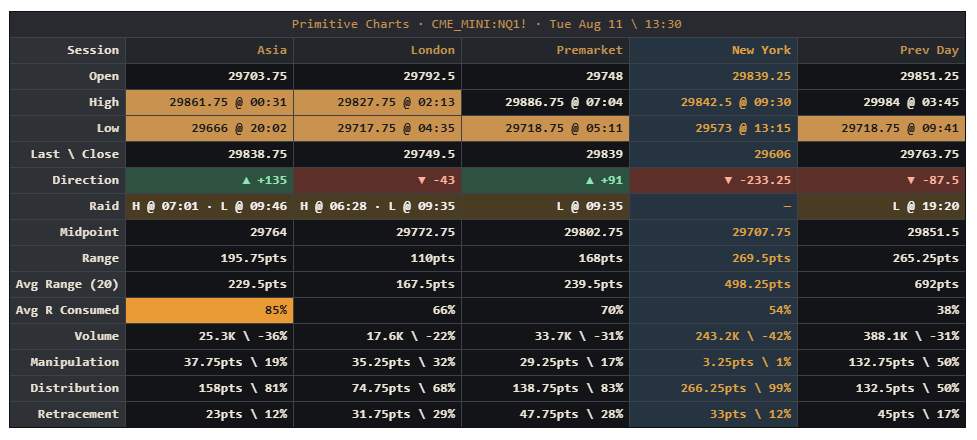
That's initially why we built the OHLC Table.
Not for signals or predictions, but rather as an honest measurement tool.
A tool versatile enough to track different metrics, intraday sessions and price legs, with tick precision.
Designed with the idea in mind that any trader could build its own version, apply it to their strategy and processes.
Extremes draws what happened, precisely. Open source, so you can read every line of it.
Two limits worth stating: alerts fire on chart timeframes of 30 minutes and below, and the session grid is ET, built for intraday futures sessions.
Free, on TradingView →
https://t.co/1Q5fK39QTC
Extremes is live — our first indicator.
Primitive Charts starts from one conviction: a chart you spend hundreds of hours in front of shouldn't look the way someone else decided.
Extremes is built to be shaped like it's yours, because it is. Up to six time windows plus the previous day.
Free and open source, on TradingView today.
https://t.co/1Q5fK39QTC
$ES $NQ $GC
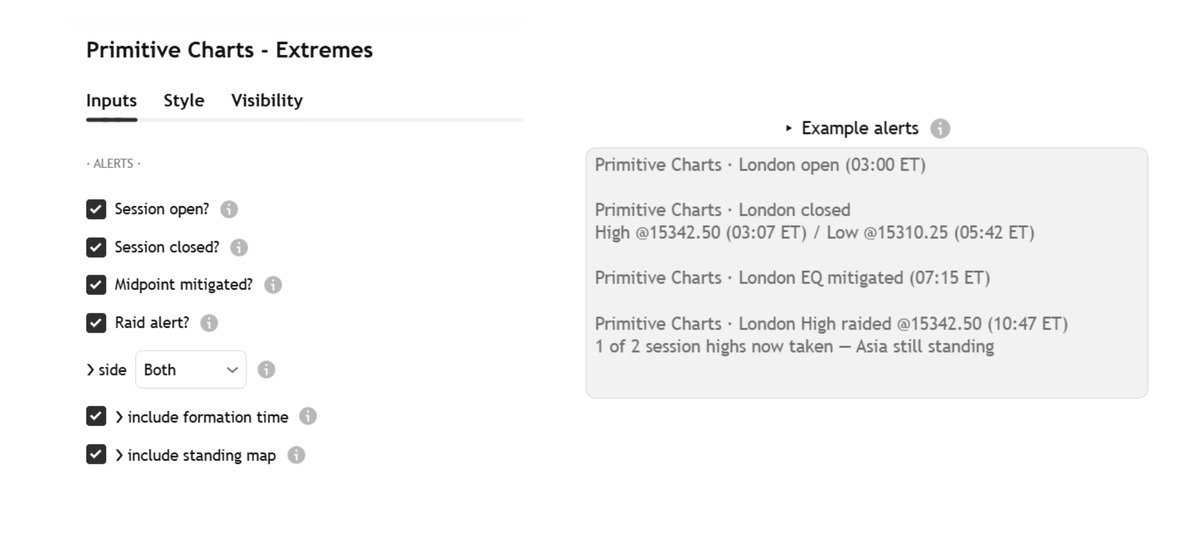
The alerts are the indicator while you're away — and each one carries its own record.
session open — get notified as soon as it starts.
session closed — high / low data with timestamps.
EQ mitigated — price traded back to the midpoint.
Raid — the level, the price, the minute it was taken. and if you want it, the minute it formed, so you know how long it stood.
Then the standing map, on any raid: "1 of 2 session highs now taken — Asia still standing." Not just what happened — what's still there.