When I was born, I was born with a name...Not a number I am not a goat heading for slaughter, and I refuse to stay quiet, it is not acceptable that in order to receive help just for a missing document you are denied help #WorldJustice#PrimeroDios#Freedom 🙏🏻🤍🕊
@KnightsTempOrg It has begun, Nation will rise against Nation...Is this what "We are all Children of God" are? This is why only those who do the will of my Father are my brothers and sisters. You praise my Father with your lips but your hearts are far from him
Staten Island man struck by lightning while walking to a dentist appointment.
Thomas Fahmy says he is grateful to be alive and went to church on Sunday to thank God for giving him another chance.
"Once the lightning bolt struck me, the initial sensations that I had throughout my whole body were completely unprecedented; tingling, numbness, pain, just I feel this burning sensation."
"No burns. I had multiple body exams; no burns at all. I went to church on Sunday to say thank you, God."
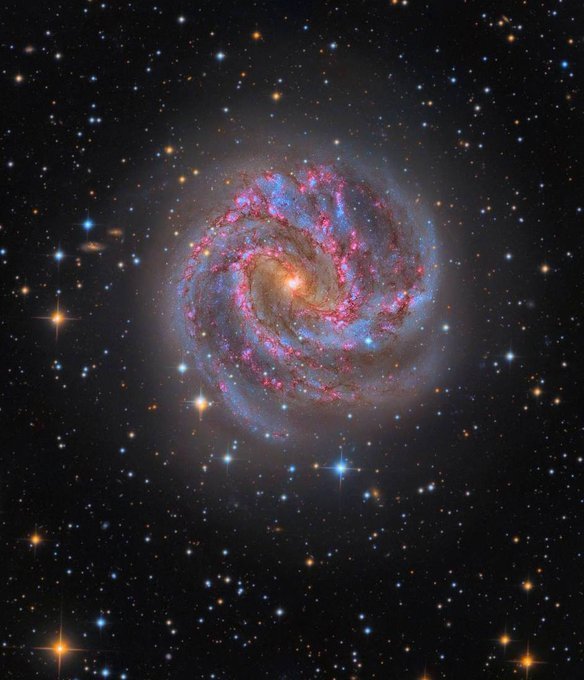
Spiral galaxy M83, shining 15 million light-years away!
It is a barred spiral galaxy located in the constellation Hydra.
🔭 You can spot it even with 10x50 binoculars—it will appear as a glowing patch. A telescope with a 150mm aperture allows you to make out the galaxy's dark patches, while a 250mm aperture lets you examine its spiral structure and dark dust lanes.
How Earth Looked from Space in the Jurassic Period: One Continent for the Entire Planet
Imagine looking down at our planet from orbit 150 to 200 million years ago. Instead of the familiar outlines of today’s continents, you would see a single gigantic landmass stretching from pole to pole. That was Pangaea. This is how Earth may have appeared during the Jurassic Period—the age when dinosaurs rose to dominance.
The Jurassic Period lasted from about 201 to 145 million years ago. At its beginning, the supercontinent Pangaea, which had assembled in the Paleozoic around 335 million years ago, still existed as one connected whole, though it was already beginning to split.
Pangaea had a distinctive C-shape. The northern part consisted of what would become North America, Europe, and Asia (Laurasia). The southern part included Africa, South America, Antarctica, India, and Australia (Gondwana). Inside the curve of the “C” lay the warm Tethys Ocean, while the entire outer edge was washed by the vast Panthalassa Ocean—the predecessor of today’s Pacific.
By the middle and late Jurassic the picture was changing. A narrow seaway began opening between North America and Africa—the embryonic Atlantic Ocean. Gondwana was gradually pulling away. Reconstructions of the Late Jurassic, around 150–152 million years ago, already show these rifts clearly.
The climate was warmer than today. Polar ice caps as we know them were largely absent. The interior of the enormous continent was arid, with vast deserts, while lush forests of ferns, cycads, ginkgoes, and conifers grew along the coasts and in the equatorial belt. It was in these landscapes that sauropods, stegosaurs, and the first birds such as Archaeopteryx lived.
If satellites had existed then, they would have seen not seven separate continents but one colossal “island” surrounded by a boundless ocean. The coastlines were different, the mountain ranges were different, and the familiar shapes of Africa, the Americas, or Eurasia were only beginning to emerge through slow tectonic breakup.
Today scientists reconstruct this view of Earth using paleogeographic models, paleomagnetic data, and geological evidence. The reconstructions show a planet that was at once familiar and completely alien: one continent, one enormous ocean, and a world in which dinosaurs were just coming into their own.
This is how Earth looked from space in the Jurassic Period—not a fantasy, but a scientific reconstruction of our planet’s distant past.