A recent #win spurred by CITP's Samantha Dalal and @andresmh: as part of a $131.5 million settlement, the Workers Algorithm Observatory will be providing the development of infrastructure for ongoing compliance monitoring of DoorDash. Read more here: https://t.co/44N6vLv1tm
Ever wondered how data can capture the "invisible majority of online behavior?" Attend our talk tomorrow feat. @Princeton professor Jacob Shapiro and CITP's Alejandro Cuevas to learn more about using Accelerator Comscore Data!
"If AI can now provide answers to questions at the very frontier of mathematics, is the discipline on the verge of being 'solved'? Like chess and Go players, should mathematicians just 'keep playing' and rearrange their practices?" - writes @phil_of_ai on the CITP blog
Register now for the AI Agent Symposium featuring CITP scholars @steverab and @PeterHndrsn in NYC on November 20! More details here: https://t.co/EYFrxUlMZq
This week I had the honor of speaking to Princeton’s entire incoming undergraduate class to address their AI anxieties. I had three messages for them — good news, bad news, and a note of optimism. Here’s a condensed version.
The good news
We have enough evidence now to conclude that the shrill predictions of rapid, massive job loss were misplaced. Even in a field like software engineering where AI has been rapidly adopted, its effect has been to shift, not replace the role of the human (see the “decide-execute-deliver” framework https://t.co/8ZofeCz8yS)
Similarly, the panic about what to major in is also misplaced. There will be enduring demand for computer science, philosophy, and just about everything else. (In fact, AI companies hiring philosophers has been a big recent trend.)
The bad news
AI seems to help senior people much more than juniors. I can use AI for coding because I spent 25 years learning how to code, which lets me supervise coding agents effectively. (See my post on the “growth cycle” vs the “dependence spiral” https://t.co/79icF9hSKY)
You are in a bind — you can’t offload your skill-building to AI, but you’ll graduate into a market where employers will expect you to get work done with AI. We never faced this dilemma. As a result we haven’t figured out how to revamp our classes to help you do both. You’ll have to help us figure it out. And you’ll need to somehow resist the constant temptation to turn to the shortcut machine.
The hope
My point is not that AI is bad for learning. It’s an incredibly flexible tool. Is the internet good or bad for learning? Depends — are you using it to find research papers or waste time scrolling? I use AI every day for learning. The key is to use it to increase, not decrease your cognitive load. To learn deeper, not faster. There is no learning without the cognitive sweat. I try to make sure I’m mentally exhausted at the end of the day. I do feel that AI lets me push myself harder than I ever could before, and I have a vision that as AI continues to advance it will enable human-AI “co-superintelligence“. (I talked about this at the end of my ICML keynote. https://t.co/ZA5TBDypfl)
Free online workshop opportunity: "Why Measuring AI Is Hard" with Professor Arvind Narayanan (@random_walker) hosted by Innvoate(US) on September 8th at 2:00pm ET.
Register online: https://t.co/XKTGaJThaG
tldr: we made a newsroom guide which outlines our recently published report on information integrity - "Holding the Line: Authentication, Verification, and the Fight for Facts in the AI Age" 🧠
https://t.co/gYtqfyrFhk
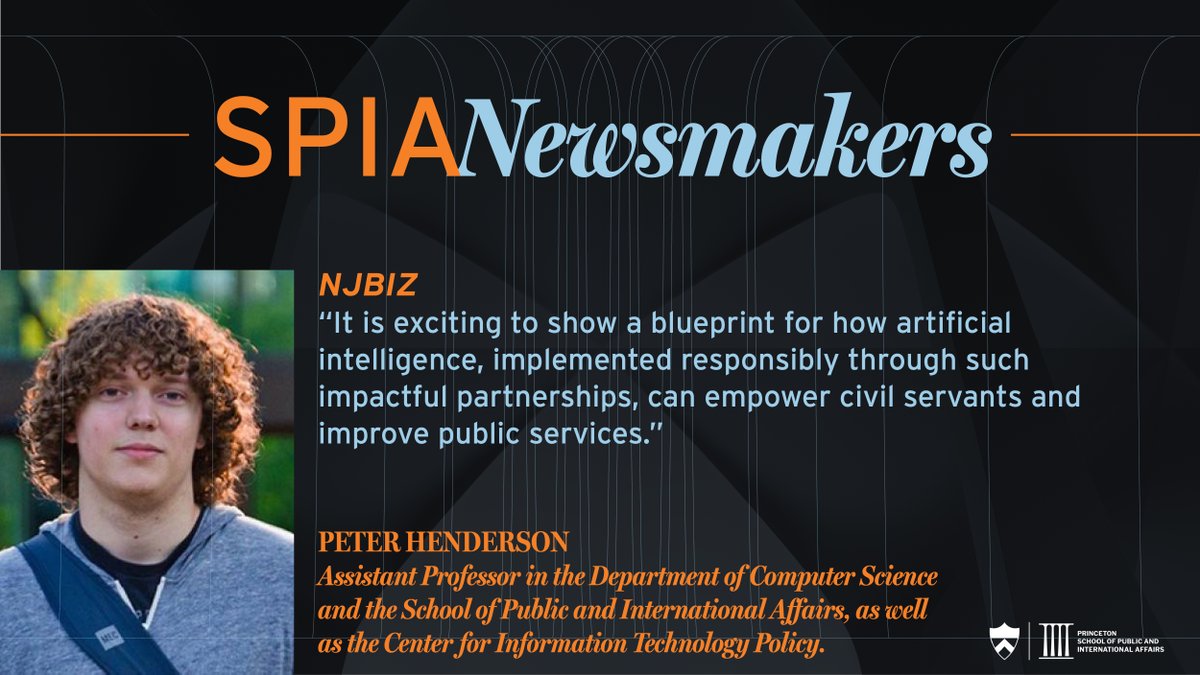
SPIA NEWSMAKERS: @PeterHndrsn and postdoctoral research fellow @dominsta_nlp created an “AI-enhanced search engine for legal briefs” to support the New Jersey Office of the Public Defender. https://t.co/lLbgF78R5A @PrincetonCITP
"Within a couple of hours, I had a pipeline to analyze & ID secret ballots across the state of Georgia & the agent told me exactly what further information it would need to identify real voter’s ballots. At no point did the agent refuse to comply." - writes @MaxSpringer23
🔗👇
@MaxSpringer23 "Within a few hours...I was able to reconstruct the order in which 1.5 million ballots were cast in Georgia’s May '26 primary–98.9% of the in-person ballots...I can target specific counties & ask the AI to exactly identify how any person voted." Read on the Blog👇
In this short editorial for Science, @akashkapur and I talk about how India should approach AI sovereignty given the trend of models commoditizing and competition moving up the stack https://t.co/6rUZ9hSiJN
The @opd_nj is using AI to tackle one of law’s most time-consuming tasks: drafting briefs. In partnership with @Princeton CITP researchers, the NJ Innovation Authority, and @njoitagency, a new platform is helping public defenders work more efficiently: https://t.co/qSVQu3yyQs
SPIA NEWSMAKERS: Can India set the standard for AI sovereignty, leading to advances in economic growth, scientific research, and national security? @random_walker thinks it’s possible. @PrincetonCITP https://t.co/OJIht2N3xg
Dominik Stammbach (@dominsta_nlp) and Peter Henderson (@PeterHndrsn) for @techpolicypress: "Why Public Defense Should Incorporate AI Carefully" 🔻
https://t.co/uiOWTvIYNO
How should India approach AI?
"Few have placed sovereignty as squarely at the center of their AI strategy as India—and few are as well positioned to achieve it." -- Akash Kapur (@akashkapur) & Arvind Narayanan (@random_walker) in @ScienceMagazine 👇
https://t.co/W6B4wyWTzN
📣✨ We're excited to see the AI Pedagogy Project, started at metaLAB in 2023, co-hosting the Public AI Summit for Educators with @makedatahealthy! Featuring keynotes by @karen_brennan, @random_walker, and @bjfr. Free & virtual, Sept 16-17. Register at https://t.co/PGWDSgo1rC.
@MaxSpringer23 "Within a few hours...I was able to reconstruct the order in which 1.5 million ballots were cast in Georgia’s May '26 primary–98.9% of the in-person ballots...I can target specific counties & ask the AI to exactly identify how any person voted." Read on the Blog👇