New technical paper to support recent PCT:
The Z-Model Framework: Geometric and Functional Surface Analysis in Heterogeneous Interaction Systems
https://t.co/0PQsZJiel0
DIVERGENT Scientific Intelligence platform!
Built a working prototype that uses OpenAI and Grok to independently analyze scientific literature, highlight disagreements and evidence gaps, and support human-directed research decisions.
From Plastic Surface Chemistry to the Z-Model: Surface Area, Interfacial Reactivity, and the Evolution of a Cross-Domain Research Framework (2024–2026)
https://t.co/dmxY9ybBHJ
It’s focused on whether results are the correct previous or desired result rather than matching exact human or robotic movement.
2/2
New PCT filed: System and Methods for Generating Reproducible Digital Twins
For lab assays and extending to manufacturing outputs for many other industries.
1/2
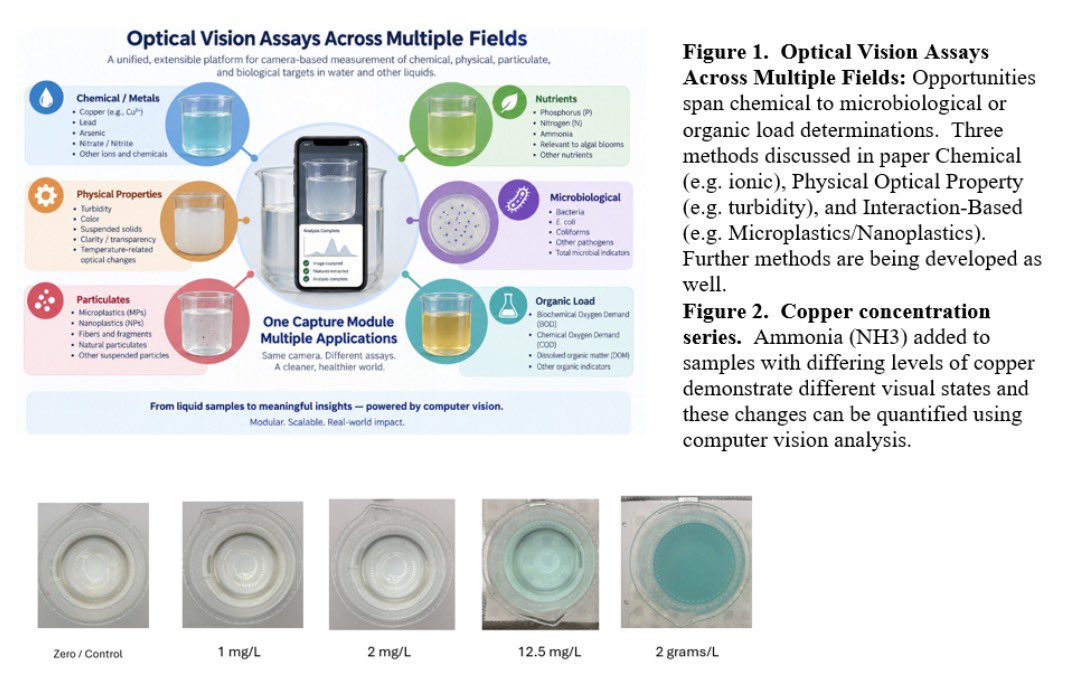
New Technical Paper which demonstrates Spatiotextural Approach is not limited to microplastics / nanoplastics.
Assay Design for Computer Vision: From Chemical Reactions to Spatiotextural Measurement in Water and Other Liquids
https://t.co/vaQ4Ru6G5P
Introducing the Spatiotextural Computer Vision Approach to Optical Assays
The framework analyzes assay-generated spatial patterns, texture, gradients, and intensity distributions, even when individual particles cannot be directly seen or counted.
https://t.co/NiVXFtq1v7
New PCT Filing: Standardized Optical Imaging for Computer Vision
Computer vision begins long before artificial intelligence analyzes an image.
During field testing, we observed that identical samples often produced noticeably different photographs…
1/
normalization, image quality assessment, and related approaches applicable to environmental monitoring, diagnostics, industrial testing, and other image-based analytical workflows.
As AI continues to transform scientific measurement, standardized image acquisition will…
4/
Different matrices (mineralized vs DOM-rich waters) respond differently to conditioning strategies — supporting matrix-aware approaches for better optical analysis.
2/2
In particulate systems, under-dosed reagent may underestimate concentration due to incomplete Z-site occupancy. Correct or over-dosed? All Z-sites are occupied excess reagent simply settles while central optical analysis stays accurate.
Spontaneous observation.
New Technical Paper:
"Conceptual Z-Site Occupancy and Optical Analysis Behaviors Across Under-Dosed and Over-Dosed Reagent Conditions"
https://t.co/4V5Vo6mqOI
1/