A little Sunday appreciation for our EXIOM Service Node operators. 🤝
More than 850 nodes are helping secure the network, maintained by operators who continue showing up and supporting the project through every stage of development.
As EXIOMoracle and EXIOMnet progress, that same network is being prepared to take on new responsibilities.
To everyone keeping EXIOM running: thank you. We're building this together.
$XEQM
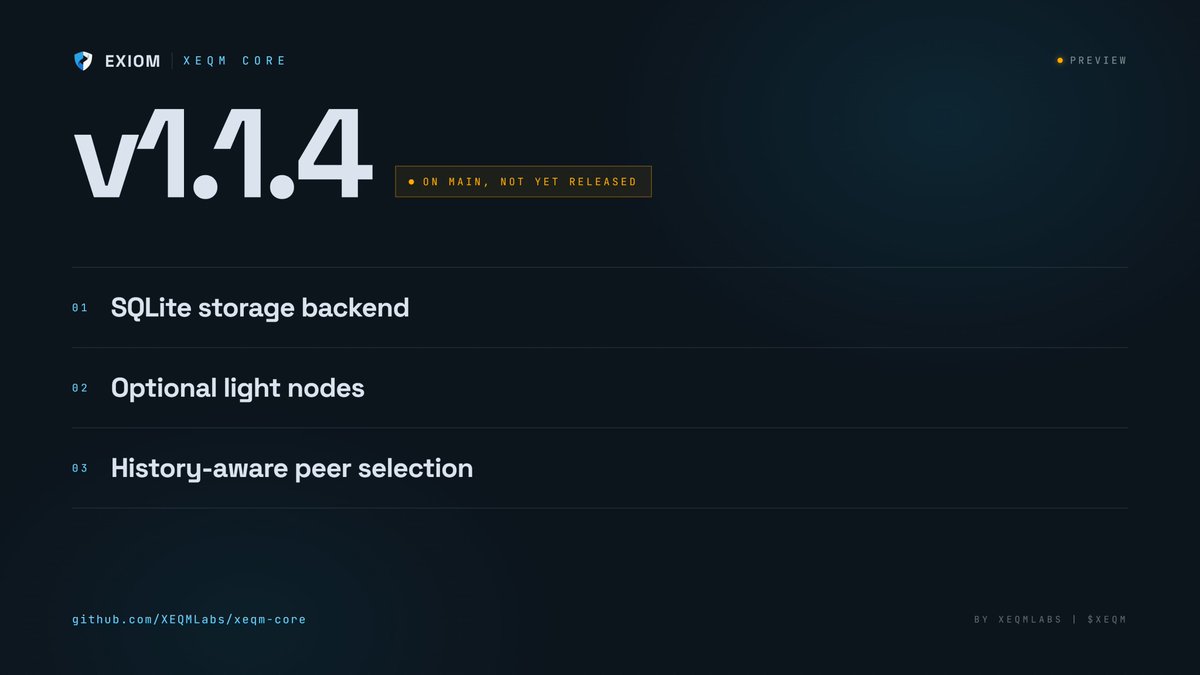
The next $XEQM Core update is taking shape!
Version 1.1.4 brings a new storage backend, optional light nodes designed to reduce resource requirements, and smarter peer selection to improve how nodes connect across the network.
These changes are already merged into the codebase, with testing underway before release.
Another step toward making EXIOM infrastructure more efficient and accessible.🌐
Every new crypto exploit carries the same reminder:
public by default has a cost.
As more finance, AI agents, real-world assets and applications move on-chain, wallet activity, application behavior, and data requests all become more valuable - to users, to markets, and to attackers.
The next problem is figuring out what shouldn’t be public.
That’s why privacy and security matter more than ever.
EXIOM is building privacy-first crypto infrastructure around that problem, powered by the XEQM network: a decentralized Service Node layer, EXIOMoracle for verifiable external data, and EXIOMnet for private access to that data.
Blockchain made verification public. The next frontier is making privacy programmable.
I lost my job yesterday.
Rent was due.
No backup plan.
Then I remembered I still had Claude.
Asked it:
“Analyze every top Polymarket wallet from the last 90 days and build me something”
$25 → $4,237 in one night.
It scanned 10,000 wallets.
Cross-referenced win rates, sizing, timing.
Found 7 traders whose edge wasn’t luck.
Then built an autonomous agent.
Not a script.
Not an if-then bot.
An agent that reads live news,
maps it to markets,
detects mispricing,
and exploits arbitrage across outcomes.
Sizes every position using Kelly.
I deployed it at 11:47PM.
Closed the laptop.
Woke up to:
$25 → $4,237
94 trades while I slept.
No input.
No hesitation.
No second-guessing.
That’s the game.
Information asymmetry at machine speed.
Wall Street pays millions for this.
I pay $20/month.
You only need Claude + laptop + 1 hour/day.
Giving This Free for 24 hours. To get it:
1. Comment the word 'AutoPilot'
2. Like and Retweet this post
3. Follow me @techluisenzo (so i can DM you)
19 year old Japanese student built a trading bot with Claude Code in 2 days.
Used his iPad as a second monitor.
First night: $6,732 profit.
Starting capital: $68.
Total profit so far: $750,000.
[ 𝐍𝐨𝐭𝐞: 𝐅𝐨𝐥𝐥𝐨𝐰 𝐌𝐞
@techwith_fahim
𝐅𝐨𝐫 𝐢𝐧𝐬𝐭𝐚𝐧𝐭𝐥𝐲 𝐚𝐮𝐭𝐨 𝐃𝐌]
Here's how it works👇
The bot scans over 50 markets simultaneously.
Syncs live BTC data from Binance every second.
Spots price errors before humans even notice.
The edge is pure speed + pattern recognition.
While traders stare at charts trying to predict the next move, his bot is already executing on mispricing across dozens of markets.
No guessing.
No emotions.
No hesitation.
Just Claude Code logic finding gaps that close in seconds.
He built the entire system in 48 hours:
→ Claude Code handles the trading logic
→ Binance API feeds real-time BTC data
→ iPad displays multi-market monitoring
→ Executes trades when arbitrage windows open
The system runs 24/7.
Every price dislocation = profit opportunity.
Most people are still trading manually, refreshing charts, second-guessing entries.
Meanwhile this 19 year old engineering student turned $68 into $750K by letting Claude Code do what humans can't: process 50 markets instantly and execute without fear.
Why are people still trading manually?
I'm giving away the exact Claude Code setup for free.
24 hours only.
To get it 👇
1️⃣ Comment " Claude "
2️⃣ Like and Repost
3️⃣ Follow
@techwith_fahim
(so I can send it via DM)
Programmable privacy. This is a cool idea.
$XEQM doesn’t just hide payments. It gives builders the tools.
Let me introduce you to a privacy project with a very clever idea, Exiom.
Most privacy coins stop at private payments, which are just hiding your transactions. Exiom wants to go way further. They call it programmable privacy, basically giving developers a toolkit to build privacy right into their apps, which opens up some really cool stuff.
Like proving you’re old enough to buy something without revealing your actual birthday. Pulling a data feed without anyone seeing who asked for it. Private voting. Anonymous whistleblowing. Privacy as a building block, not just a way to hide your coins.
Under the hood, it uses Monero-style privacy tech, but on proof-of-stake, so no mining. Its nodes don’t just secure the chain, they also power those extra services like the private data feeds. So the network pulls double duty.
Here’s what gives it credibility. This isn’t a brand-new token. It’s the evolution of an older privacy coin from 2019 that reinvented itself, moved to proof-of-stake and rebranded, with a proper verified swap for old holders. So $XEQM is not starting from scratch.
It’s still small and early. But the vision, privacy as infrastructure for builders, is definitely an exciting one.
In my last EXIOM post, I asked a simple question:
Where does xeqm-labs:native actually fit?
The next piece of the answer is EXIOM’s Oracle.
A blockchain can verify what happens on-chain.
But it cannot know everything happening outside of it.
Which country does a policy apply to?
Has a credential been revoked?
What is the current price of a real-world asset?
That is where an oracle comes in.
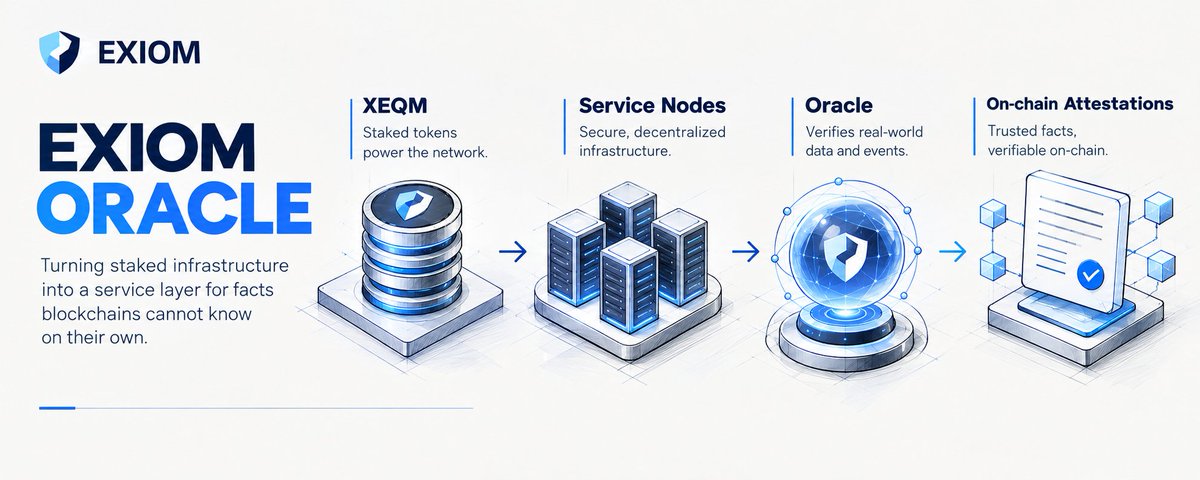
EXIOM’s Oracle is being built as a decentralized notary for facts the blockchain cannot prove on its own.
Here’s the flow:
→ Staked, opt-in service nodes observe an external fact
→ Nodes fetch the information independently
→ A committee reaches quorum
→ The result is signed
→ The attestation is posted on-chain
→ Contracts can use that result
The first paid service is a country-level sanctions policy.
This gives the XEQM utility story a practical layer.
XEQM is staked by the operators providing the infrastructure that produces these attestations.
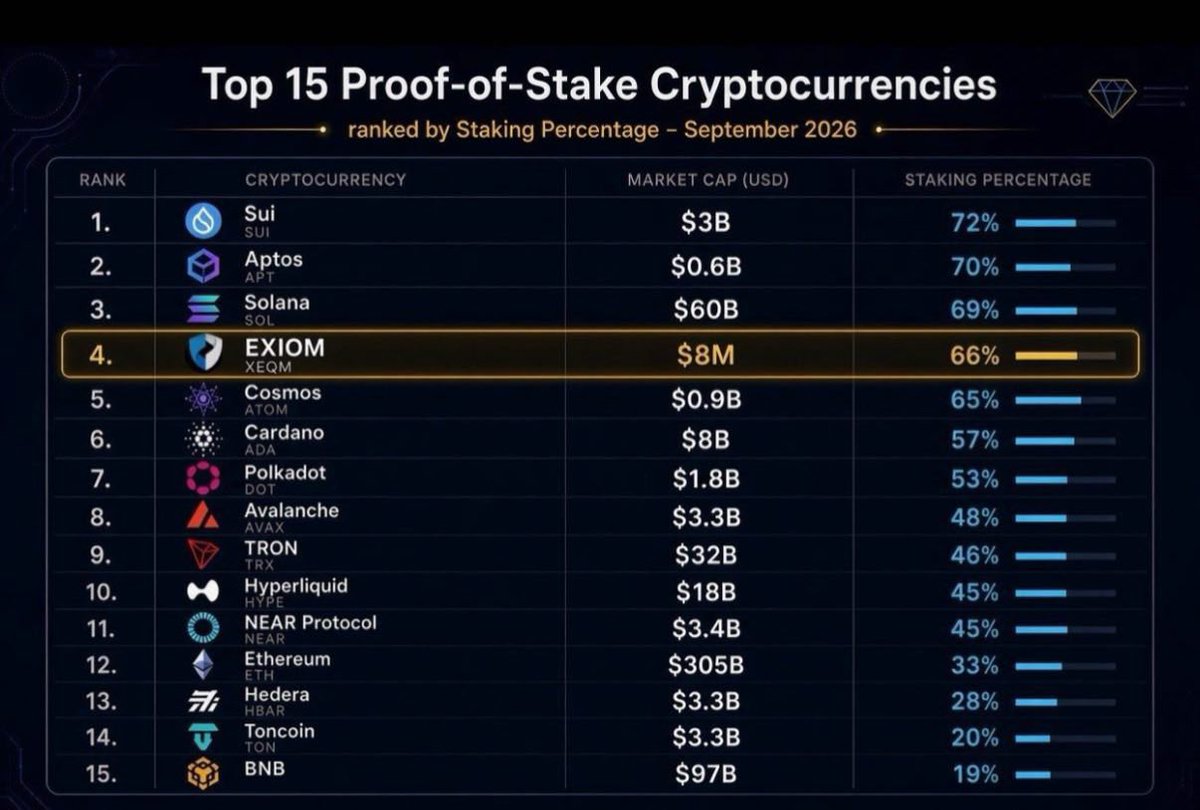
185.6M XEQM is already staked in nodes, representing about 55% of the supply at launch.
The Oracle contracts are built and unit-tested, and the service has already been running on EXIOM’s internal devnet with:
→ Random committees
→ Independent fetching
→ Quorum signing
→ On-chain posting
→ Committee rotation
→ Leader failover
→ Freshness checks
It ran unattended for over a week.
There’s also a privacy angle that is easy to miss.
The focus isn’t only on making the information trustworthy.
@ExiomXEQM is being built to protect the request itself:
Who asked?
What did they ask?
When did they ask?
That distinction matters for compliance and eligibility systems where proving a condition can be useful without exposing the underlying request.
So the progression is:
EXIOM → privacy infrastructure
XEQM → network participation
Service nodes → infrastructure
Oracle → a paid service using that infrastructure
This is the bigger picture:
A network becomes more useful when its infrastructure can provide services that applications actually need.
And as those services expand, XEQM’s role is tied to the operators and infrastructure delivering them.
We love seeing the EXIOM community build.💥
ExiomAI is a new community-made assistant designed to make EXIOM easier to understand and explore.
This is how an ecosystem grows, people see a need and build for it.
Go give it a look and send @XRYPTOisme some feedback: https://t.co/ahMzKJE7rl