@CDF_LVATT_JB Google Pay provisioning isn’t enabled for Priva Card yet.
For now, use the card details directly at supported merchants.
Binance support is already live, and we’re recording a walkthrough now. We’ll publish the video shortly showing the full flow.
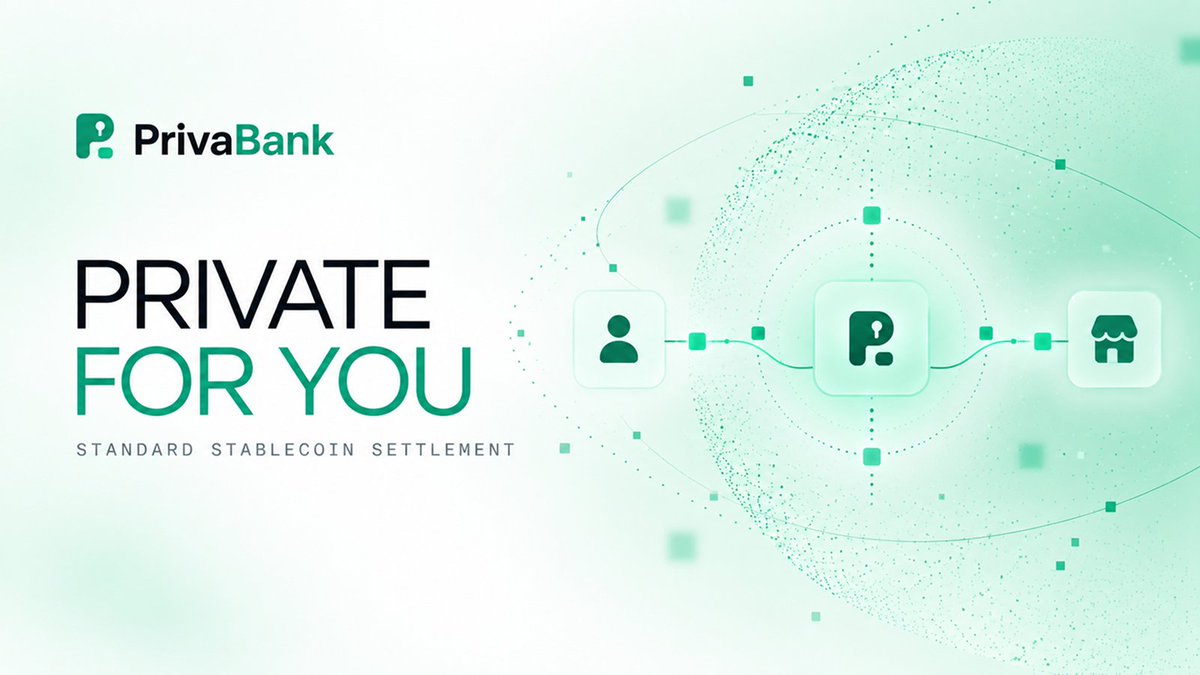
Private for you. Usable for them.
PrivaBank keeps the payer side private while merchants receive standard stablecoin settlement.
No need for the merchant to see your wallet balance or underlying account.
Your privacy stays yours.
Their settlement stays simple.
Appreciate it.
Next up is expanding the core payment infrastructure, strengthening the compliance layer, and then moving into recurring payments, private payroll, and institutional treasury tools.
The goal is simple: make private financial infrastructure usable beyond a single transaction.
Yes. The card is designed to be used like a normal payment card at supported merchants.
You authorize your PrivaBank account, create the card, then use the card details at checkout.
The payment authorization and cryptogram are handled in the background. Your private account stays underneath the card.
$PRIVA is built around protocol utility, not just holding.
Holders can use it for:
• Governance over protocol parameters
• 25% discount when paying protocol fees in $PRIVA
• Participation in the ecosystem that rewards relayers for carrying proofs and transactions
• Supporting a treasury used for audits, circuit development, and relayer growth
Relayer rewards are earned by operators doing the work, not automatically by every holder.
1/ We got asked:
“How can you buy something without the payment cryptogram?”
You don’t.
PrivaBank does not remove the cryptogram. It changes what gets exposed about the user behind the payment.
Here’s the flow ↓
Privacy is not a feature layer.
Inside PrivaBank:
Shielded liquidity holds funds privately.
Authorization proofs confirm permission.
Relayers verify and execute.
Settlement completes in stablecoins.
Privacy runs in the infrastructure.
8/ So the workflow is:
Connect
→ Authorize
→ Create CC
→ Pay
→ Validate authorization
→ Generate cryptogram
→ Send through payment rail
→ Complete payment
Privacy does not mean removing payment security.
It means removing unnecessary financial exposure.
@panzonhl@ponsdotfamily You don’t remove the cryptogram.
If the payment runs through standard card rails, the required transaction cryptogram is still generated at the payment layer.
PrivaBank is about hiding the user’s underlying account and financial footprint, not bypassing payment authentication.
@panzonhl@ponsdotfamily If you mean cryptography, that’s literally the foundation: authorization proofs, shielded liquidity, and privacy-preserving execution.
Maybe read how it works first.
Onchain privacy shouldn’t require exposing ownership.
PrivaBank shifts the model from public accounts to authorization.
Prove you’re allowed to act without revealing your full financial footprint.
Permission, not exposure.