The AI agent economy of the future will not operate on a public ledger.
An AI agent that pays for APIs, data and compute on a transparent chain publishes its own playbook: which tools, how often, how much.
Machines will need private money before they need anything else. 🔒
Pirate Chain ($ARRR) — October 14 Exploit: Full Incident Report
We are publishing a comprehensive report detailing the October 14 consensus exploit, the network recovery process, and what it means for ARRR holders.
On October 14, an attacker exploited two vulnerabilities in Pirate Chain's consensus code to create approximately 39.8 million ARRR.
Key takeaways:
No wallets were drained, and no user funds were stolen.
The exploit-minted coins are not part of the current blockchain.
The vulnerabilities were identified and patched.
The network successfully restarted on October 19.
Users should update to v6.0.14 and verify transactions from October 14–19.
Our full report provides a transparent account of what happened, how the exploit worked, the steps taken to secure and restore the network, and the lessons learned.
We encourage the entire community to read the report to better understand the incident and recovery.
Read the full incident report on Medium: https://t.co/uF1zKULNrn
BEYOND THE HYBRID | Zcash is testing a hybrid finality layer. Ryo plans a pure private PoS adaptation.
Different architectures. Same hard questions: Who finalizes? What happens when consensus stalls? How do you preserve privacy?
https://t.co/Hum7i67lsA
#Zcash#RyoCurrency
Zano aliases are about to become tradable.
Buy, bid at auction, or make an offer in $ZANO or $FUSD, with escrow holding the payment until the transfer is confirmed on-chain.
@ZanoNames is launching soon. 🔒
Private money ≠ private tokens.
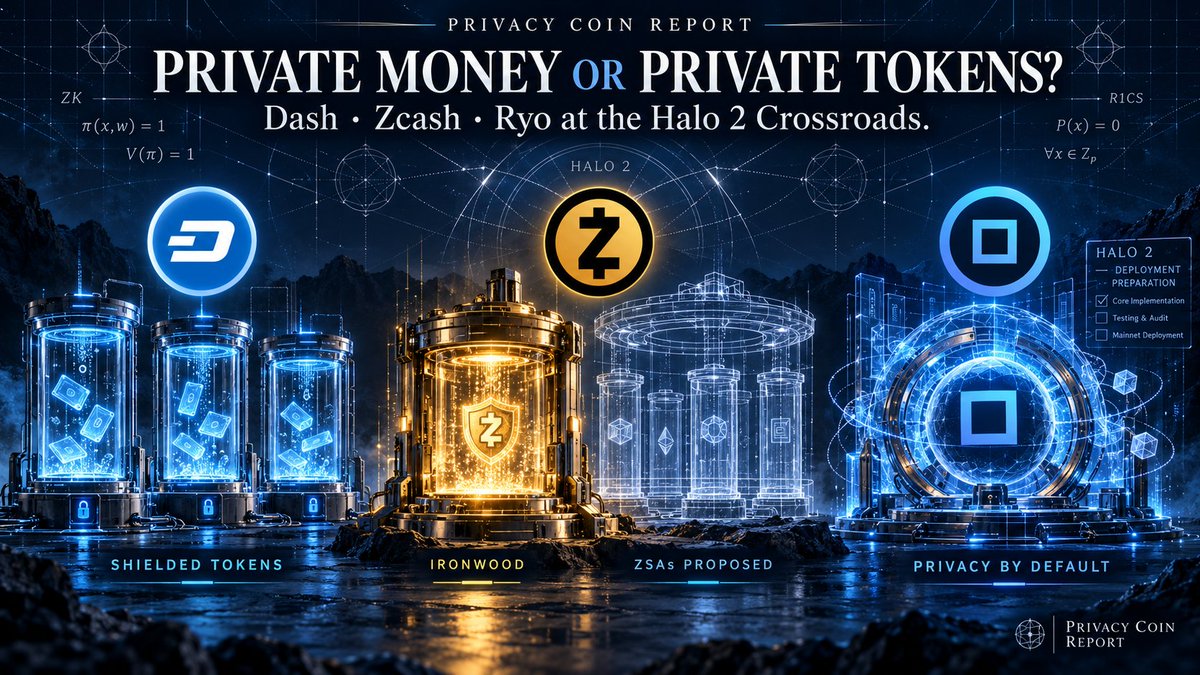
Dash is expanding what can be shielded. Zcash is developing ZSAs while Ironwood is live. Ryo is moving its mandatory Halo 2 upgrade toward deployment.
What should a privacy network build first?
https://t.co/ixgxGHORLm
$DASH zcash:native ryo:native
Proof of Stake usually means showing the network how much you hold. The more you stake, the more often you produce a block, so the amount has to be public.
Zarcanum changed that in 2024. It was the world's first Proof of Stake where your balance stays hidden and the network can still verify your stake is real.
You earn rewards without revealing what you own. 🔒
If PoW is the problem, why preserve it?
Crosslink keeps miners, adds validators, and inherits the complexity of both systems.
Ryo is pursuing what Zcash is still debating: a full transition to private PoS.
https://t.co/SPGxtvtft3
Same research. Different destinations.
Zcash is testing Crosslink: PoW produces blocks, PoS adds finality.
Ryo plans to adapt the research for pure, private PoS.
Two architectures. Different trade-offs. Security must be proven.
https://t.co/Hum7i66ND2
zcash:native ryo:native
2014: Zano co-founder @_cryptozoidberg ships on-chain aliases.
2017: ENS brings .eth names to Ethereum.
2026: millions of .eth names, and every one of them is a public balance and a public transaction history.
Zano aliases work the same way, except there is no balance or transaction history attached to yours. It tells people where to pay you, not what you hold.
@ZanoNames is coming soon, a marketplace for trading Zano aliases. 🔒
Behind every public movement are people willing to help—sometimes at personal risk.
The right to speak matters. So does the freedom to help when speaking becomes dangerous.
The Right to Help, by @K1ngVV.
https://t.co/uq6axWpiDy
#FreedomOfAssociation
Zcash’s Crosslink adds stake-based finality without removing mining. Ryo plans to adapt the research for pure private PoS.
@Dr_Max_Anon examines the architectural trade-offs, privacy challenges and six critical security tests.
https://t.co/Hum7i66ND2
#Zcash#RyoCurrency
Zcash’s Crosslink debate isn’t about staking rewards. It’s about finality, failure and how much complexity a monetary network can absorb.
Ryo plans a different endgame: pure private PoS. But architecture is not security.
https://t.co/SPGxtvtft3
zcash:native ryo:native
Conceal $CCX has been online for ~8+ years and still produces bi-weekly updates.
Anon, DYK you can stake privately with Conceal with up to 6% APY?
It's privacy that works.
https://t.co/yVL7Ckx7XQ
A valid zero-knowledge proof isn't a complete consensus audit.
Supply accounting, block validation and independent review matter. With Ryo's Halo2 in testing and deployment coordination, the lesson is timely.
ryo:native #ZK
https://t.co/N96idKcbaq
Your balance can be intact while your access disappears.
London's cloud outage and Japan's trading-cloud breach expose the gap between owning money and using it.
Privacy. Control. Availability. Recovery.
My analysis:
https://t.co/BXtIxZVvlu
#FinancialPrivacy#Cybersecurity
Different bugs. Same hard question.
Pirate: 39.82M unauthorized solana:5u83eeMKS5drqAdchhJQeUpt7x4DNaU7ZBnaMZjUpump; roughly a week of discarded history.
Zano: ~36.9M unauthorized zano:native plus fUSD; roughly a month.
Fixing supply isn't the same as settling payments.
https://t.co/5pWSva2wlm
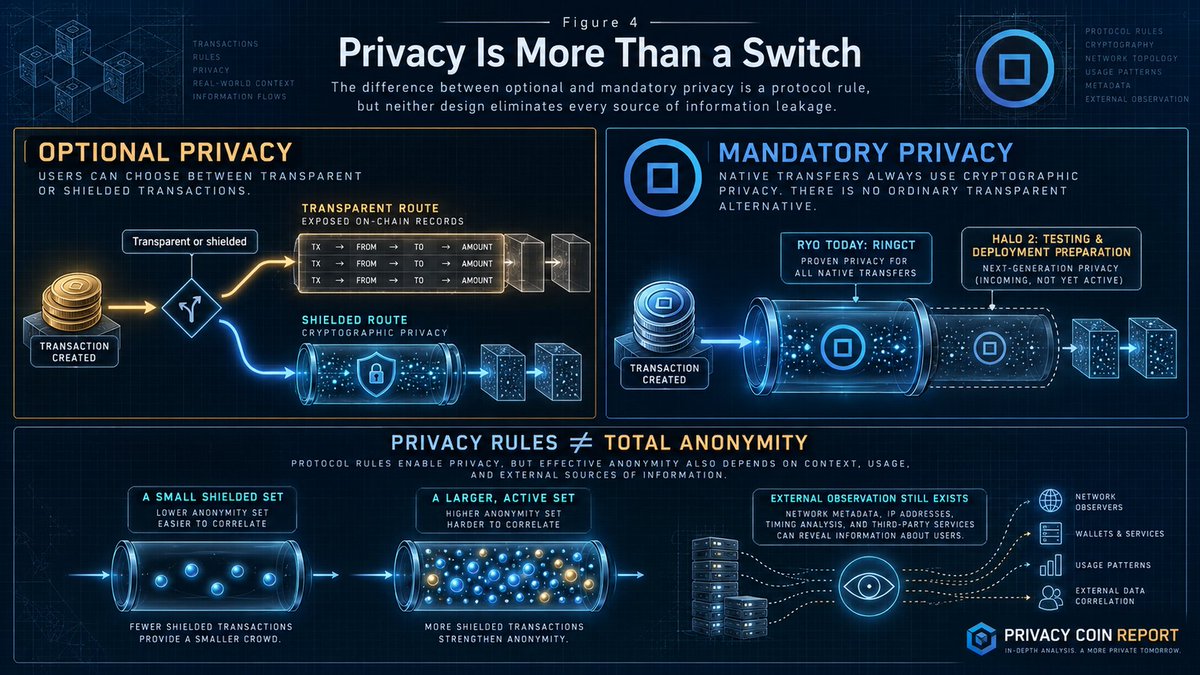
A wallet can make privacy the default. Only a protocol can make it mandatory.
Zcash permits transparent and shielded transfers. Ryo requires privacy for all native transactions.
Neither approach erases metadata or user behavior.
https://t.co/7oSm69YWnM
ryo:native zcash:native
@Wika_Native 🚨 PSA: Don’t deposit on “new” CEX promos — especially WikaEx (@Wika_Native).
Same playbook victims have reported across MecaCEX → FinanceX → BitgoGet → rebrand again:
• Deposits work. Withdrawals sit on “audit” forever.
• Support ghosts you — then Telegram/Discord bans.
• Site dies. New name, new domain, new X/TG accounts.
• Fresh “team,” obfuscated web code, hype + own token (WIKA).
If you can’t verify who runs it, where they’re licensed, and years of clean history — it’s not FUD, it’s pattern recognition.
DYOR. Don’t be the liquidity for the next exit.
#CryptoScam #WikaEx
You didn't just leak shipping details. You exposed names, home addresses and hardware-wallet purchases—a potential target list for extortion or physical attacks.
Private keys may be safe; customers may not be.
KYC risks becoming “Kill Your Customer.”
https://t.co/IsN3HCuQnL