ethereum:0x7420b4b9a0110cdc71fb720908340c03f9bc03ec
I’m going to call it again.
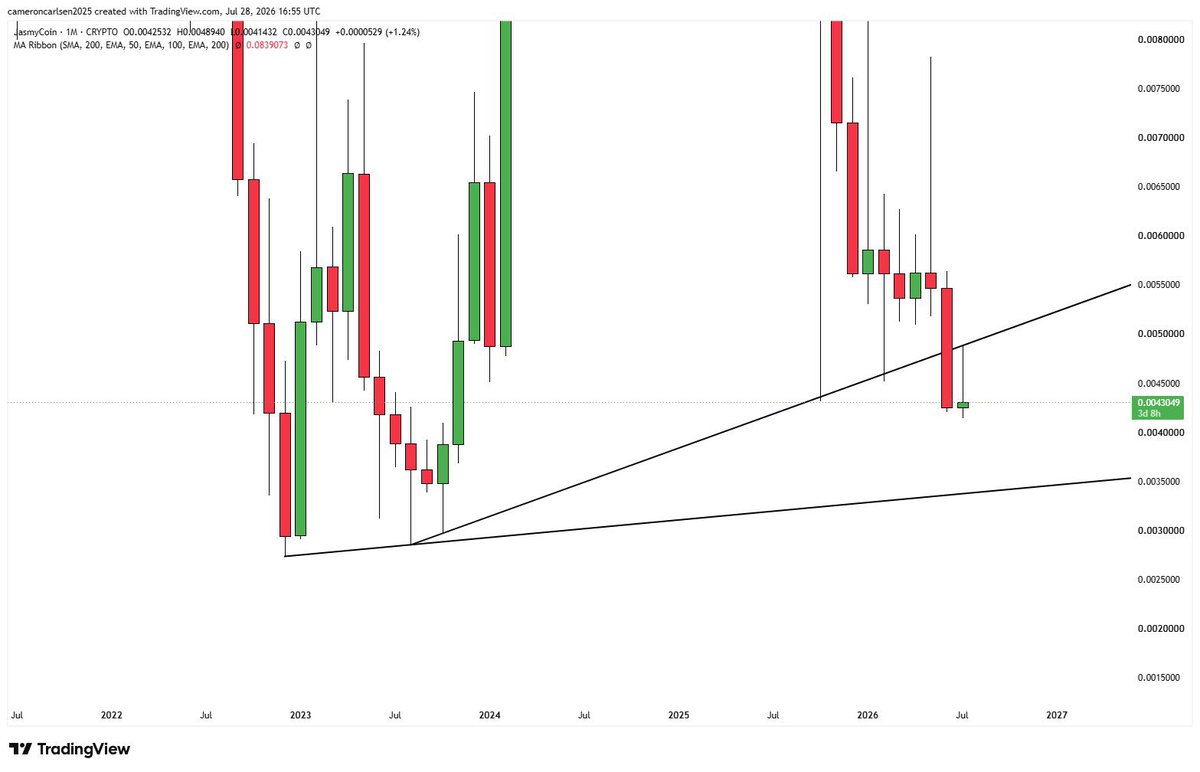
Watch this fucking level.
This is the level I’m watching.
This is where the chart gets interesting.
Mark it. Screenshot it. Come back to this post.
Let the chart do the talking. 📈
$JASMY
Here was the prior picture… $JASMY
Now I’m going to prove that PA is all you need in this game…
Not RSI
Not MACD
No Elliott wave bullshit
Nor shitty order blocks or FVG
Just the basics is all you need but most don’t have a clue how to stick to the basics…
A few months ago, Hara mentioned a few words about the importance of deepfakes during a meeting. Today, the combination of #JASMY and #JANCTION could theoretically be capable of contributing to the authentication and verification of content generated or manipulated by AI, particularly deepfake videos. At present, AI is becoming increasingly capable of producing extremely realistic videos, and it is sometimes becoming difficult to determine simply with the naked eye whether a scene actually took place. The question would no longer simply be whether an AI thinks a video is real or fake, but above all, being able to answer a much more fundamental question; what is the origin of this video, and can its history be verified cryptographically?
We could then imagine that a video captured by a compatible device would be associated, from the moment it is created, with a cryptographic fingerprint and information allowing its provenance to be verified. Through #Jasmy's authentication and data management system, associated with the PDL, the origin of content could be verifiable. If the file were subsequently modified, edited, or transformed by an AI, its history could also be taken into account. When a video is published on an SNS, a system could then verify its provenance, integrity, and any modifications, and then complement this verification with an analysis performed by an AI within JANCTION. A person could thus obtain a level of confidence rather than simply a "true" or "false": verified provenance, authenticated but modified content, or an origin that cannot be verified.
This is where #Janction could take on an additional dimension. The massive analysis of video content by AI models requires considerable computing power and GPU resources. An infrastructure capable of distributing these workloads across multiple GPUs can provide the power necessary to analyze very large quantities of content. We could therefore imagine an architecture combining authentication, data provenance, distributed computing, and AI: the device authenticates the content when it is created, a fingerprint makes it possible to verify its integrity, provenance information can be verified, while GPU resources allow AI systems to analyze content whose origin is unknown or whose integrity is uncertain.
Here, we are not simply creating an AI capable of detecting deepfakes. Rather, it is about building a genuine layer of trust around digital content: authenticating what can be authenticated from the moment it is created, maintaining verifiable provenance, detecting modifications, and using AI to analyze content that has no proof of origin. This type of application could represent an evolution in the fight against falsified content and the disinformation that is proliferating with AI nowadays.