private investor. account is to help me keep up with events. engagement is to keep a record not necessarily support. no opinion. probably not worth following
European bond markets are now approaching meltdown territory. Britain is the most vulnerable. France and Italy are next - at least in terms of major countries. 🇪🇺☢️📉
Your ability to profit as a day trader & exploit an edge is directly proportionate to your ability to ignore noise. For me it means waiting on and reacting to 1 pattern, 1 market (nothing on my watch list), 1 trade mgmt system, total blinders to all else. No macro, no predicting
Bond vigilantes are sending a message to G7 nations. Global yields will keep rising until the equity market breaks & QE restarts.
“The rise to 3% (10y JGB) is a message from the market that could, to some extent, force Takaichi to correct some of her expansionary fiscal policy,”
Jason Needham @TradingBasesUK returns with a new guest article exploring the portfolio habits that can quietly damage long-term returns. From cutting winners too early to averaging down on losers, he explains how disciplined position sizing and letting winners run can create asymmetrical returns over time.
https://t.co/FbPPcvdwfT
Position sizing is one of the most overlooked aspects of trading, yet it is crucial for improving your trading.
Here's everything you need to know about it:
This is a phenomenal piece. As long as there is an open, a close, a high and a low-I can make money. So can you. Treat trading like a business. Manage your expenses, take profit along the way and learn to add to positions.
Four months ago we released "Empire by Code" which laid out a thesis for the rise of USD Stablecoins.
We have now released “Stablecoin Wars" which deals with the various factions vying for control of this new system.
Both can be found at the link below.
https://t.co/GJMiJKQ2UK
In 2021, Stanley Druckenmiller explained how he compounded at 30% for 30 years straight.
He broke down why:
- Winning isn’t about being right
- Markets reward puzzle-solvers
- Entitlements threaten youth
12 lessons from Druckenmiller on markets, risk and the future of America:
Is this a “canary-in-the-coalmine” moment, similar to August 2007?
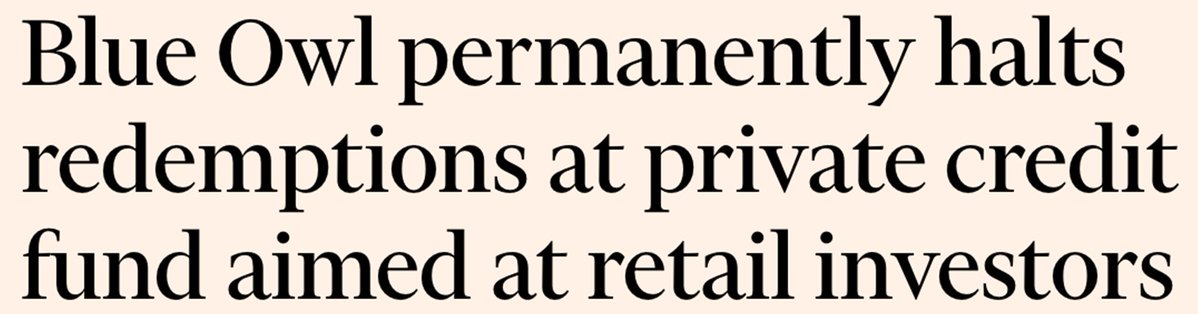
This question will be on the mind of some investors and policymakers this morning as they assess the news that, quoting the FT, the “private credit group Blue Owl will permanently restrict investors from withdrawing their cash from its inaugural private retail debt fund.”
There’s plenty to think about here, starting with the risks of an investing phenomenon in advanced (not developing) markets that has gone too far overall (short answer: yes), to the approaches being taken by specific firms (lots of differences, yet subject to the “market for lemons” risk). There’s also the “elephant in the room” question regarding much larger systemic risks (nowhere near the magnitude of those which fueled the 2008 Global Financial Crisis, but a significant – and necessary – valuation hit is looming for specific assets).
More to follow on this.
#economy #markets #privatecredit @FT #BlueOwl
I'm sure someone can explain to me the curiosity of sentiment indicators showing stress in the labor maket (and more recently Jolts, challenger and payrolls data too) and yet initial unemplyment claims are consistant with a booming jobs market! H/T @zerohedge
For reference.
fwiw I focus on 2. & 18. but the latter with an emphasis on rVol/ relative volume.
Surprised to see 1. on top but I guess it’s not in order of priority & seen it used by ppl who know their stuff.
8. Moon phases is not what it sounds like, … is it??
AI is like a vampire, sucking the lifeblood out of the rest of the economy.
This is similar to the late 1990s tech bubble. Free money for the current investment fad misallocates resources across the economy. Eventually investors find the pot of gold is just a crock of s***!
Nvidia emailed a memo to Wall Street sell side analysts to push back on my arguments.
I stand by my analysis. Obviously, the full analysis does not fit in a tweet. I will release on my timeline.
The first post in The Heretic’s Guide to AI’s Stars “Supply-Side Gluttony” is up now.
It is a fairly light read. The second in the Heretic series will be a heavier lift.
Every post of mine on Substack will have a follow up Q&A with 5 Qs selected from the comment section on the post.
https://t.co/9XZhbbg6RO
A long interview with @FortuneMagazine about the current risks in the market. In particular how a unwinding of the AI bubble could be recessionary as it hurts not just AI investment, but consumption is increasingly driven by the richest consumers.
https://t.co/gxDGq7kppI
Rising AI capex pushes energy prices higher, strains local infrastructure, and funnels capital toward data centers instead of real wages.
That pressure hits working households first.
If the promise of AI ends up being higher bills and fewer jobs, the same voters cheering the boom today will turn against it tomorrow.
They’ll oppose more buildouts, block permits, and fight the expansion because they’ll feel squeezed and shut out.
Political support flips fast when people see costs rise and employment security fall.
This is going to be a big problem for the administration which has basically staked its entire agenda of data center buildout rather than focusing on what got them elected which was dealing with affordability and inflation.