Excellent breakdown of the structural realities facing Sat Kartar Life. from a digital product vendor to a hospital operator Highlighted by @PriyamInvests co-founder of @TrinetraAsset
Source :- https://t.co/YtWqReFyW0
Ep 2 -= Sat Kartar Life Ltd
WEe continue looking at all the listed players within the listed Ayurvedic ecosystem
Sat Kartar stands out from all other manufacturers and vendors of medicnes ( allopathy and ayurvedic) as it is pure play D2C brand in the listed space
Exciting model but untested on scale
The more and more we look at other models , the more we realise how operationally effecient and Superior Jeena Sikho really is.
@TrinetraAsset #investing
The TAM Based story telling that folks are skeptical about Jeena Sikho can is not too much of a concern ;
Having visited ~ 4 Hospitals/ Day Care centers in Mumbai and Surat - The demand is very real
A - Five Lakh Seventy Thousand people walked through Clinics and Day Care centers ( OPD Patients) through FY 26
The demand is real , visible and not manufactured - If there wasnt an underlying belief in Ayurveda or usage of Ayurvedic products - This pace of growth wouldn t have been possible .
You can fool one person all the time, but not all people all the time .
B - The Unit economics can be questioned on paper but you need to visit a hospital to understand why this is the case
They look nothing like a allopathy hospital - No OTs, Cath Labs, ICUs, radiology machines - nothing
The rents are low as almost all are on the outskirts of cities.
C - I still believe, the way JSL operates unit economics are very similar to how a Hotel runs , and not a hospital
The model has evereything that a well run Hotel needs
Low Opex, high occupancy , High Average Length of Stay ( ALOS )
Its actually quite opposite to a allopathy hospital as any reputable hospital would try to shorten their ALOS - reason being Day 1 or 2 has surgery post which any additional days of stay tends to taper off the ARPOB
D - Insurance tie ups validate their workings
Why has IRDAI mandated that AYUSH treatments be covered by all insurers
Why is every single insurer , including GIPSA ( Government insurers) on board and on the panel for JSL
E - Mental model to think aboout JSL is that it operates on the intersection on health and wellness - leveraging the fact that Ayurveda has always existed in India
But has only existed with the abscence of a national end to end integrated chain . JSL is simple institutionalising what has already existed
Ayurvedic doctors have always been there . Medicines have always been there - JSL Has branded them and formalised the chain
E - Yes treatment efficacy for some causes like Cancer is questionable but that is a miniscule percentage of revenue
Everything that Ayurveda propogates is ultimately wellness and a way of life.
Theyve never said its a magical 8 day treatment - Its a way of life that needs to be followed
F - Yes the key man risk is real and always be there.
Best of brands in India are first built on personal brands and institutionalised over time
There can be endless debates on the clinical efficacy of treatments and the fact that they may not work - Think about JSL as a category creator.
A 45 minute video taking you through the Jeena sikho business
We like the business and are in awe of the execution that has happened and also what yet has to take place
You may ot may not be a believer in Ayurveda but cannot deny that massive tailwinds exist here
If an Industry has gone from 2.5 billion to 45 billion USD ( AYUSH prooduct sales), something special has already taken place and the demand is real
Pace of Growth
Why do we say, that Good times never last
They did not last, even for the King of Good Times
Investing across small or midcaps have crated this narrative that multibaggers are easy to disover, hold and nurture and see through
Some potential investors we talk to @TrinetraAsset , whether we are discussiong our model portfolios or individual stock research - tell us they expect multibaggers 5 years out
We find it funny because the future is uncretain , unpredictable and definitely not on an excel sheet
Intrinsic value, a concept washed down your throat by professors and finance magazine peddlers is a broken word.
Intrinsic value of a stock today for FY 30 or FY 35 is basically your abiliity to chart out all the cash that the business will at will generate over the next 5 to 10 years, use a discount rate and get it back to its Present value
The only problem , is neither the promoter knows the shape of his company 10 years out , neither the merchant bankers who bought the issue and defintely not you.
Our view on looking at companies is to follow earnings , intead of predicting them
Continue investing in companies which exhibit and deliver high pace of earnings growth and exit those who dont. ( earnings momentum, not price momentum - I will one day take a seperate session on why Technical analysis is a dastardly and stupid thing to do )
Instead of considering investing outcomes as certainities , we consider them as variables, say in a Bayes probability theorem
Probaility of a ( Multibagger Stock A ) =
Prior Knowledge of the event ( Stock A )
+
New evidence that either adds to or refutes Prior knowledge
The fact that , in the last 10 years only 150 odd cos out of the 4500 companies were able to cross from the 1000 cr to 5000 + cr market cap says, that our starting probability itself is 5% tops and not what people assume.
Not to be a pessimist here, we look for asymmetrical returns but not through single bets and single mindedness .
Look out for companies doing better than others, and continue backing them as long as they continue outperforming ( in numbers)
Markets mimic life very well - The world only cares about winners.
If Indias richest man, circa 2008 and bankrupt today - couldnt map his own cash flows - Aap or hum toh kya hi he.
hashtag#investing
Not as bad as it sounds
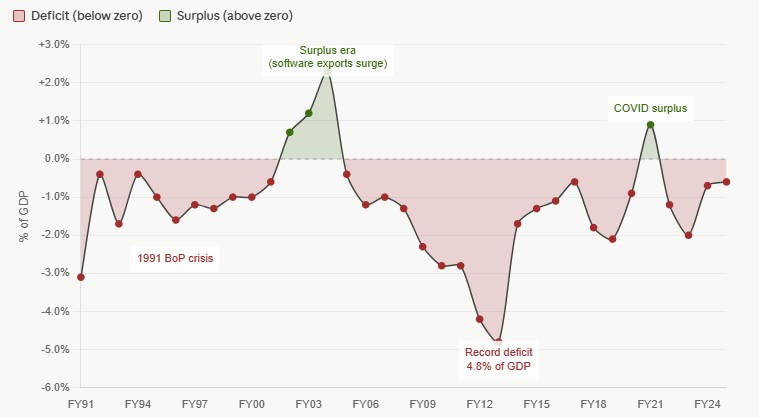
We have more or less been running a current account deficit since forever.
I would split CAD into controllables and uncontrollables
A current account statement is like a P/L statement that then flows into The Balance Sheet
Put simply - A current account has 4 variables
A - (Good exports - Good imports) - Uncontrollable
The imports are primarily crude and Gold - And exports from India will never match up in the forseeable deficit
We ran a negative Deficit of 87 Billion USD in Q2 FY 26
B - ( Serevices exports - Services Imports ) - Controllable
Our services , namely IT services exports and the GCC wave has kept this tab in surplus since 2 decades now - This nicely negatesd the impact that our Goods deficit has
As long as talent pool doesnt shrink and we continue to have a cost arbitrage with the west, this will continue to do well
C - Primary Income - ( Income earned by Indians owning assets abroad - Income paid to foreigners on Indian Assets ) - Uncontrollable
Here the income earned is NOT remittances but say dividends on our reserves, a majority of which are hel;d through T Bills, dividends received by Indian cos have a subsidiary abroad'
Income paid to foreigners include everything from dividends paid to bond holders to all the OFS that MNC cos do in India at obscene valuations and promptly remit the money home
D - Secondary Income ( Incoming transfers - Outgoing transfers) - Controllable
Thank god to our India Loving diaspora abroad, we have a very healthy inward remittance that offsets a lot of pain
So the Current account is largely - A + B + C + D = which has largely been negative
Whatb do you do when you incur a loss on the P/L ?
You draw from your reserves
What do you do do when reserves are depleting ( Like we had in 1991? )
You do a QIP - Only caveat is here the institution would be the World Bank
None of this of course is going to happen to us. We have healthy reserves and many monetary measures to offset this
Only problem is that GOI is trying to control the uncontrollables
Wont work
In India, if you tell someone to not do something - They will definitely do it.
We need some bold economic policy decisions, rationalisation of taxes and a need to tone down the freebies .
#investing
Hospital scuttlebutt
We were in Delhi and Faridabad a whike back to visit some of the newer hospitals of Yatharth Hospitals, a listed entity that is expanding fast within the NCR region
Public data suggests that the hospital industry is entering into a new capex cycle
Almost every single hospital chain has announced major capex with the likes and size of even *Max* hospitals announcing their intention of doubling their bed size over the next 4/5 years
When one of the largest players in the industry announces capex at this scale, it means that the industry as a whole has entered into a capex mode.
We crunched some data on when the last time the hospital industry went into a capex mode as whole – 2015 to 2019
-Hospital bed counts almost increased by 70 to 100% for multiple hospital chains during that period ( 2015 to 2019)
-The period had low/ no returns for hospital stocks
We believe that while we are in a hospital supercycle as of today similar to that we saw in 2015/2019 – but we are unlikely to see the same low/no return cycle.
There are *distinct* differences between the both cycles
A – Conventional capex in the 2015 to 2019 cycle was greenfield and brownfield.
In simple terms ;
*Greenfield* capex cycle means purchase of land, construction of building and the entire facility – Has a 5 to 6 year payback period.
*Brownfield* capex is construction of a new facility either on or near your existing hospital/ Land parcel. – Has a 2 to 3 year payback period.
This time the capex cycle has one distinct difference -
A - A lot of the new capacity that is being added in few hospital chains is through *acquisitions* .
There are 500 + multiple defunct hospital assets available for sale if you just look at *SARFAESI* website
These hospitals went defunct due to lack talent/ Branding.
The new play within the sector is to acquire hospitals either through NCLT/ SARFAESI in a good location, spend a minimal amount on capex, re brand them and voila you have a running asset in a few months
These Hospitals are take less than 6 months to breakeven and thus add to the topline very fast.
B – Unlike the last cycle, when a lot of these new assets were created through debt, the new playbook is acquiring these new assets through money raised via QIP/ Prefential issues.
While this leads to equity dilution , there is no debt burden so ROE expands immediately on breakeven unlike the last cycle where it took years for the new capacity to be ROE positive for shareholders
Our view on *Yatharth*
-Went from 1000 to 2800 beds – almost all through acquisitions led by QIPs and IPO proceeds
-Plans to follow similar playbook to reach 6000 beds in 3 to 4 years
-Major focus on oncology which is the highest ARPOB ( Average revenue per occupied bed )
-The mental model with such business models is to stay with them to as long as growth persists
@TrinetraAsset
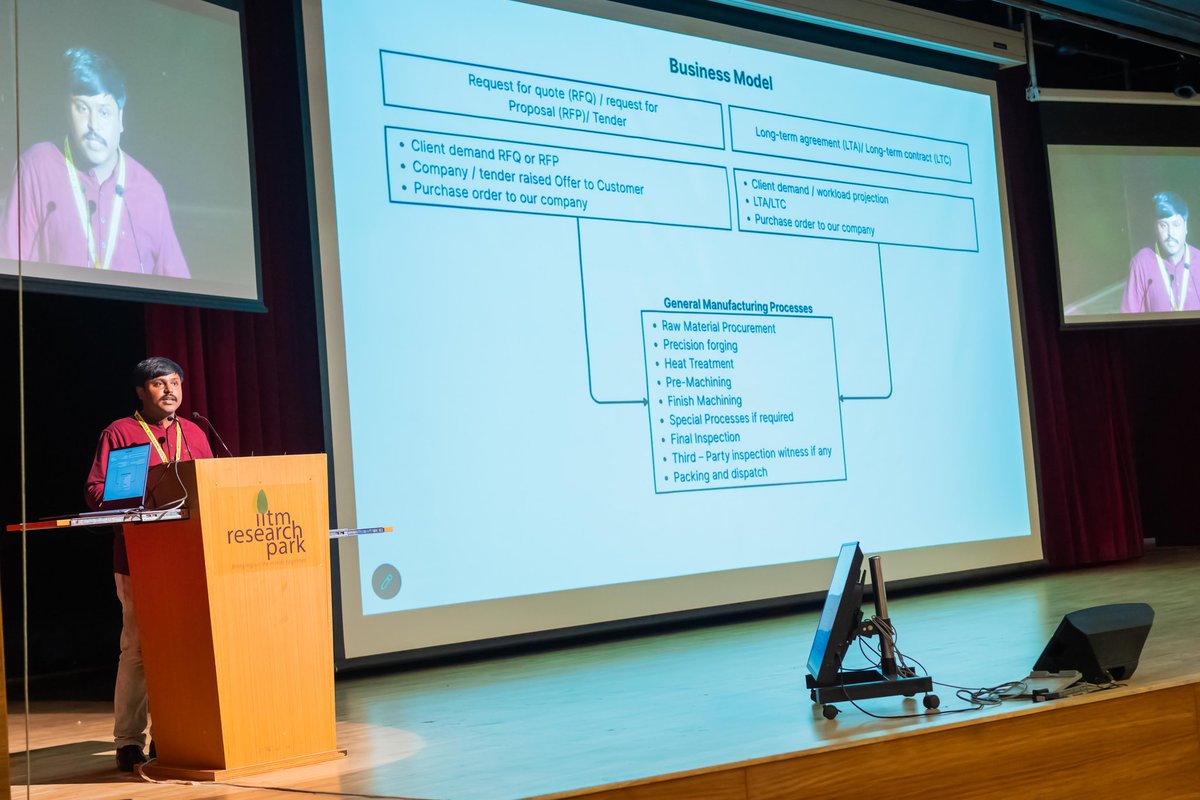
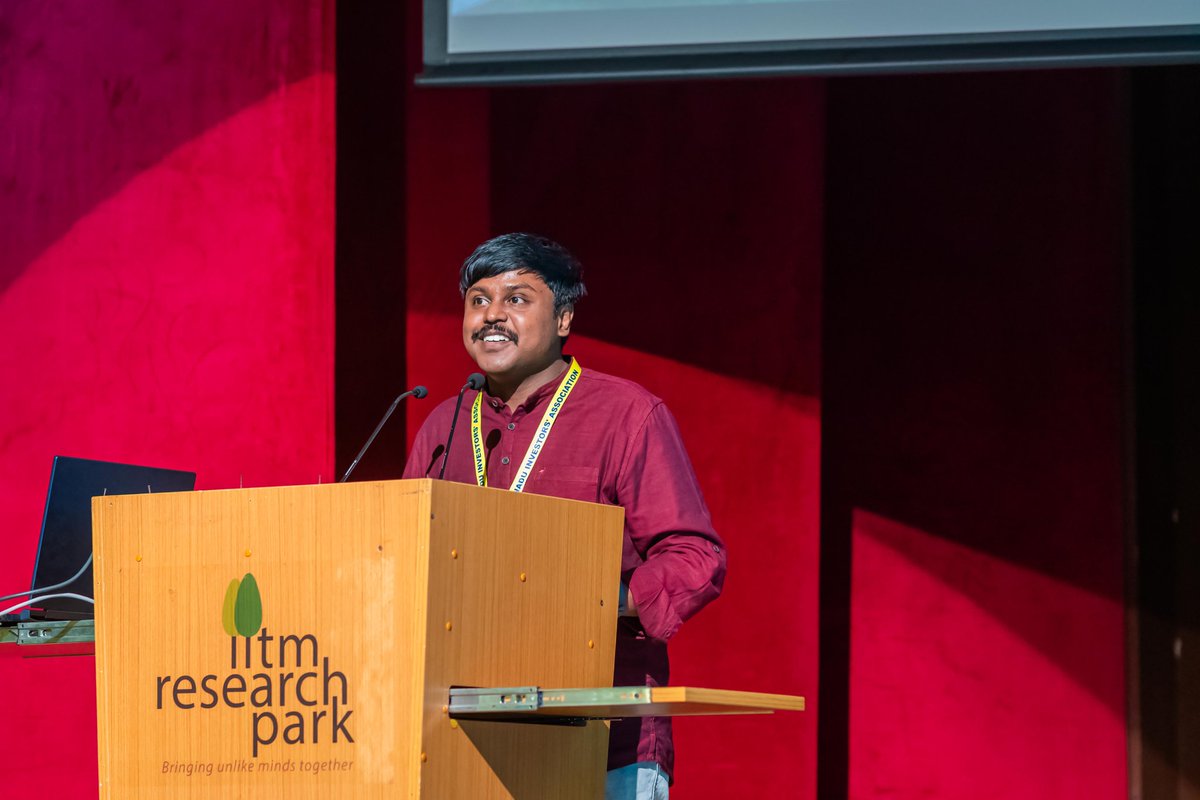
Grateful to present at TIA 20:20 at IIT Madras, sharing my thesis on #Azad Eng 650+ passionate investors. Powerful conversations.
Honoured to share the stage with Mr. G. Maran, Mr. Sunil Shah, Mr. Naresh Katariya, & Mr. Shyam Sekhar sir & many more.
Thank you team @TIA_Investors
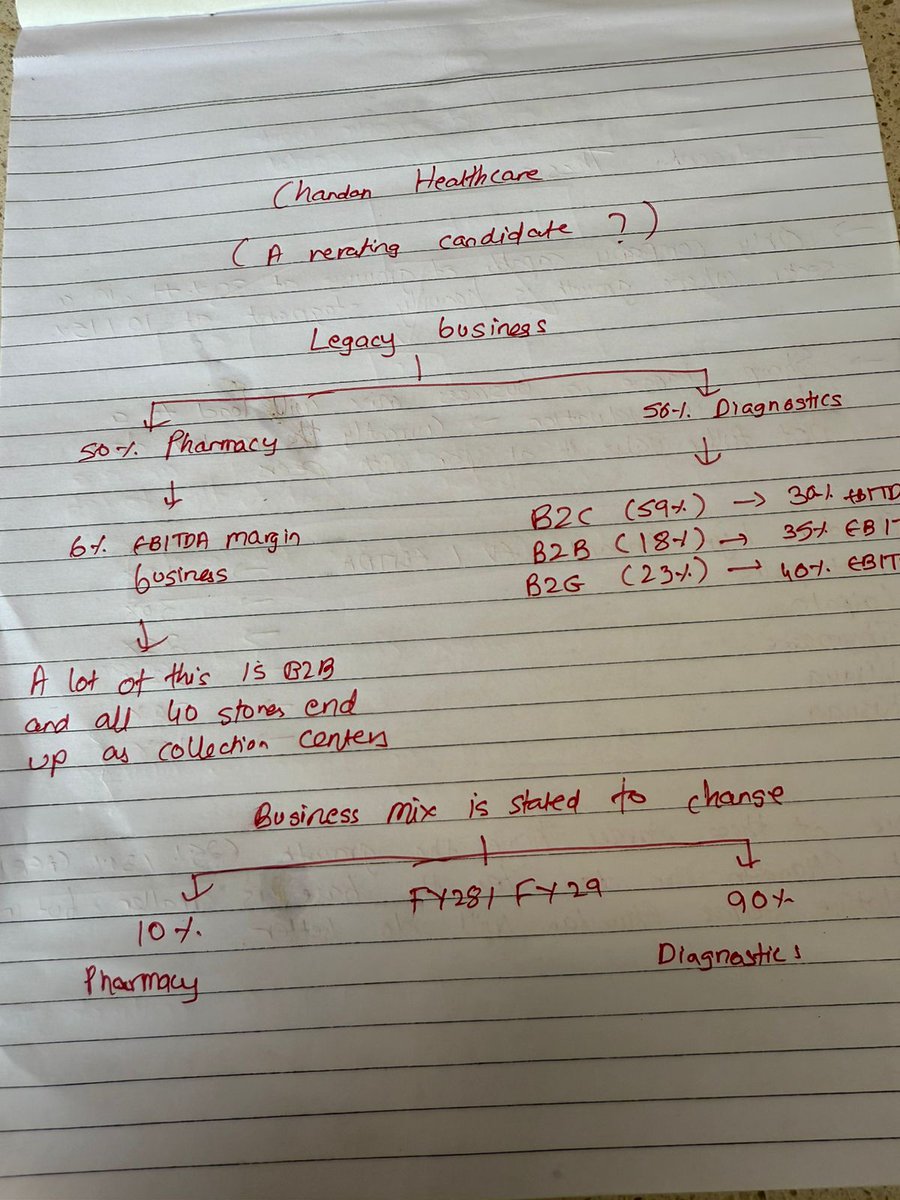
Our Thesis and notes on Chandan Healthcare
If execution is on point for the next few years, we feel the rate of change in this business is going to be phenomenally high in this business
Notes attached in the comment section
We shot a long form video taking you through our thesis of Unihealth Hospitals
Our original thesis - https://t.co/IyxsyKrxlR
The video is a conversation with the management on the business, future outlook and what lies ahead.
Disc - Invested, biased.