Net kreeg een stel @NS_online medewerkers een vraag:
“Jullie weten bijna alles he?!”
De ene antwoordde met: “Bijna alles”
Maar die daarnaast zei zachtjes “42”
Dankjewel 🤣
@AntiTrumpCanada@sarobertson_@sherlockeditor We had this man as the ambassador of the US during the first Trump presidency. You should look into the crazy stuff he said while he was here…
No one is more annoyed by the AI revolution than people who can actually write a sentence. Basically, having any ability to write now is suspect - you will get accused of being AI at some point. It feels like you are being accused of being a witch, of holding a type of rare magic that only the machines are now allowed to have.
Stel je voor dat je iemand wijst op de realiteit. Dat kan natuurlijk niet he? Dan moeten ze je wel blokkeren, want dan barst hun zorgvuldig gecreeerde fantastiebubbeltje uiteen...
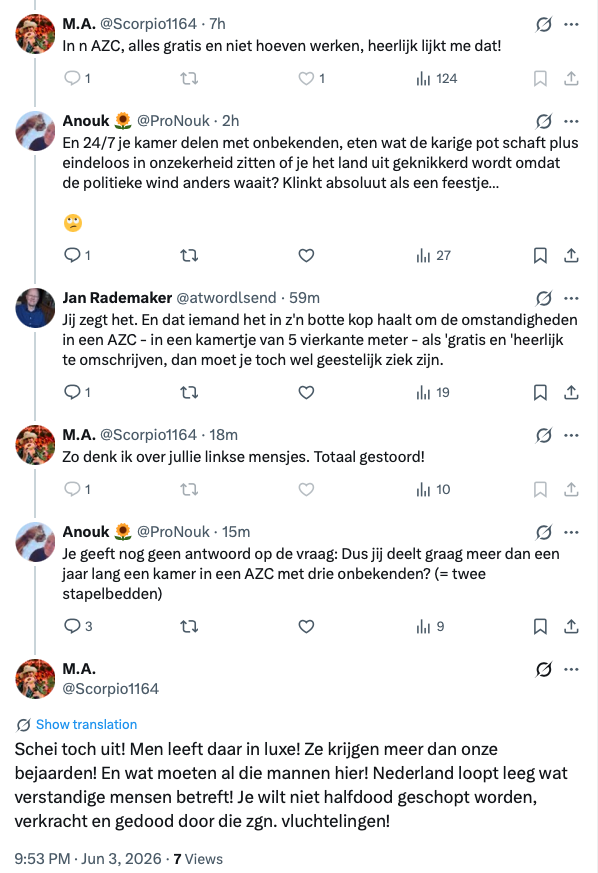
@Scorpio1164@Ingeborgvraagt En 24/7 je kamer delen met onbekenden, eten wat de karige pot schaft plus eindeloos in onzekerheid zitten of je het land uit geknikkerd wordt omdat de politieke wind anders waait? Klinkt absoluut als een feestje…
🙄
@Scorpio1164@atwordlsend@Ingeborgvraagt Je geeft nog geen antwoord op de vraag: Dus jij deelt graag meer dan een jaar lang een kamer in een AZC met drie onbekenden? (= twee stapelbedden)
Weet je nog toen Martijn de Koning grapjes ging maken over de afkomst van Thierry Baudet en dat ‘zogenaamd’ veel te ver ging?
Ja. Dat ging helemaal niet te ver.
https://t.co/SsYpxfTO5q
If any of you pro lifers get tape worms you better suck it up and be a good host, because tape worms have a heartbeat and feel pain. It deserves a choice and it chose you to be its mother.
@Scorpio1164@Ingeborgvraagt En 24/7 je kamer delen met onbekenden, eten wat de karige pot schaft plus eindeloos in onzekerheid zitten of je het land uit geknikkerd wordt omdat de politieke wind anders waait? Klinkt absoluut als een feestje…
🙄
Such a scene is often framed as proof the Dutch are superhuman—they’re not.
The real miracle isn't the Dutch cyclist. It's the environment that allows ordinary people to do extraordinary things. Build the infrastructure, and you'll find your city is full of capable cyclists too.
They call it a “وديعة”.
A deposit.
That is the word many Lebanese families are now using for the temporary burial of loved ones who cannot be taken home because of the war.
In English, the word sounds cold & administrative. A deposit is something placed somewhere temporarily until it can be reclaimed.
So much bureaucratic connotation in a word for something so intimate.
A deposit.
As though she were luggage.
Or a document.
Or an item being stored.
But in Arabic, وديعة carries another meaning too. It is something entrusted. Something left in safekeeping. Something precious that is being held until it can be returned.
And yet, when we are talking about a mother who has just died, it feels unbearable.
Because no daughter wants to say:
“We are placing my mother as a وديعة.”
It sounds as though death itself has become temporary storage.
As though war has reached so deeply into ordinary life that even burial has been put on hold.
These days, because of the war, many Lebanese families are having to place their loved ones as وديعة.
Not because they want to.
Because they have no choice.
Roads are inaccessible. Villages remain under threat. Entire areas are subject to bombardment & displacement orders. Families can no longer safely reach the towns & villages where generations before them were buried.
Last week, when my mother died, we became one of those families.
Taking Siran back to Nabatiyeh to lay her beside my father, where she always asked to be buried, was simply a mission impossible.
So instead, my brother & I followed the vehicle carrying her coffin to a temporary burial ground.
There was no familiar procession.
No gathering of relatives.
No prayers in the Hussainiya before departure.
No final journey home.
Only a quiet drive.
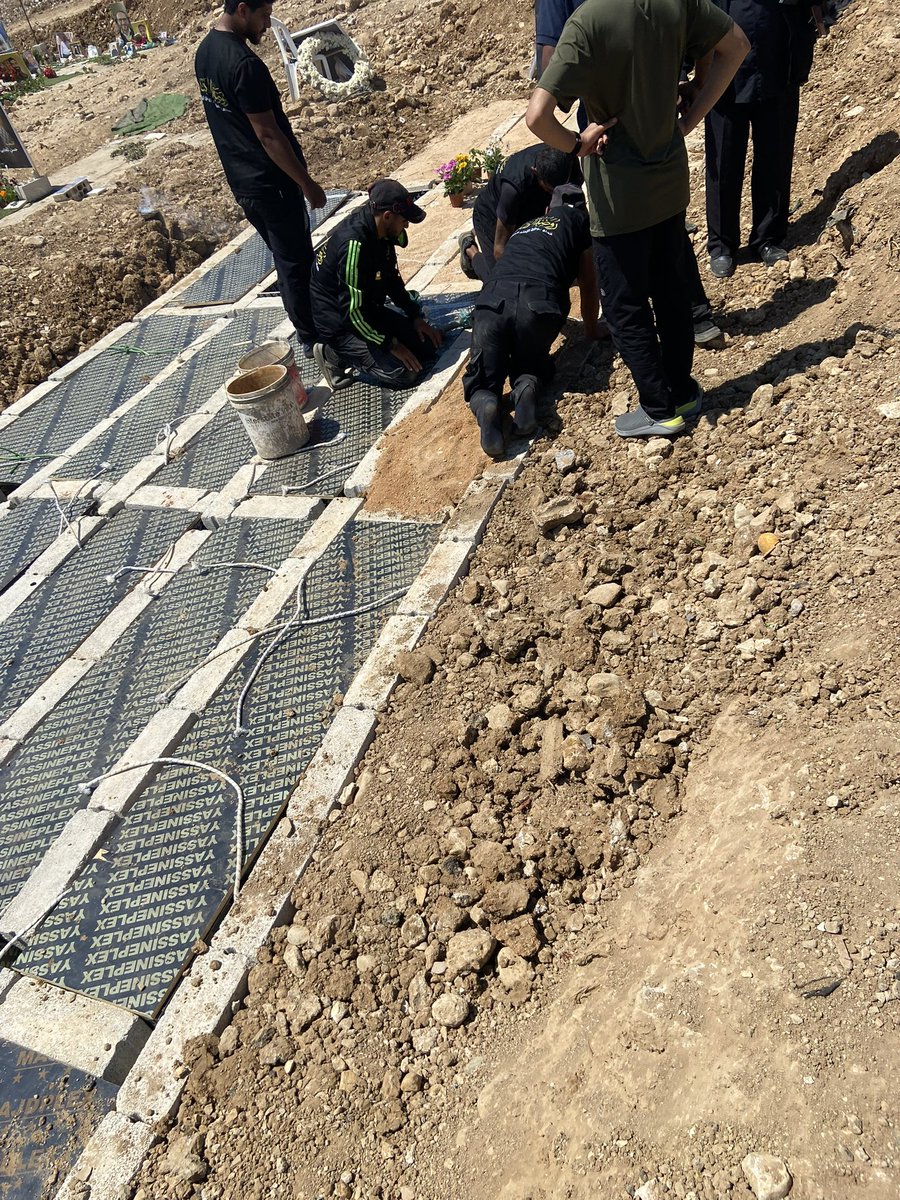
A Sheikh offered prayers over her body. Strangers gathered around us & prayed alongside us. Then a few men carried her towards a section of the cemetery reserved for what people now simply call the deposits.
A small concrete space had been prepared. Inside it sat a simple wooden coffin-sized box built to the exact dimensions of the concrete cavity, designed to facilitate transfer in the future.
Another prayer was said.
The soil was placed over her.
Around us, women wailed over other graves. A microphone carried prayers for someone else’s dead. Flags fluttered above nearby tombs. The whole scene felt surreal, suspended somewhere between mourning & administration.
Then one of the men looked at us & said:
“Write this down. Memorise this number.”
3/5.
The fifth coffin in the third row.
That is where my mother now lies.
A small stone bearing her name will eventually be placed there so that one day we can find her again & take her home.
Home.
What a simple word.
For centuries families buried their loved ones beside parents, spouses, ancestors & neighbours. It was a final act of belonging.
Today many of us are forced to say:
“Not yet.”
“For now, we leave them here.”
“We will come back for them later.”
War takes many things from people.
Homes.
Safety.
Certainty.
But I never imagined it would take this too.
That even in death, my mother could not be laid to rest beside the man she loved & always called ‘the best of men.’
For now, Siran remains a وديعة.
Entrusted.
Held.
Waiting.
And one day, God willing, when the roads are open, the bombs have stopped, & Nabatiyeh is once again reachable, we will take her to where she always wanted to be.
Beside my father.
Where she belongs.
@Th447371@PiersUncensored@piersmorgan@normfinkelstein You mean the action of pretending that the people in Gaza were ‘left alone’ while actually living under a full blockade for nearly two decades has consequences?
Oh wait, you only mean it one way… Yeah. That tracks.