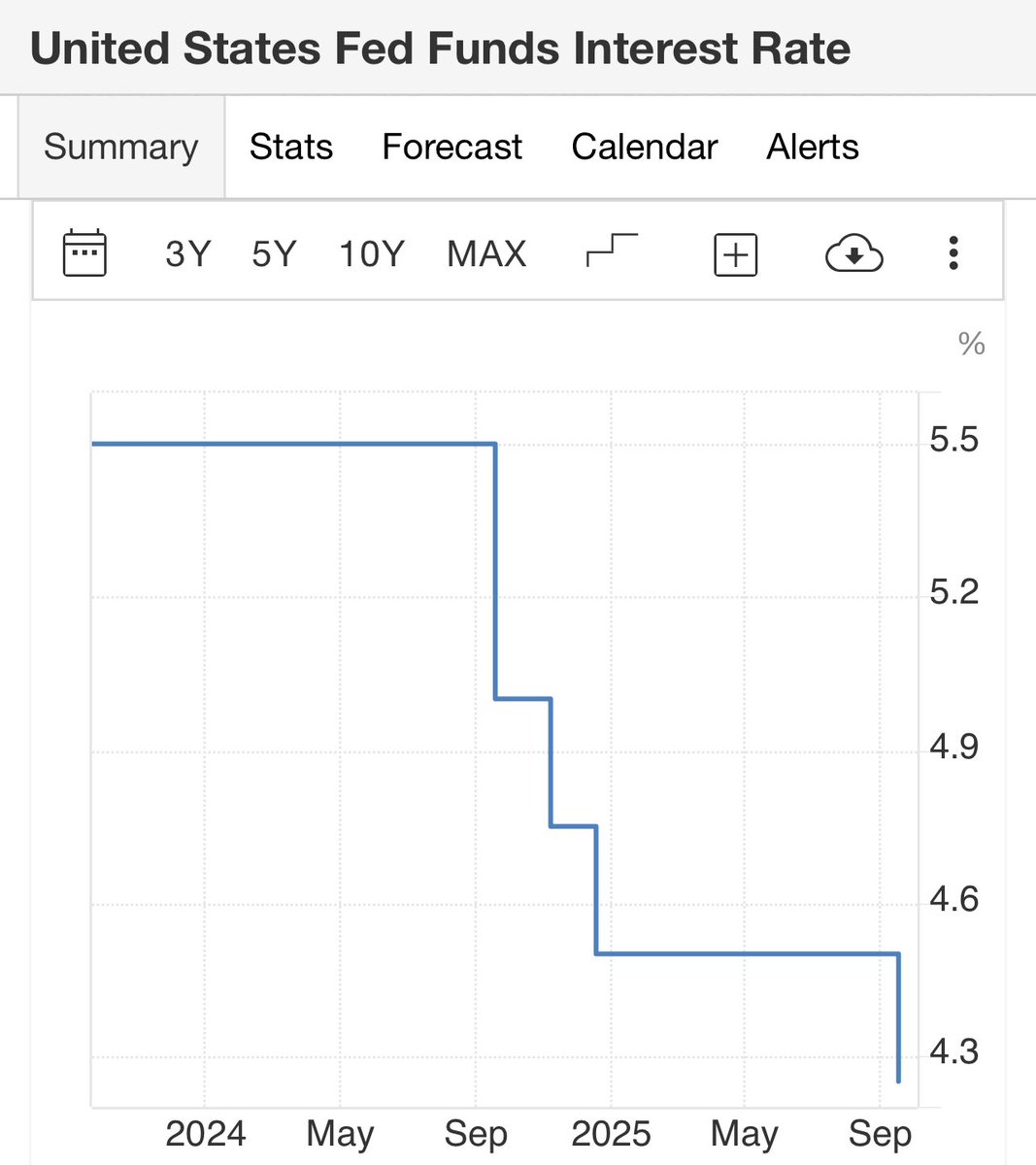
The Federal Reserve cut the federal funds rate by 25bps in September 2025, bringing it to the 4.00%–4.25% range, in line with expectations. It is the first reduction in borrowing costs since December.
PCE inflation is seen at 3% for this year, the same as in June but the projection was revised higher for 2026 (2.6% vs 2.4%). Core PCE projection was also left at 3.1% for 2025 but was revised up for 2026 to 2.6% from 2.4%.
New orders (50.4 vs 52.2) and inventories (50.3 vs 50.6) slowed and employment contracted sharply (46.2 vs 53.9).
Also, supplier deliveries eased (50.6 vs 53.4) and backlogs of orders indicated contraction for the seventh time in the last eight months (47.4 vs 51.7).
Meanwhile, production rose faster (55.9 vs 54.4) and price pressures eased (60.9 vs 62.6). " There has been a significant increase this month in the number of respondents reporting cost increases due to tariff activity.
Despite an increase in comments on tariff impacts and continuing concerns over potential tariffs and declining governmental spending, there was a close balance in near-term sentiment”, Steve Miller, Chair of the ISM Services Business Survey Committee said. source: Institute for Supply Management
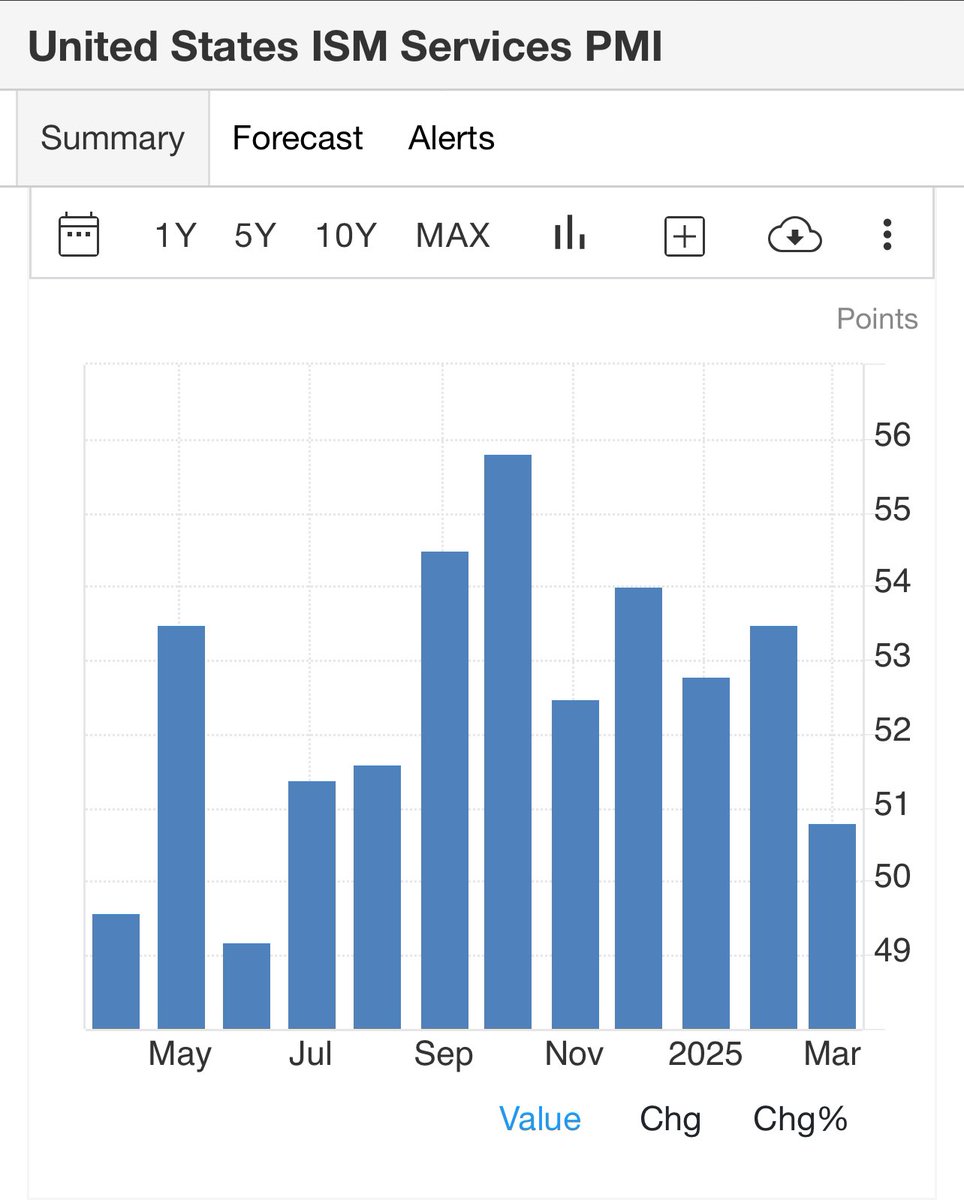
The ISM Services PMI fell sharply to 50.8 in March 2025 from 53.5 in February, well below forecasts of 53. The reading pointed to the softest expansion in the services sector since June last year.
The gauge for current economic conditions was also revised lower to 65.7 from 68.7 and the expectations subindex was revised down to 64 from 67.3.
The decrease in sentiment was unanimous across groups by age, income, and wealth.
The drop was led by a 19% plunge in buying conditions for durables, in large part due to fears that tariff-induced price increases are imminent.
Expectations for personal finances and the short-run economic outlook both declined almost 10%, while the long-run economic outlook fell back about 6% to its lowest reading since November 2023.
Meanwhile, inflation expectations for the year-ahead soared to 4.3%, the highest since November 2023.
The five-year outlook increased to 3.5% from a preliminary of 3.3% and above 3.2% in January, the largest mom increase seen since May 2021. source: University of Michigan
The University of Michigan consumer sentiment for the US was revised sharply lower to 64.7 in February 2025 from a preliminary of 67.8, reaching the lowest level since November 2023.
Prices accelerated primarily for motor vehicle insurance (+11.8% vs +11.3%) and recreation (+1.6% vs +1.1%).
Meanwhile, the shelter index increased 4.4%, the smallest 12-month increase since January 2022, easing from 4.6% in December.
Other indexes saw smaller price growth such as medical care (+2.6% vs +2.8%) and education (+3.8% vs +4%).
On a monthly basis, core consumer prices rose by 0.4%, the most since March last year, also above market estimates of 0.3%. source: U.S. Bureau of Labor Statistics
The annual core consumer price inflation rate in the United States, which excludes items such as food and energy, edged up to 3.3% in January 2025, from 3.2% in the prior month and surpassing market expectations of 3.1%.
Job gains occurred in health care (44K), retail trade (34K), and social assistance (22K) and government employment continued to trend up (32K).
The BLS said that wildfires in LA and severe winter weather in other parts of the country, had “no discernible effect” on employment in the month.
Meanwhile, the BLS published the annual benchmark revisions for 2024. The change in total nonfarm payroll employment for November was revised up by 49K to 261K and the change for December was revised up by 51K to 307K.
With these revisions, employment in November and December combined is 100K higher than previously reported.
Considering full 2024 however, payroll employment increased by 1.99 million, averaging 166K jobs per month, lower than 2.2 million or an average monthly gain of 186K initially reported. source: U.S. Bureau of Labor Statistics
Consumer sentiment fell for the 2nd straight month to reach its lowest reading since July 2024, with the gauge for current economic conditions falling to 68.7 from 74 and the expectations subindex declining to 67.3 from 69.3.
There was also a 12% slide in buying conditions for durables, in part due to a perception that it may be too late to avoid the negative impact of tariff policy.
In addition, inflation expectations for the year ahead soared to 4.3%, the highest since November 2023, from 3.3%.
This is only the fifth time in 14 years we have seen such a large one-month rise (one percentage point or more) in year-ahead inflation expectations.
Many consumers appear worried that high inflation will return within the next year.
Also, long-run inflation expectations ticked up to 3.3%, the highest since June 2008, from 3.2%. source: University of Michigan
The University of Michigan consumer sentiment for the US fell to 67.8 in February 2025 from 71.1 in January and below forecasts of 71.1, preliminary estimates showed.
The reading pointed to a slower expansion in the services sector, due to smaller increases in business activity (54.5 vs 58) and new orders (51.3 vs 54.4).
Also, inventories were in contraction territory for the third month in a row (47.5 vs 49.4).
On the other hand, employment (52.3 vs 51.3) and new export orders (52 vs 50.1) increased faster and price pressures eased (60.4 vs 64.4).
"Poor weather conditions were highlighted by many respondents as impacting business levels and production.
Like last month, many panelists also mentioned preparations or concerns related to potential U.S. government tariff actions; however, there was little mention of current business impacts as a result”, Steve Miller, Chair of the ISM Services Business Survey Committee said. source: Institute for Supply Management
The reading pointed to the first expansion in the factory sector after 26 consecutive months of contraction. New orders increased at a faster pace (55.1 vs 52.1) while a rebound was recorded for production (52.5 vs 49.9) and employment (50.3 vs 45.4).
Meanwhile, supplier deliveries were marginally slower (50.9 vs 50.1), inventories fell more (45.9 vs 48.4) and price pressures intensified (54.9 vs 52.5).
"The Prices Index indicated increasing prices for the fourth consecutive month, likely reflecting the agreement and deployment of prices by buyers for 2025.
Mill materials (steel, aluminum and copper), food elements and natural gas registered increases, offset by plastic resins and diesel fuel moving down in price", Timothy Fiore, Chair of the Institute for Supply Management Manufacturing Business Survey Committee said. source: Institute for Supply Management
The gauge for expectations was revised down to 69.3 from 70.2 and the current conditions subindex was revised lower to 74 from 77.9.
Meanwhile, inflation expectations for the year were unchanged at 3.3% (vs 2.8% in December), and the 5-year outlook was revised down to 3.2% from 3.3% (vs 3% in December). source: University of Michigan
The University of Michigan consumer sentiment for the US was revised lower to 71.1 in January 2025 from a preliminary of 73.2 and compared with 74 in December.