Vape merchants I see turned down most often leave every product line blank on the app so the underwriter has to hunt the site for tobacco details.
#TobaccoRetail
The companies shaping what’s next for money are heading to #Money2020Asia 2027. In other words? Your next partner could be in the room. 🤝
PSA: Just 3 weeks left to get your pass at the lowest rate of the year. Register now: https://t.co/j9aT445vt1
Big thanks to @HeyBilt for letting my jet-lagged self join their inaugural town square event to celebrate the launch of Bilt Neighborhood OS. A truly impressive event!
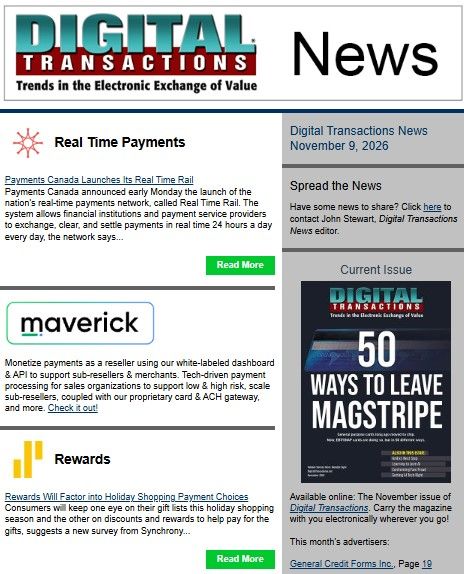
⏱️ QUICK TAKES: Picture a Canadian small business owner getting paid at midnight on a Sunday. Canada just built a national rail for exactly that.
The Real-Time Rail launched Nov. 9 with mandatory centralized fraud services from day one, a first for a G7 country, according to Payments Canada.
@TCHtweets SVP Jim Colassano is cheering on “our neighbors to the north” and sees 24/7 instant payments as the future for businesses and consumers.
Read how Canada built fraud defenses in before the first payment cleared. https://t.co/MD0oYjwXB7
Before matching your descriptor to the store name on nutra renewals, how many disputes were you seeing from unrecognized charges? Did adding the exact terms cut the ratio?
A hemp brand's site looked fine.
Underwriter still declined over the app.
No clear refund policy showed up in the first scan. They moved it front and center.
For two years, PYMNTS has tracked CFOs on a mission to get cash moving faster. Most of them pulled it off.
87% say their cash flow cycle improved, up from 71% the year before. AI got a seat at the table and started shaping where the money goes.
Then the music changed. Customers and suppliers started pushing back, and fraud showed up right on cue. Faster cash, it turns out, needs a bigger bodyguard.
Read the Time to Cash™ report from PYMNTS Intelligence and @jpmorgan to see where CFOs can find their next gains. https://t.co/GQYpRku7oG
Banks, stop treating a passed authentication check as proof a payment is safe.
“It doesn’t matter how sophisticated your authentication protocol is, if it’s actually me [the legitimate customer] who’s trying to initiate the payment,” @Paymentology CPO Stephen Bowe told PYMNTS.
Watch the full interview to find out what else banks should be checking. https://t.co/Dysc1Ee6JU
Vape shops lose carts when AVS demands an exact address match on every new order.
Buyers hit a wall and bounce before paying.
Loosen it for the first purchase only, then tighten if they come back.
An ecommerce merchant came to me after BFCM with chargebacks spiking from delays and unrecognized charges. They matched the descriptor and added shipping emails—has your friendly fraud followed that same pattern?
#Ecommerce
An ecommerce brand saw disputes jump right after BFCM. Shipping delays plus a descriptor that didn't match the store name turned every return into a chargeback.
Fix the descriptor and add clear shipping updates before the next rush hits.
@ClaraHessHere Yeah, the initial drop-off stings, but the bigger issue is issuers reading no challenge as added risk and hammering retries or later attempts. Cross-border just accelerates that. Watching retry metrics separately usually shows it first.
CBD brands get told to stack every check at checkout.
AVS must match exactly. 3DS on every card.
That keeps fraud out, but real buyers leave.
The contrarian files run the first order light, then tighten only on repeats.
#CBDBrand
The biggest AI model isn’t always the best security tool.
@PayPal SVP and Chief Information Security Officer Shaun Khalfan found that skills, workflows and business context can matter just as much. “A smaller model with the right context and guardrails can be more precise, faster and more useful,” he writes in a new PYMNTS eBook.
Find out what PayPal builds around its models that a bigger model alone would miss. https://t.co/9UfJ4Drhax
Small businesses are navigating a complex environment. How can the payments industry help them succeed?
Join ETA on Nov 18, for a webinar exploring the challenges facing small businesses and opportunities for the payments industry
https://t.co/NsQsS95qIV #Payments#Fintech
It’s 7 p.m. on a Wednesday in Manhattan. You can finally get away from work for that MRI. But MRIs typically only happen during business hours.
Superscript CEO and co-founder Rahul Naidoo says plenty of people would pay 40% to 60% more for an after-hours scan. “Why is no one providing that after-hours MRI?” he asks.
His answer is that patients can’t shop and prices aren’t broadly disclosed, so the demand never reaches the providers who could meet it.
Watch Naidoo’s full Monday Conversation with PYMNTS CEO Karen Webster to hear what disclosed pricing could change. https://t.co/EekLP6unis