I think it's even more complicated than that. Hard to define what a "top" college is (and by whose ranking) but let's go with a label that has a bit more consensus, such as, "highly selective" taken to mean a school that admits fewer than 20-25% of applicants. For them GPAs don't offer the same predictive utility, and as you wrote, part of that is restriction of range---but I think that misses the point to some extent because the restriction of range is precisely due to grade inflation such that these applicants are coming in with >4.00 GPAs at percentages unheard of less than a decade ago. UCLA is a good example. For recent cohorts, nearly 60% had GPAs above 4.0 vs. about 25% as recently as 2018. It's become very clear to researchers and perhaps even more importantly, faculty teaching freshmen year courses, that these GPAs have increasingly become divorced from actual academic competence. Add to that that every other more standardized metric of aptitude has been generally flat, you then have start thinking of GPA as a less useful predictor. What about lower tiers of selectivity, such as those in the 25-50% admissions rate and those above 50%? It goes as predicted. For highly selective institutions, SAT/ACT scores are 3-4X better predictors than HSGPA. For just "selective" it becomes more even, but the truth remains that using both metrics is still far superior to using HS GPA alone. And a note of caution: many studies that promoted GPA as a better predictor suffer from survivorship bias, such that college students who dropped out during their first year are not adequately taken into account (sometimes they are treated as missing date and then have their data imputed---which is full of problems as well)
@iosif_lazaridis@DAMendelsohnNYC This. For Greeks this word doesn't have the ambiguity that many translators seem to be wrestling with. If we say someone's tropos, the characteristic way someone goes about something, behaviorally, stylistically, etc..
I have a lot of hope and optimism about our young men. Navigating a changing world and conflicting messaging about how to be a man today is not an easy feat these days. But I think people are starting to move past the ideological traps society has placed on them.
A Response to Pearson's recent piece in https://t.co/luP4dgjpHg: Are boys really in crisis? What the science says in the age of the manosphere https://t.co/ESf7z8GEGZ
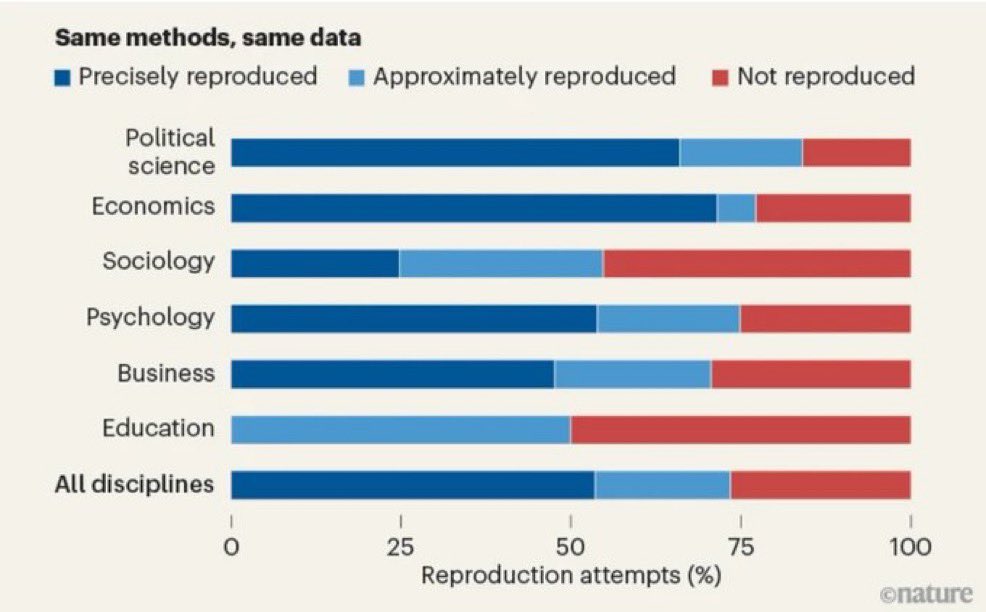
type of research that is has gained in popularity in schools of ed is also an issue. I'm a quant guy, but I have a lot of experience with ed research and there's been a big shift into qual research---particularly phenomenological which by it's nature is going to fare poorly on replication.
@marcportermagee Just to be clear because some of the replies seem to be confusing replication with reproduction. Reproducibility = consistent analytic results using the same data, analysis, methods, etc. Replicability = consistent results across studies on the same question, different data.
I will be a guest tomorrow (Friday) on Airtalk on 89.3FM (for those in Socal) and https://t.co/COStYvzcH5 for the streaming feed. I think I'm kicking off the show at 9am...in studio in Pasadena. Topic? A bit nebulous. Producer told me to be ready to discuss masculine identity and its influences. Ready to push some buttons and trigger some nerves to end the week? Tune in to find out.
My friend, colleague and all around great guy Dr. Matt Englar Carlson will be a guest on Airtalk with Larry Mantle (89.3FM for those in SoCal and https://t.co/COStYvzcH5 for the live feed) 10am PST tomorrow, Wednesday. He will discussing issues around challenges young men face in the transition to college.
"This is not a partisan issue, everybody can recognise a society where so many of our boys and men are struggling is not good for anybody," Richard Reeves of The American Institute for Boys and Men tells #PoliticsLive
https://t.co/nuEL4pMix3
Beyond the great reception & engagement, I got to hear some great ideas from the people who, ultimately, are the ones that will make the difference on the ground, in the classrooms, in the schools where the work will happen. @menincollege@aibm_org
2 wks ago I had the privilege of delivering the keynote address to the Puente Project's Spring gathering to discuss the challenges boys and adolescents are facing. Puente is a superb program designed to improve college admissions. @menincollege@aibm_org
We had over 200 teachers from 40+ schools in attendance. The workshop that followed had some 80 additional participants. I was really heartened by the earnest response & clear desire to improve the recruitment of boys into the program. @menincollege@aibm_org