Personal reflections of a global citizen, educator, policy enthusiast & nature lover, Vice-Chancellor, U of Western Australia🇦🇺, 10th President, UWO 🇨🇦.
Canadians are only now realizing the potential of liquefied natural gas exports after the global supply disruptions experienced this year, says Daniel Yergin, vice chairman of S&P Global https://t.co/kSEvH4PpVp
I gave this speech to the recent social cohesion summit on why anti-immigration sentiment has increased to a degree that Hanson is more trusted on migration management than Labor or Coalition. https://t.co/Q54OMESrAY
The story of Jan and Judy Johnson, the grandparents of Michigan Senator-elect Abdul El-Sayed, is a wonderful tale of humanity's best - it is worth a listen.
https://t.co/0FAP4CdbvQ
Budget 2026 sets new temporary arrivals at 370,000 a year from 2027 to 2029, down from 686,000 in 2024.
Permanent admissions hold at 380,000 a year, and up to 200,000 temporary residents already here could become permanent by the end of 2027.
Delighted to meet Katie Gratton and Stephanie Kwan, exchange students from Western University, one of my favourite universities, at the garden beside the Vice-Chancellery. I was pleased to be able to make UWO's signature "W" sign with them. @WesternU@westernuAlumni
Opinion: Stanford’s main investment pool returned 31.7 percent. Harvard’s endowment grew by more than $11 billion. Yet both have made cuts. In this essay a former endowment investor explains why a gain on paper is not the same as money in the budget. https://t.co/oNZGFEx0no
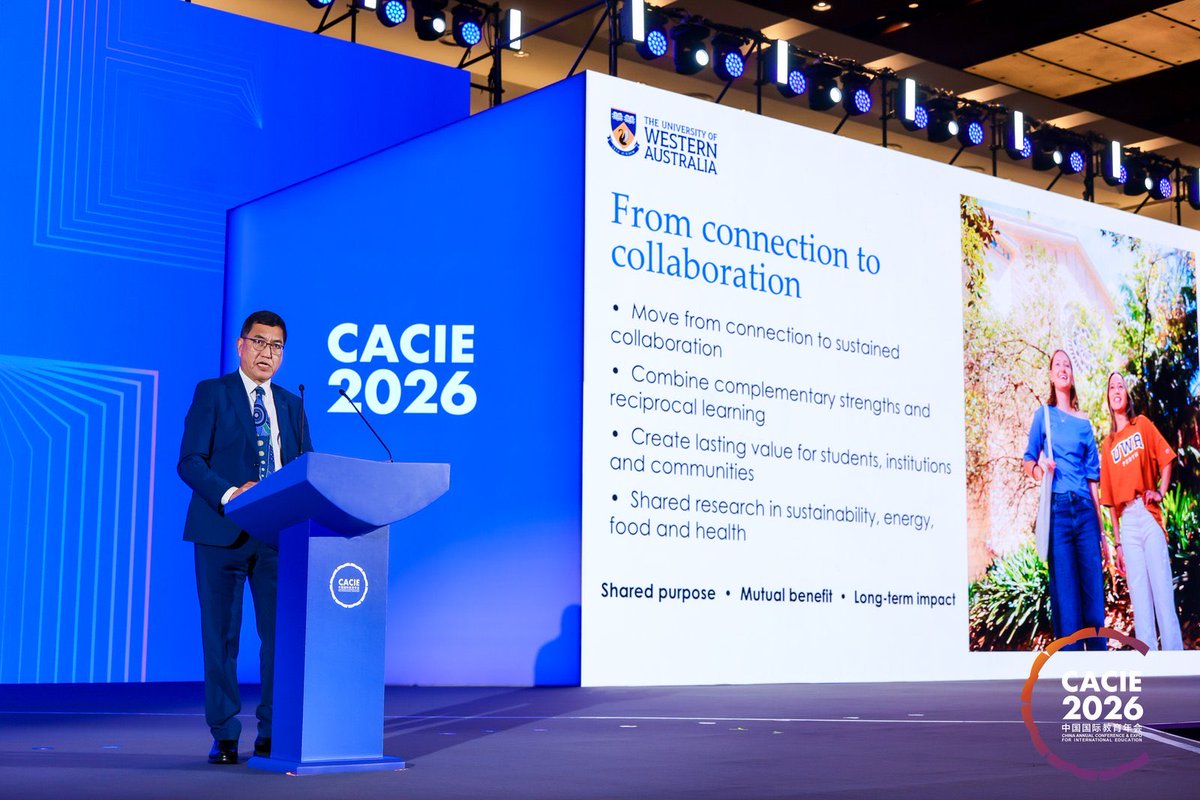
Honoured to deliver a keynote address at the 2026
China Annual Conference for International Education in Beijing. Thank you, CACIE, for the invitation to speak.
“Mines don't last forever”.- Gina Rinehart. Let’s use our resource endowment as a lucky break to build an innovation-based, advanced Western Australian economy before we run out of it.
Gina Rinehart’s Hancock Iron Ore generated a healthy net profit for the 2026 financial year as Australia’s richest person warned policymakers that ‘mines don’t last forever’.
https://t.co/IV11pK3wX6
"WA needs a top-ranking university that can compete for top talent. A merger could give us just that"
"It is also an opportunity for the government (state) to engage more strategically with the University moving forward".- Emeritus Professor Tony Wright
https://t.co/Gh4FErt6yf
Notwithstanding the current wave of ill-conceived and politically motivated targeting of immigrants for all ills caused by govt. policy failures, the world needs Indian immigrants for economic growth - the only solution to the economic woes we face today
https://t.co/P8cI221GKQ
“The Asian century is no longer a forecast; it is already here.
In 1996, Asia accounted for about 29% of global GDP. Today, it is about 40% and contributes 60% of global GDP growth. By 2050, the Asian Development Bank sees it at 52%.” - Dominic Barton.
https://t.co/Ma71XIg5Dm
“Between 2015 and 2024, the federal public service grew from approximately 257,000 employees to nearly 368,000—an increase of 43 per cent.” - This is beyond belief! Thank you @Sean_Speer for making a compelling case!
Mark Carney confronts the federal public-service unions
Mark Carney deserves support as he confronts the federal public-service unions. After the extraordinary expansion of government employment under his predecessor, restraint is overdue.
The Public Service Alliance of Canada announced this week that it will hold strike votes for 120,000 federal employees, beginning Nov. 16. The dispute reportedly involves wages, job security, remote work, and protections concerning artificial intelligence. A strike vote, of course, doesn’t guarantee a walkout, but the union is preparing to increase the pressure.
Carney should hold the line. And if he does, Conservatives (and conservatives) should support him.
The starting point is to distinguish the civil service from the unions representing its employees. The civil service is a noble and necessary institution. Its traditions of professionalism, impartiality, and public service deserve respect. Its interests aren’t identical to PSAC’s.
As my former boss Stephen Harper used to say, government employs people to deliver services and discharge public responsibilities. Providing employment itself isn’t its purpose.
Between 2015 and 2024, the federal public service grew from approximately 257,000 employees to nearly 368,000—an increase of 43 percent. Are Canadians supposed to assume that government became correspondingly more effective?
The broader productivity evidence points in the opposite direction. Economist Stephen Tapp’s research finds that government-sector labour productivity declined by an average of 0.3 percent annually over that period, while business-sector productivity grew.
As I argued in a 2024 paper for the Public Policy Forum, layers of approvals, outdated technology and cumbersome processes can consume resources while frustrating public servants and the people they serve. Boosting state capacity requires changing how it works rather than adding more people.
PSAC president Sharon DeSousa says the union will not let the government find savings “on the backs of workers.” But where, precisely, should savings come from if compensation, staffing and working arrangements are all treated as beyond serious reconsideration?
Taxpayers are workers too. They have families to support and their own employment uncertainties. Their interests deserve representation.

The strike threat also exposes a problem with labour relations in government monopolies. Canadians cannot obtain a passport from a competitor. That strengthens the case for resolving disputes through binding arbitration rather than withdrawing services from people who have nowhere else to go.
Public servants deserve fair compensation and fair treatment when their positions change or disappear. But preserving every existing job cannot be the overriding objective.
We should neither disdain public-sector employment nor lionize it. It’s a means to an end. If government can deliver those ends better and more cheaply with fewer people, it has an obligation to the rest of us to do so.
Carney can respect public servants while insisting on a smaller, more effective administration. Indeed, defending the institution’s performance and public standing requires him to resist the union’s demands.
The European Union and Canada will endorse an unprecedented alliance at a summit next week, cementing plans for associate EU membership for Ottawa as both reduce their dependence on the US. https://t.co/tSWpe5d4YH
“Institutional interests are
not a relevant factor.”
“In the long term, however, it
is the interests of future gener-
ations of the people of WA and
Australia that matter most.”
- Hon. Robert French AC
https://t.co/cTaz8sSgVm
As WA’s oldest and flagship university, UWA has links to most WA leaders, including many critics of the merger proposal, such as Professor Andrew Deeks, VC of Murdoch University.