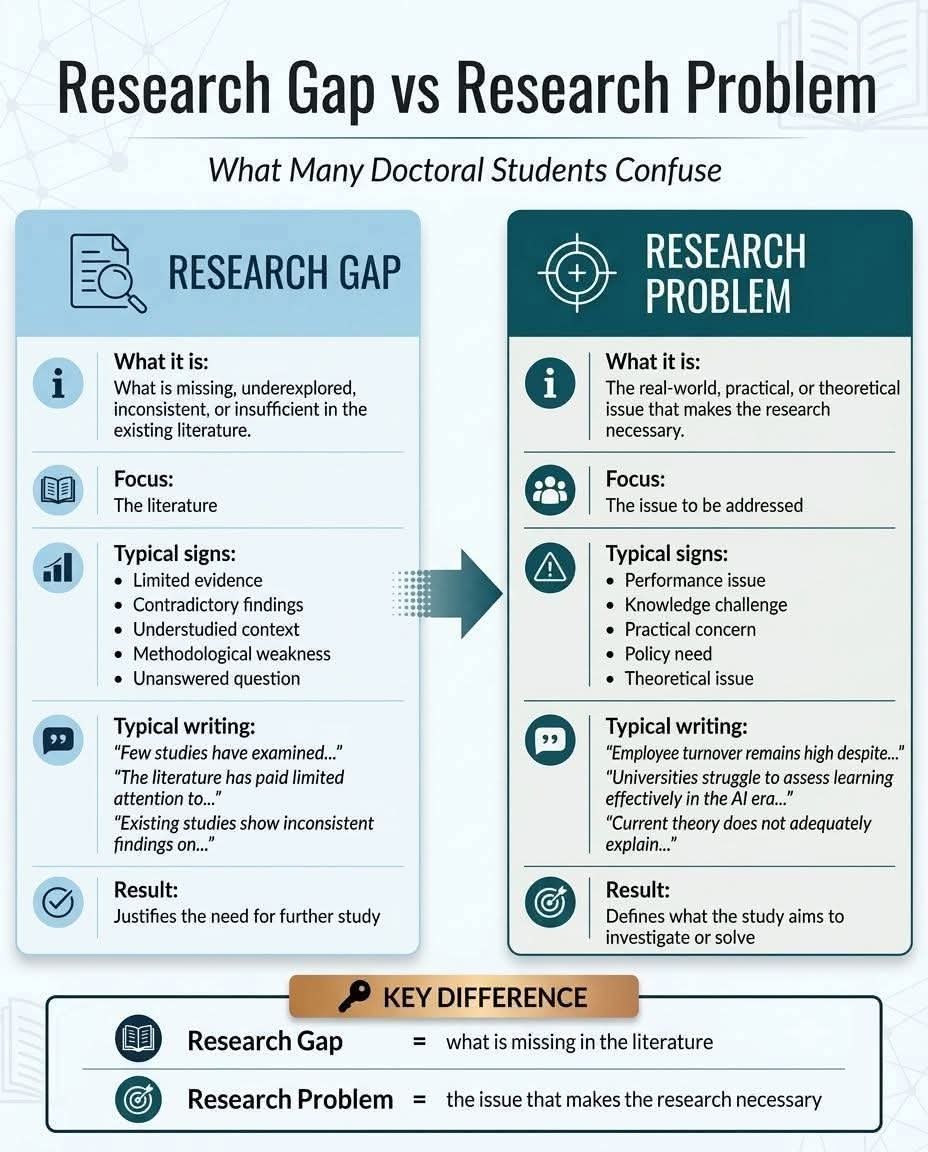
Unfortunately, not all areas of study show real world problems requiring practical solutions. Many areas of research are inherently theoretical, yet classified as research for which identifying research gaps are sufficient as substantial contributions the literature.
🎓 Research Gap ≠ Research Problem
A research gap is what is missing in the literature. 📚
A research problem is the real-world or theoretical issue that needs to be addressed. 🎯
In short:
🔹 Research Gap → What we don't know.
🔹 Research Problem → What we need to solve
#PhD
I strongly disagree with the proposals in this thread. Rejecting papers because the author "lacks a publication record or credentials in the research area" is the worst form of gatekeeping. It violates the first Mertonian norm: universalism. And requiring "oral examinations" for arXiv authors is absurd.
Even with 20+ peer-reviewed Journal publications, I wouldn’t endorse shutting the door on first time and unaffiliated authors who need some mentoring and guidance from reviewers. One useful approach is to recommend submitted manuscripts for major revisions so they improve.
We are seeing a new trend in submissions to @arxiv (and presumably to conferences and journals): Authors submitting papers whose contents they likely do not understand. 1/
MIT published a brutally honest report on what AI is doing to students.
A committee of professors and students spent five months studying how AI changed learning on campus, and the findings read like a warning to every university on the planet.
Study groups are disappearing. Office hours are emptying out. Problem sets and take-home exams no longer prove anything, because AI can produce credible solutions to almost any written assignment in the undergraduate curriculum. Students who lean on chatbots lose mastery and confidence, and some slip into what the report calls cognitive surrender, reaching for AI at the first hint of struggle.
The numbers are rough. 46 percent of surveyed MIT undergrads use LLMs daily. 90 percent worry about their own overreliance. Undergrads who feel AI makes them replaceable now outnumber those who feel it makes them capable.
The committee's answer surprised me. They refused to fight AI with surveillance. The report calls AI detectors unreliable, says lockdown browsers feel like spying, and warns that policing students builds a classroom atmosphere of mutual distrust.
Instead, MIT wants to rebuild education around the things AI can't replace. That means oral exams, semester portfolios, in-person project work, and a required social component in every subject. The report even floats the idea of rethinking grades entirely, since without a GPA to optimize, much of the incentive to cheat with AI evaporates.
The committee warns professors against replacing undergrad research assistants with AI agents just because they're cheaper, because a university exists to grow people, not output.
The most famous tech school on earth admitted the machines broke its way of teaching. Its answer is more humans, not more software.
An interesting read! I have always maintained among colleagues that the war against AI cannot be won by Professors. They should harness AI’s usefulness, while refining standardized testing cum course evaluation methods to minimize its use by students.
MIT published a brutally honest report on what AI is doing to students.
A committee of professors and students spent five months studying how AI changed learning on campus, and the findings read like a warning to every university on the planet.
Study groups are disappearing. Office hours are emptying out. Problem sets and take-home exams no longer prove anything, because AI can produce credible solutions to almost any written assignment in the undergraduate curriculum. Students who lean on chatbots lose mastery and confidence, and some slip into what the report calls cognitive surrender, reaching for AI at the first hint of struggle.
The numbers are rough. 46 percent of surveyed MIT undergrads use LLMs daily. 90 percent worry about their own overreliance. Undergrads who feel AI makes them replaceable now outnumber those who feel it makes them capable.
The committee's answer surprised me. They refused to fight AI with surveillance. The report calls AI detectors unreliable, says lockdown browsers feel like spying, and warns that policing students builds a classroom atmosphere of mutual distrust.
Instead, MIT wants to rebuild education around the things AI can't replace. That means oral exams, semester portfolios, in-person project work, and a required social component in every subject. The report even floats the idea of rethinking grades entirely, since without a GPA to optimize, much of the incentive to cheat with AI evaporates.
The committee warns professors against replacing undergrad research assistants with AI agents just because they're cheaper, because a university exists to grow people, not output.
The most famous tech school on earth admitted the machines broke its way of teaching. Its answer is more humans, not more software.
The future of North Carolina’s classrooms starts with the educators who lead them.
I got to hear directly from impressive students like Sawyer about what inspires them to pursue teaching. It was encouraging to hear their perspectives and see the work happening at UNCG to prepare North Carolina’s future educators.
The Spartan family keeps growing! 💙💛
More than 2,700 new students are joining UNCG this fall, bringing total enrollment to 19,078, the University’s largest student body in five years.
Read more: https://t.co/ObIEBIONpG
Some have certainly done this, but it’s far from the benchmark advising style. It’s crucial to get to know your students strengths and weaknesses & support them to develop & succeed.
The Spartan family keeps growing! 💙💛
More than 2,700 new students are joining UNCG this fall, bringing total enrollment to 19,078, the University’s largest student body in five years.
Read more: https://t.co/ObIEBIONpG
Research shouldn’t wait until graduate school. Encourage younger students to ask questions, explore ideas, work with mentors, and get involved in research early. Today’s curious student could become tomorrow’s scientist, innovator, & problem solver.
After returning to school 30 years after earning her undergraduate degree, Dawn Gaug found her calling in library outreach.
Today, she’s taking story time and early-literacy programs on the road through the Person County Public Library Book Mobile.
https://t.co/7oX3xPFUBB
@UNAIDS 2026 fact sheet: 74% virally suppressed, 10.7M PLHIV not virally suppressed, that's systemic: people not reached with testing, linked to care or getting treatment support.
The Political Declaration promises 38M suppressed by 2030. PLHIV hold the commitment to account.
The decline of Nigeria is a major lesson on how not to run any enterprise. Wealth without enterprise, the rot in public service & the primitive accumulation of wealth by the politicians led to this horrifying reality.
Two brothers left MIT and Georgia Tech, came back to India, and raised the largest private drone funding in the country's history. Their UAVs were deployed during Operation Sindoor. Not a single component inside them is Chinese.
Their names are Vikash and Vivek Mishra. Vikash trained in aerospace engineering at MIT, with stints at Idaho National Laboratory and CERN. Vivek holds a PhD in electrical and computer engineering from Georgia Tech. In 2016, while both were still students abroad, they decided to build what India had never built: fully indigenous, combat-ready drones with zero dependency on foreign components.
They founded Raphe mPhibr in Noida in 2017. Not with a product. With a question.
For the first three to four years, they built nothing. They spent that time in the field, studying exactly what India's armed forces needed across different terrain, weather, and combat conditions. "We focused on both research and manufacturing," Vivek said, "because we didn't want to be constrained by what already existed."
They started in a 2,000 square foot facility. Today they operate a 650,000 square foot integrated manufacturing and R&D complex with 600 employees, offering nine drone models, the mR10 swarm, the mR20 for high-altitude logistics, the X8 for maritime patrol, and the Bharat man-portable surveillance system. Every component: flight controllers, batteries, airframes, navigation systems is designed and manufactured in India.
The Indian Army, Navy, Air Force, Border Security Force, CRPF, and ITBP are all active customers. In June 2025, Raphe raised $100 million in a Series B led by General Catalyst, bringing total funding to $145 million; The largest private drone raise in India's history.
India tripled its drone budget to $470 million in the months following Operation Sindoor.
Raphe mPhibr already has the facility, the fleet, and the orders to fill it.
@VivekMishra___@Raphe_mPhibr
Why on earth would we want to attack one of the major pipelines for human talent into the U.S.? What purpose does that serve?
I’m all for reform and amendment but don’t end H-1Bs.
So many founders who have risen to the top of their fields and built leading companies that employ and enrich Americans came here to study and ended up on H-1Bs.
We should absolutely prioritize people who studied here, want to build their careers here, and want to build companies here.
Have just arrived the US. These days travel reminds me of who we used to be. When I first traveled to the UK in the early 70s.I did not have to have a visa from Lagos. Our Asian friends still enjoy that privilege. Some of my friends used to finish class on Friday fly overnight to London go shopping on Saturday, party all night, get on a flight on Sunday and be in class on Monday. Which undergrad would contemplate that today.
The international community punishes people from countries that have not been well governed. Visa requirement is usually a first test. So when I hear the swag of those who talk about experience I want to remind them that their experience devalued Nigeria.
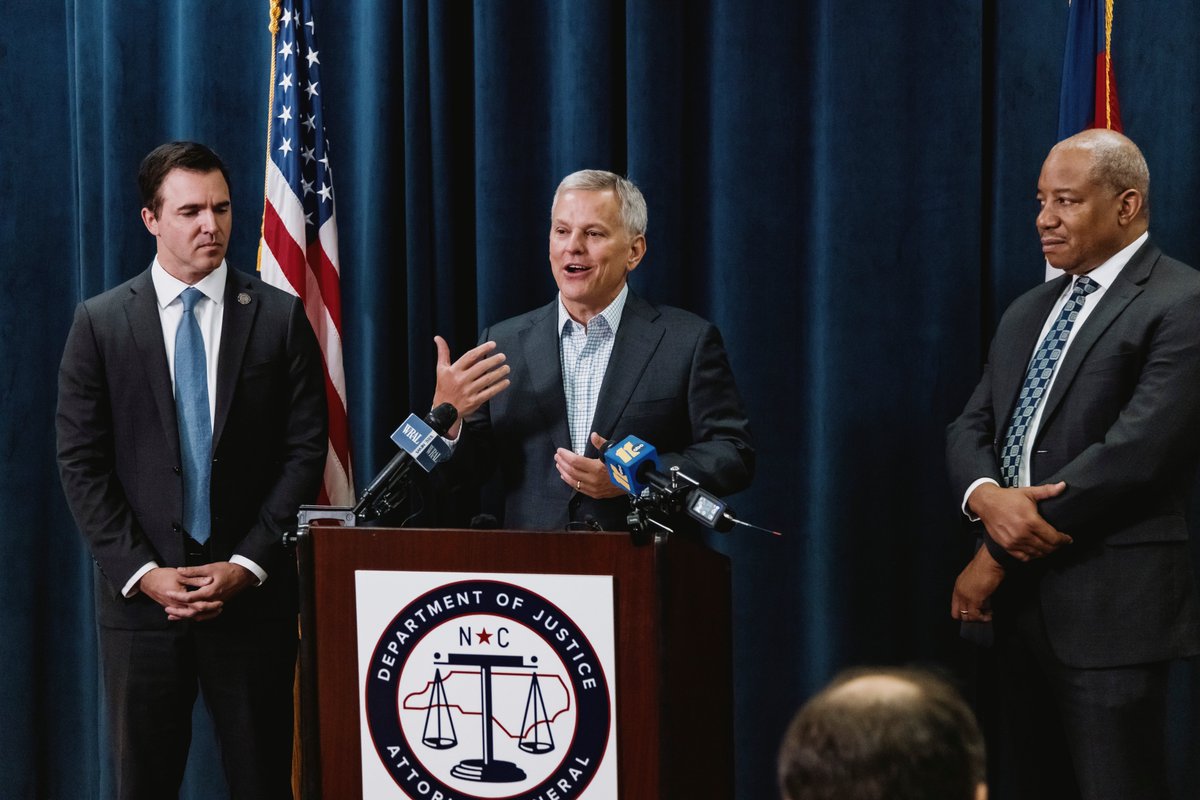
As Attorney General, I took Meta to court in 2023 for knowingly addicting our kids to its applications. Today, NC DOJ announced a settlement that requires Meta to make meaningful changes to its apps to better protect kids and pay North Carolina up to $645 million.
I look forward to working with the General Assembly, NC DHHS, the Department of Public Instruction, and the DOJ to identify the best ways to use these funds to support teens’ mental health.
Today, AG @JeffJacksonNC announced a landmark $645M settlement with Meta alongside @NC_Governor and @MoGreenNCDPI. Meta will make major updates to protect teens, including a two-hour time limit and nighttime blocks on Instagram and Facebook. https://t.co/wp19lTcduD
Research is a global enterprise. For collaboration on accelerating the discovery of new interventions for improving the health of older adults with comorbidities such heart diseases, substance use disorders, or anxiety disorders & living with HIV, please reach out on this thread.