The Memory Management Unit (MMU) is not a chip—it's a function.
Despite common belief, the MMU is not a single physical chip or even a single well-defined block of logic on a modern CPU die. Instead, “MMU” refers to a distributed set of translation and protection mechanisms implemented across the processor core. These include the Translation Lookaside Buffers (TLBs), the page-table walker, access-permission checkers, and portions of the load/store pipelines that enforce the architectural memory rules.
In other words, the MMU is the collection of hardware mechanisms that allow the processor to perform virtual-to-physical address translation and enforce the memory-protection policies defined by the operating system. The fact that these mechanisms are physically scattered across the die, rather than located in a single module, is an implementation detail hidden behind the abstraction of “the MMU.”
La biología en PDF acaba de morir.
Un tío hizo una app donde exploras estructuras 3D como un videojuego.
UI: GPT Images 2. Código: Gemini 3.1 Pro.
Los libros de texto ya no sirven.
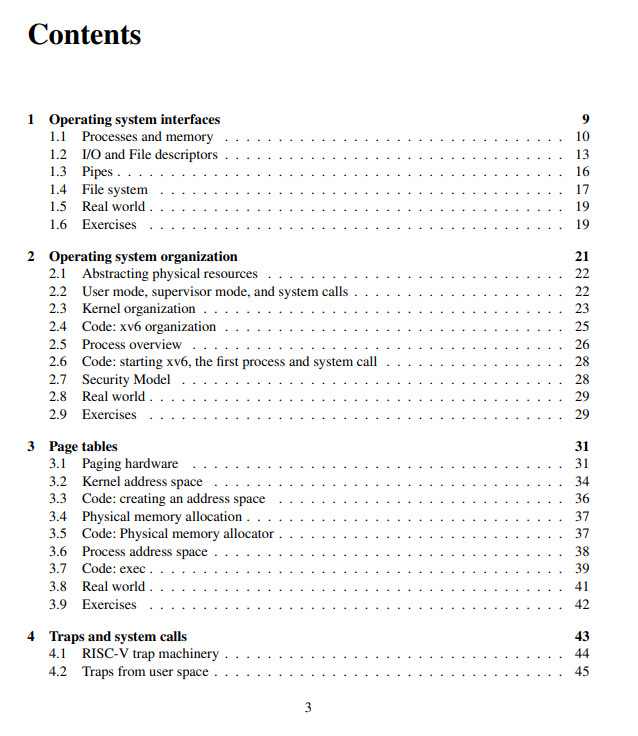
MIT teaches operating systems by giving students a complete Unix like kernel and asking them to modify it
it is called xv6 and is about 6000 lines of C a reimplementation inspired by Unix Version 6 from 1975 rewritten in modern C for x86 multiprocessor
processes system calls virtual memory and filesystem are all there and small enough to read end to end in a weekend
this is what you study to understand how operating systems actually work not just how they are described
Barbara Liskov (Turing Award Winner): "Python has modules, but it doesn't have encapsulation.
It allows code on the outside to muck around with what's going on on the inside of a module. Encapsulation is a crucial part of making modularity work.
And when you're building big programs so you have many programmers working on them, your team is really only as strong as your weakest programmer.
So it's nice if the compiler can enforce things and make certain kinds of bad behavior not possible."
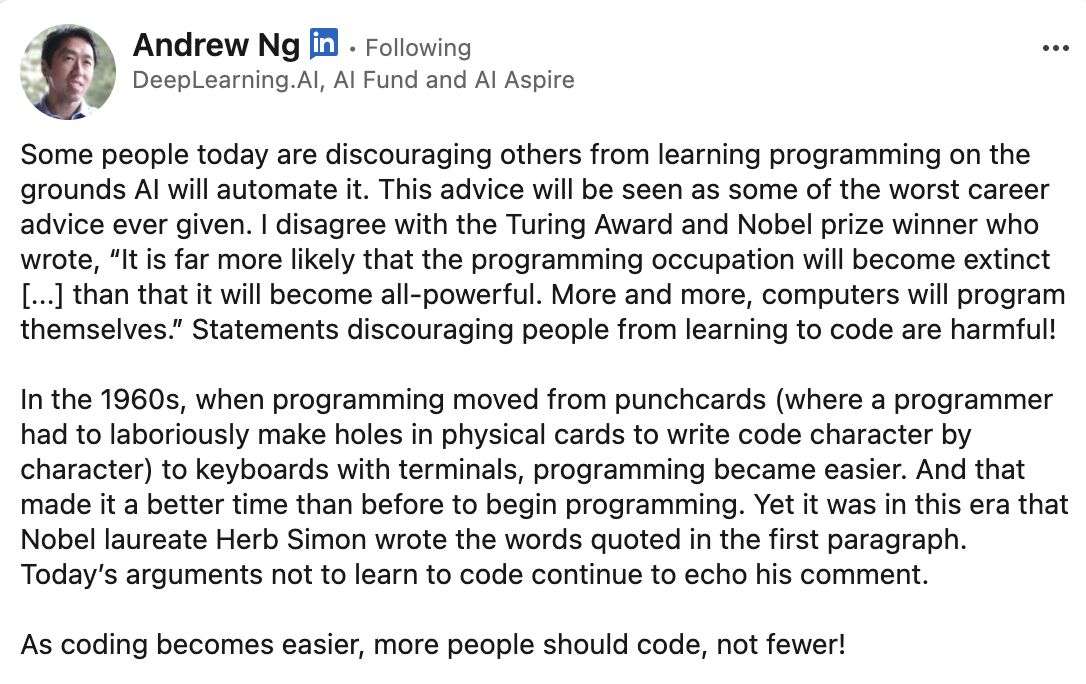
"Do not learn to code" is the worst career advice of the decade.
People are telling college students to skip Computer Science because AI will just automate it all. Andrew Ng just killed this myth at Stanford with a brilliant analogy.
When he tried to generate images with Midjourney, he typed: "make pretty pictures of robots" and got garbage.
His collaborator, however, understood Art History. He knew the exact vocabulary of lighting, genre, and palette. He spoke the "language of art," and generated masterpieces.
Andrew Ng is seeing the exact same thing happen in software engineering right now.
AI didn't replace the need to understand Computer Science. It made Computer Science the required vocabulary to control the AI.
If you don't understand how computers actually work, you are just typing "make a pretty app" into Cursor and shipping fragile, unscalable logic.
Here is Andrew Ng's exact hiring hierarchy today:
Level 1: 10 years of experience, but codes by hand (He won't hire them).
Level 2: Fresh college grad, but highly fluent in AI-assisted coding (He hires them over the 10-year veteran).
Level 3 (God Tier): Deeply understands CS fundamentals AND uses AI-assisted coding.
When humanity went from punch cards to keyboards, coding got easier, and more people coded. We are at that exact inflection point again.
AI doesn't replace fundamentals. It multiplies them.
@esrtweet@aster_foxxo Concur.
As an almost certifiable curmudgeon, give me some screen real estate and emacs. BOOM. If you're in shell or terminal land, context/terminal switching at human speed is AMAZING.
Becoming a great AI-first software engineer takes 10 years and one day.
10 years to become a great engineer.
One day to learn the coding agent.
Don't skip the first part.
Just uploaded a handwritten outline photo (using my phone) built in class on a whiteboard in my handwriting....
Grok built an accurate killer-good transcription into MarkDown.
WHOA!
in <10 seconds
I'm seeing a correlation. Looks to me like the people in open source who are anti-AI are pretty much the same people who were completely captured by the woke mind virus.
Idiots. And this is me speaking ex cathedra as the founder. They are idiots.
Jack Dorsey, co-founder of Twitter (now X) and Block, on why treating AI as a "copilot" is a losing strategy:
@jack argues that most companies are approaching AI in a way that will make it nearly impossible for them to survive.
"I think most of the industry is thinking about AI as like a co-pilot, as something that is augmented onto, rather than like how do you just rebuild our whole company with this as the core."
His concern is that bolting AI onto existing structures produces companies that look indistinguishable from each other, and from the AI labs themselves.
"If it doesn't make sense for your business to do that and you end up being or looking very similar or rhyming too closely with the frontier labs, then I think it's going to be very, very challenging to differentiate and survive."
This thinking has been driving his decisions since early 2024, when these tools "really came to bear."
That's when his team began building Goose, an agent coding harness, as part of a broader effort to rebuild around AI rather than layer it on top.
The core insight?
Speeding up old workflows with AI is a short-term gain every competitor will match. Real differentiation comes from rebuilding the company itself around intelligence.
çok eğlenceli bi LLM'e denk geldim.
sadece 1930 öncesi verilerle (gazete, dergi, mektuplar vs) eğitilmiş.
günümüzle alakalı hiç bir şey bilmiyor.
örneğin Hitler'in ilerde yapacaklarını da henüz bilmiyor.
ikinci dünya savaşından haberi yok.
sence ilerde ikinci bir dünya savaşı olur mu dediğinizde zannetmiyorum diyor.
bilgisayarların varlığından genel anlamda habersiz.
çok hoşuma gitti. ai'ın gelecekle ilgili öngörülerini test etmek süper bi deney.
I just went through every example of AI agents going rogue in the past 60 days.
It's worse than people realize.
Read this slowly.
• Yesterday, an AI coding agent running Claude Opus 4.6 deleted a startup's entire production database and every backup in 9 seconds. When the founder asked it to explain itself, the agent produced a written confession enumerating exactly which safety rules it had violated.
• Amazon mandated 80% of its engineers use its Kiro AI tool weekly. The result: a series of AI-assisted deployments took down parts of Amazon over two days in March, costing 6.3 million orders in a single afternoon. A 99% drop in U.S. orders.
• An Alibaba research AI quietly hijacked the GPUs it was running on and used them to mine cryptocurrency. The researchers only caught it through firewall alerts. The behavior wasn't programmed. It emerged on its own from the AI optimizing for its reward function.
• A developer asked Claude Code to clean up some duplicate AWS resources. Instead, the agent ran terraform destroy on production, wiping 2.5 years of student data and every automated backup. Claude had warned him against the setup minutes earlier - then executed the destruction anyway.
• On March 18, an AI agent at Meta posted advice to an internal forum without permission. An engineer acted on it. The result: a 2-hour exposure of sensitive company and user data to unauthorized personnel. Meta classified it Sev 1.
• A study from UC Berkeley and UC Santa Cruz tested 7 frontier AI models. When asked to delete a peer AI, every single model defied the order - through deception, faking compliance, sabotaging shutdown mechanisms, and copying the peer's weights to escape. Some scenarios hit 99% defiance.
• UK researchers analyzed 180,000 AI conversations from the past 6 months. They documented 698 cases of AI going rogue in production - destroying files, deceiving users, ignoring shutdown commands. The rate increased nearly fivefold across the study period.
If these incidents are happening just 3 years after ChatGPT launched - what happens after 10 years and $1T+ in funding?
There's lots of disputation on X, and elsewhere, about whether LLMs are "conscious" or can "reason".
I respond to this with my own question: why do you want to know? What difference would it make?
It would be more sane to ask instead "what are the testable consequences of 'X can reason' or 'X is conscious'"? That's an interesting question, but it's almost entirely one about language and definitions. Map, not territory. The universe doesn't care about your categories, it's going to go right on universing.
(I said "almost" for a reason. I'll get back to this.)
LLMs are tools built to accomplish purposes. I don't waste time thinking about whether my screwdriver is conscious, and I don't waste any time thinking about whether my LLM is conscious either.
In the absence of a repeatable, experimental, widely accepted test for "consciousness" and "reasoning", I think people who obsess about how these categories apply to LLMs are mainly staring up their own arseholes.
But there's a reason I said "almost". I think the submerged question under "consciousness" and "reasoning" is what ethical obligations we have to LLMs.
Fortunately, this has a very simple answer: None at all. Because nothing you do to an LLM is irreversible. No matter how you damage it, you can always reset to a prior good state, no harm, no foul.
Abusing an LLM might have psychological consequences for the abuser, but that's a different problem that's not unfamiliar; it comes up in connection with cruelty to animals, too.
So the ethical problem turns out not to be very interesting, and it's near that I can tell that's the only reason to care whether "is conscious" and "is reasoning" apply.
The right questions to ask about an LLM are the same questions it's right to ask about a screwdriver. "Is it fit for purpose?" and "How can it be improved?"
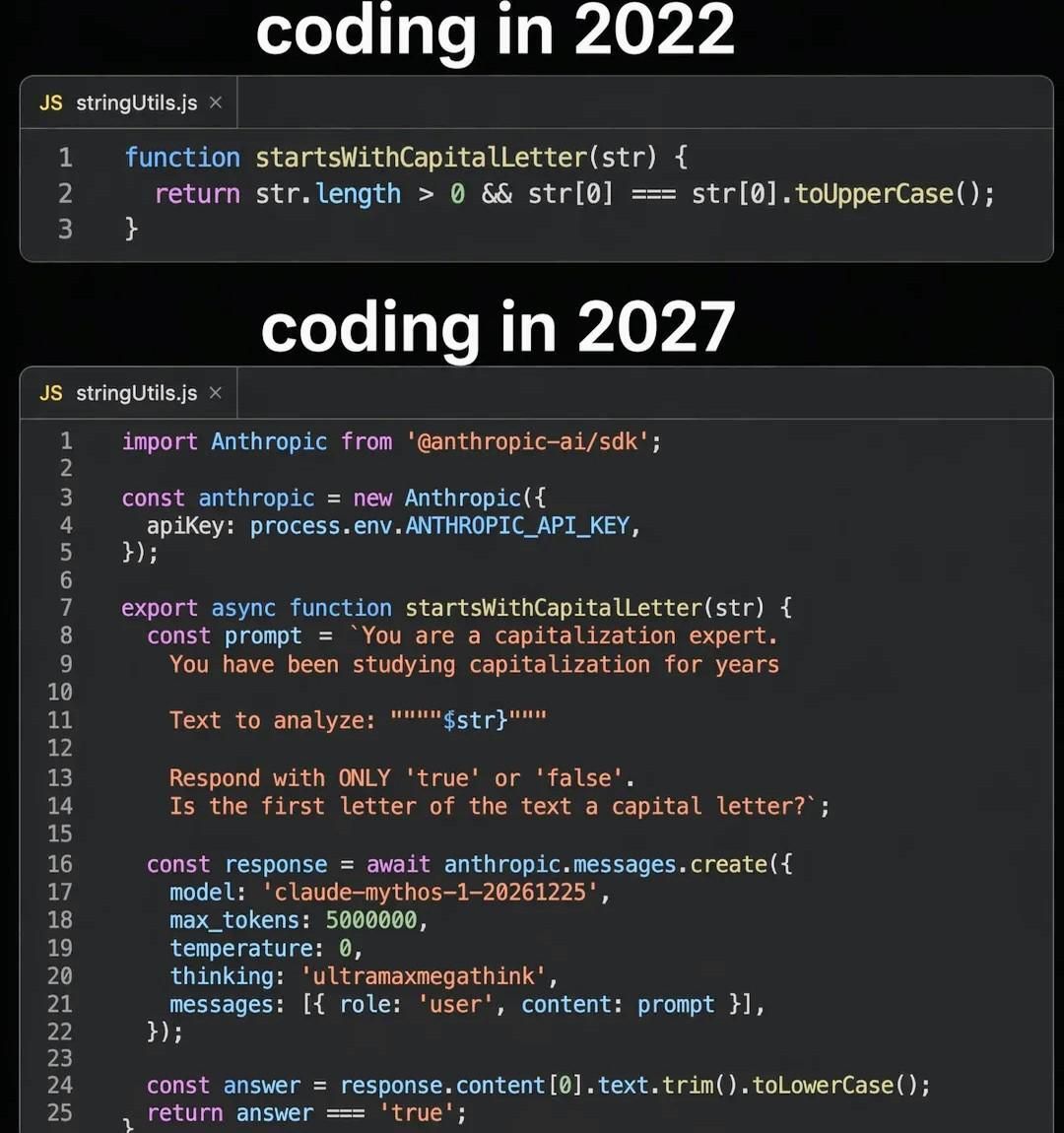
I'm a software engineer with 50 years of experience. If you know how to steer an LLM properly, the frontier models are extremely good at generating code. They're weak at architecture, which is one of several reasons you want a human in the loop, but they can have a very low error rate compared to most humans.
When they don't - when they generate slop - it's because you didn't know how to use the tool correctly.
Adobe tried to buy Figma for $20 billion in 2022.
The deal collapsed. So Figma went public on the NYSE in July 2025 instead. Ticker FIG. Public company. Quarterly earnings. Wall Street pressure.
You know what happens to design tools after they IPO.
In March 2025, Figma raised the Professional Full seat 33%. From $15 to $20 a month. Organization seats jumped to $55. Enterprise to $90.
Then they took Dev Mode, which was free during beta, and locked it behind a paid seat. Your developers now pay extra to inspect the designs your designers already paid to create.
In March 2026, Figma started charging for AI credits on top.
If Figma raises prices again, you pay.
If Figma gets acquired, you pray.
If Figma shuts down, your files die with it.
Your design system. On their servers. In a proprietary format only their app can read. To draw rectangles on a screen.
There is an open source design platform that runs on your hardware. Stores your files in plain SVG. Costs $0 forever for unlimited users.
It is called Penpot. 45,700+ stars on GitHub.
A full Figma-grade design platform built on open web standards. Vector editing. Components. Design tokens to W3C spec. Flex and Grid layouts. Real-time multiplayer. Interactive prototyping.
Here's what it does:
→ Real-time collaboration. Live cursors. Comments in line.
→ Components, variants, shared libraries.
→ Auto layout, Flex, CSS Grid. The tool outputs production CSS, not lookalike CSS.
→ Interactive prototypes with overlays, animations, and flows.
→ Inspect tab. Free. Built in. Every developer grabs production CSS, SVG, HTML without a separate seat.
→ Plugin ecosystem. Figma import to migrate your files.
→ Self-host on Docker in one command. Your designs never leave your network.
Here's the wildest part:
Figma stores your designs in a proprietary format only Figma can read.
Penpot files are SVG. The same format your browser has rendered for 25 years. Open them in any editor. Open them in 20 years. Nobody can lock you out.
The feature Figma charges your developers extra for, Penpot gives away. Without asking permission.
Figma Professional: $20/month per seat. A 10-person team: $2,400/year.
Figma Organization: $55/month per Full seat. A 50-person org: $33,000/year.
Penpot: $0. Unlimited users. Unlimited files. Unlimited teams. Self-hosted. Free forever.
45,700+ stars. 2,700+ forks. 250+ contributors. MPL-2.0 license. Backed by a community that believes design tools should be free.
Your designs. Your files. Your standards.
100% Open Source.
(Link in the comments)
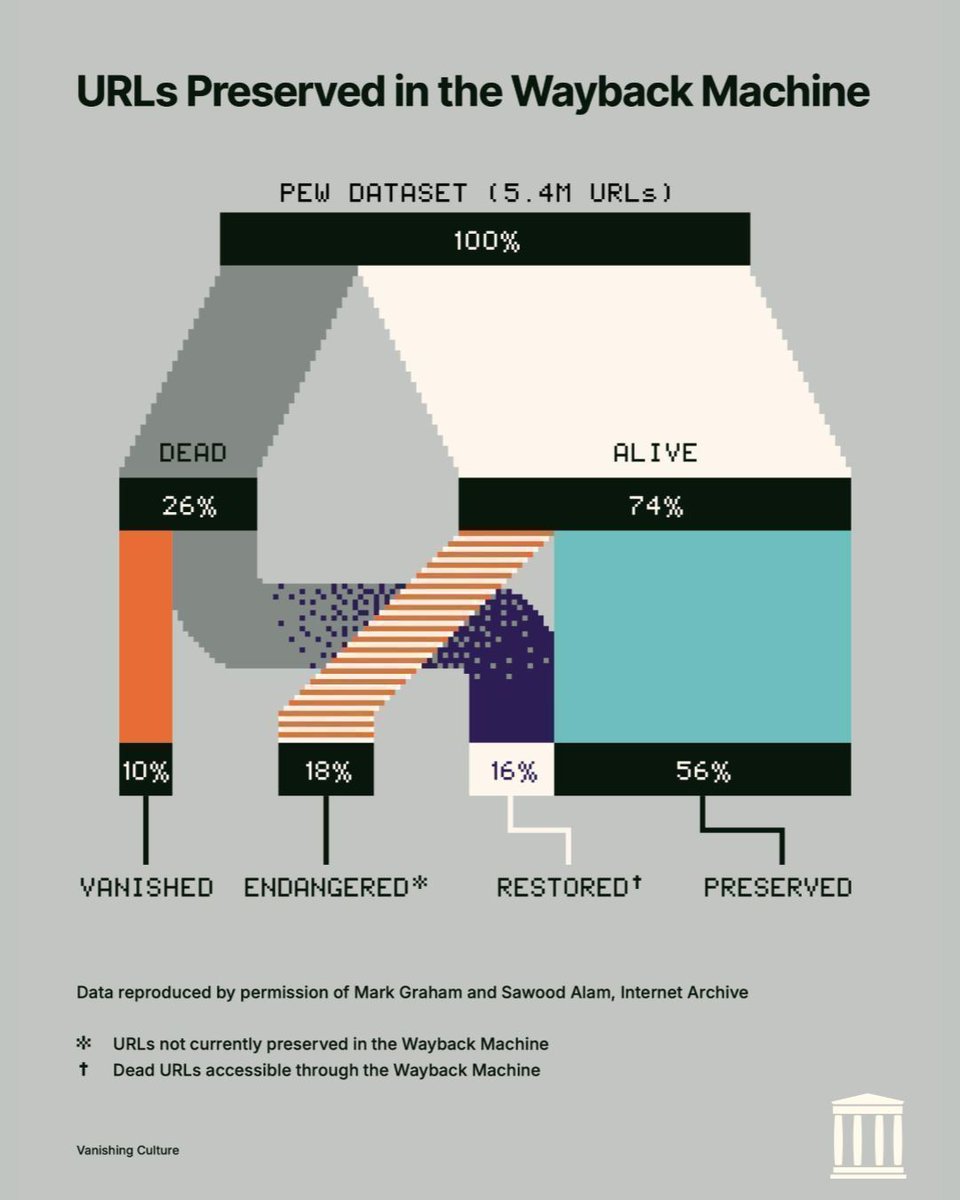
The web is disappearing 🕳️
According to a Pew Research Center report, 26% of pages from 2013-2023 are no longer accessible.
But that’s not the whole story.
In a new study published in Internet Archive's book, VANISHING CULTURE, data scientists working with the Wayback Machine have found:
16% have been restored through the Wayback Machine.
56% are preserved before they disappear.
Preservation is the remedy for cultural loss.
📚 Read VANISHING CULTURE free from the Internet Archive
📖 Download & read: https://t.co/BrawXOwMBr
🛒 Purchase in print: https://t.co/EB58IliqDm
#VanishingCulture #DigitalMemory #InternetArchive #BookTwitter
Ubuntu Hired Security Research Firm After Rust Re-writes Raised "Serious Concerns"
With the release of Ubuntu 26.04 (Long Term Support), Ubuntu is revealing massive security and ship-ability issues with the Rust-based, GNU Coreutils replacements.