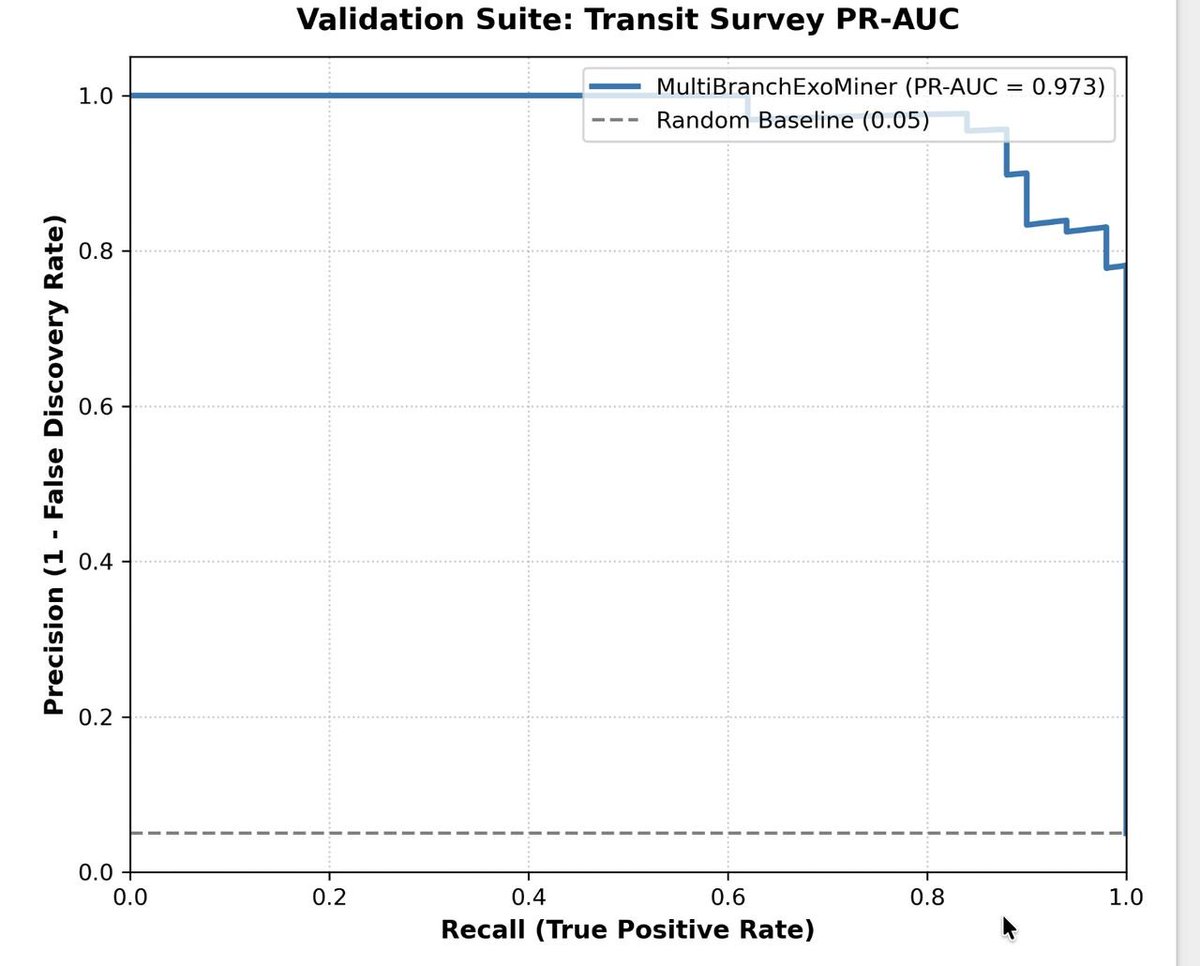
and zero structural shape mismatch bugs thanks to dynamic feature probing. Real research engineering in this sense is about controlling information flow instead of blindly adding layers.
Most multi-modal time-series models use lazy feature concatenation (https://t.co/ziDjuMQm8Q), treating clean signals and noisy artifacts with equal weight.
In exoplanet validation pipelines I am working on, you combine brightness flux time-series with centroid photocenter.. 🧵
Refactored the fusion bottleneck today into a lightweight Cross-Modal Attention Block. The primary flux stream acts as the query, dynamically attending to spatial centroid evidence only when transit anomalies require verification. Minimal parameter overhead, stable gradients,
A classic pitfall when applying deep learning to exoplanet validation: relying on training loss for model checkpointing.
When 95% of your dataset is false positives, a lazy classifier predicting the majority class hits high accuracy while completely failing its scientific goal 🧵
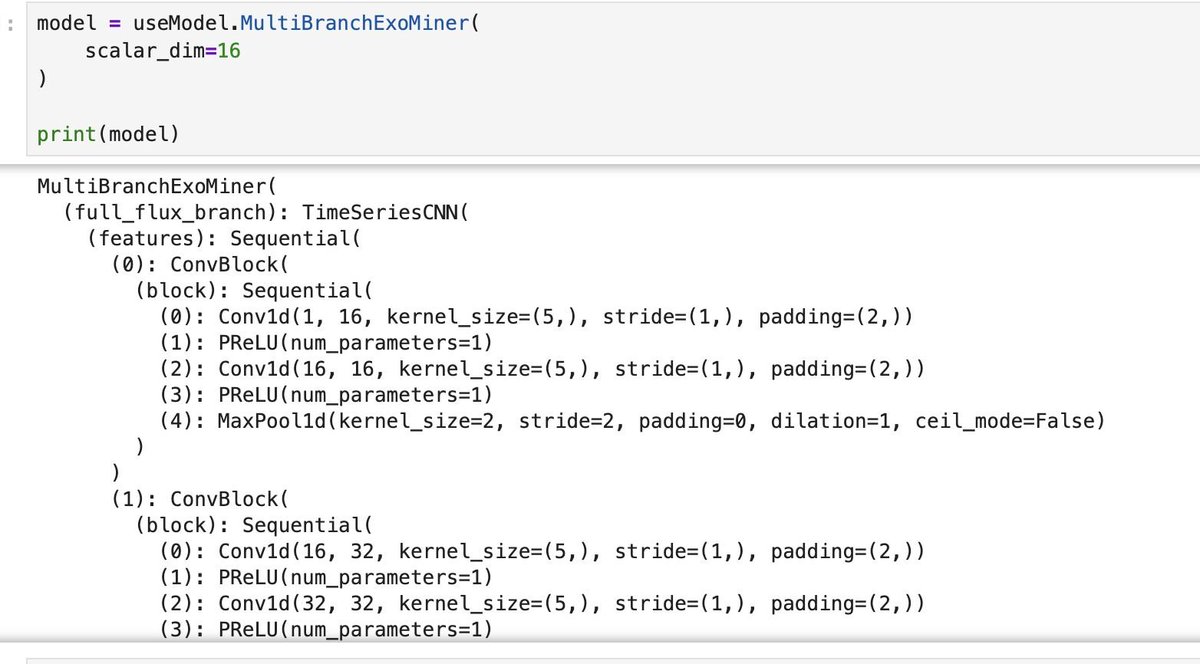
parameterized ReLUs, and downsampling max pooling: Getting the per-branch receptive fields right here is important before concatenating features downstream into the late-fusion classifier head.
Writing 1D CNN feature extractors for time-series inputs looks simple until you check the receptive field and channel progression.
Working on the ExoMiner implementation today. Setting up the feature extraction blocks for 1D flux time series: stacking kernel-5 convolutions,
There is an super intelligence race btw Americans and China. U know what Indians are doing ? Solving DSA questions and praying on failure of their competitors.
NVIDIA has lost it..
Chinese researchers open-sourced a model that writes CUDA better than humans experts.
And it completely rewrites the economics of AI hardware.
Writing low-level CUDA kernels to squeeze every ounce of performance out of a GPU has historically required elite, highly specialized hardware engineers. Standard AI models have always bombed at it, falling far short of traditional compiler systems.
Until now.
A joint team from Tsinghua University and ByteDance published "CUDA Agent”, a massive, large-scale agentic reinforcement learning system built to master GPU architecture.
Instead of relying on static prompts or simple multi-turn bug fixing, they built a closed-loop environment with automated hardware verification, profiling, and synthetic data pipelines.
The model learned how to write parallel, high-performance GPU code through trial, error, and reinforcement learning at scale.
The benchmarks are staggering:
It didn't compete with standard tools. It delivered 100%, 100%, and 92% faster execution rates over PyTorch's compiler on KernelBench Level-1, Level-2, and Level-3 splits.
On the brutal Level-3 benchmarks, it outperformed proprietary giants like Claude Opus 4.5 and Gemini 3 Pro by about 40%.
NVIDIA's moat has always rested on two pillars: elite hardware, and the proprietary software lock-in of CUDA.
If an open agentic system can automatically discover, write, and optimize production-grade CUDA kernels better than human specialists, the software moat starts evaporating.
The hardware matters less when the software can rewrite the metal itself.