AI Progress is an advocacy alliance that emphasizes existing U.S. copyright law’s essential role in innovation, IP protection, and America's AI competitiveness.
.@ProgressforAI is on file for @OpenAI: "Generative AI training is a transformative use because it does not use copyrighted works to communicate their expression." https://t.co/R8Y2kbP5zN
Today, AI Progress filed an amicus brief in the consolidated lawsuit against OpenAI, supporting the defendant’s motion for summary judgment on fair-use grounds. See the brief ➡️ https://t.co/t5AxjrLIwP
50 years ago this week, the Copyright Act of 1976 codified fair use. For nearly 185 years, fair use has let innovators build from one idea to the next — from the VCR to the search engine. Today, it powers AI-driven progress, accelerating medical breakthroughs and scientific discovery.
Earlier this year, CCIA, @NetChoice, and @Progressforai filed a joint brief in In re Mosaic LLM Litigation, urging the court to recognize AI training on copyrighted works as fair use. The brief argued that #AI training is transformative, promotes innovation, and advances the Constitution’s goal of promoting progress in science and the useful arts. https://t.co/p7euxlU8xu
Fair use isn’t a loophole. It’s been a core feature of U.S. copyright law for generations, protecting original expression and fueling transformative innovation.
As AI advances, current #USCopyrightLaw is key to supporting creativity and innovation.
Learn more: https://t.co/mH1cEjPnAx
The fair use and AI debate isn't just about tech companies. Researchers, universities, and libraries rely on broad access to information to advance scholarship and discovery.
Fair use preserves their ability to learn from and build on knowledge.
Learn more: https://t.co/xvebYF0RmI
In April 2026, CCIA joined @NetChoice and @Progressforai in urging the Northern District of California to affirm that training generative #AI models on copyrighted works is lawful #Fair Use. Courts should protect AI training that transforms copyrighted works into new tools for creativity, research, and innovation. Read more: https://t.co/hk0H6bcLk0
Speed, scale, and data access increasingly matter in the global AI race.
As China accelerates AI deployment, restrictions on training could weaken America's edge.
Good AI policy is targeted and smart, addressing harms while preserving American competitiveness.
AI is already driving economic growth — improving health care, accelerating breakthroughs, boosting productivity, and helping small businesses compete. Realizing AI’s full potential depends on access to diverse datasets. Fair use provides a flexible framework that supports innovation while respecting IP rights.
Read more: https://t.co/rsJjXiLBVN
Tools like AI crawler blocking, paywalls, watermarking, and bot detection help creators control how their content is accessed online without imposing impossible requirements on AI developers.
Read more: https://t.co/PckKIzkdCy
35 of the world's top 50 AI companies are in California, and the state's tech sector generates $2.6B in annual state revenue.
AB 412 would put CA’s economy at risk, burdening startups and developers with unfeasible reporting mandates.
Learn more: https://t.co/PckKIzkdCy
From accelerating medical breakthroughs to empowering small businesses, AI is delivering real-world benefits.
The fair use doctrine, which was established nearly 200 years ago, is the foundation of this kind of innovation.
Learn more: https://t.co/81fT8LdP00
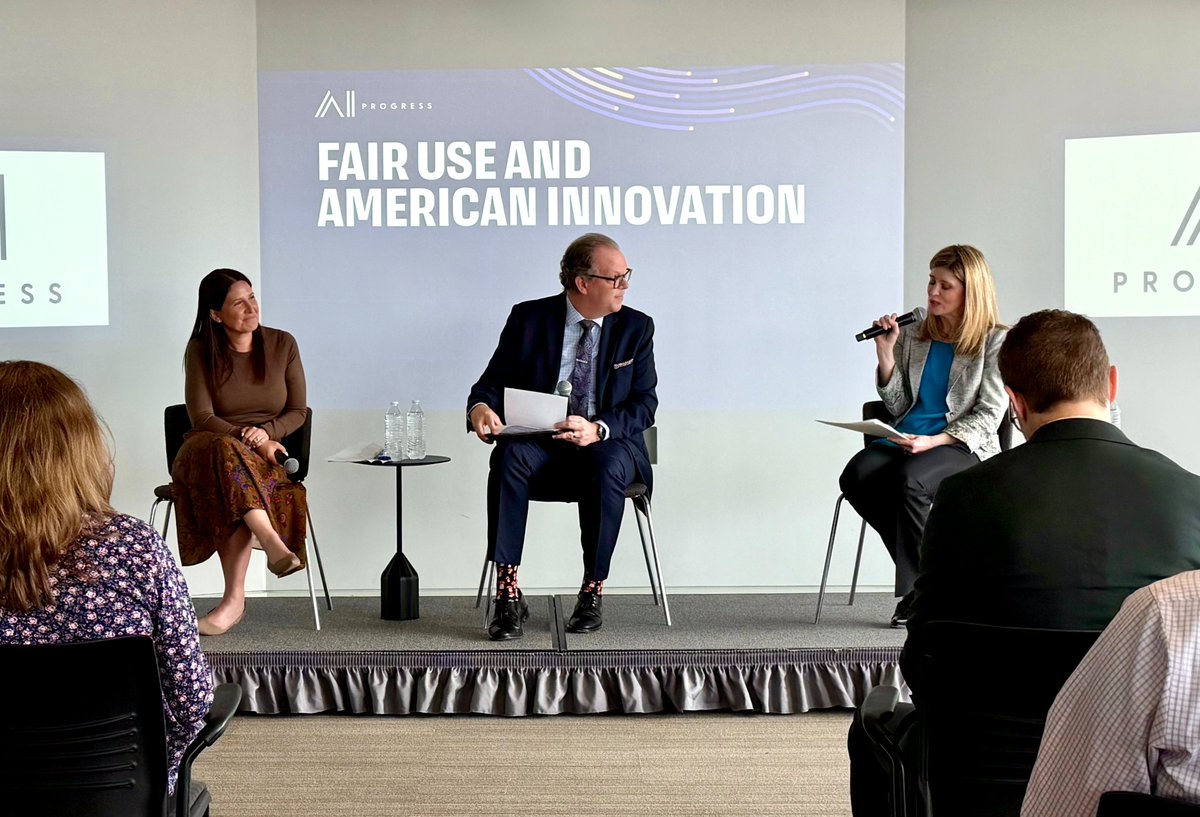
AI Progress recently hosted a discussion at Microsoft's Innovation and Policy Center, examining the of role fair use in American innovation.
Panelists shared perspectives how on how fair use supports research, education, accessibility, libraries, and AI technologies.
See key takeaways from the panel: https://t.co/o58a1CKuzA
At a panel on Capitol Hill, AI Progress advisor Anna Chauvet tackled a pressing question: How essential is existing #USCopyrightLaw to maintaining America’s global leadership in AI?
Learn more:
https://t.co/MzvxuBsQiG
Today, the White House released a National Policy Framework for Artificial Intelligence, acknowledging the key role #FairUse plays in AI innovation and U.S. tech leadership.
Read AI Progress’ statement in response: https://t.co/ilobLWwu4R
AI Progress advisor Anna Chauvet speaks to how current #USCopyrightLaw bolsters American innovation, helping the U.S. remain a global AI leader.
Learn how fair use plays a role in the global AI race ➡️ https://t.co/QIK14cJXht
Generative AI systems, including large language models, are trained on vast datasets to learn how language and ideas relate.
Learn more about how AI training works ➡️ https://t.co/0f98e30QVj
How do AI models learn?
@Anthropic’s Janel Thamkul explained how AI models learn patterns and relationships from datasets at a recent AI Progress event. Watch and learn more.
Learn more: https://t.co/QIK14cJXht
Did you know that AI could lift the U.S. GDP by $3.8 trillion per year by 2038?
But unlocking AI’s full economic potential depends on access to diverse, high quality datasets.
Learn more: https://t.co/6CETGY8FSG