We’re excited to announce that Marin Ivezic @infosec is joining Project Eleven as an advisor.
Marin is the Founder and CEO of Applied Quantum, a quantum security professional services and systems integration firm, and the author of https://t.co/HgjmyomYPX, one of the most widely read independent sources on quantum computing security.
"Given everything I know, including scary non-public information, I now put the odds of qday by 2032 at 50%. 10% by 2030."
@drakefjustin's numbers echo the conclusion from our recent report: "Q-Day is more likely to occur than not by 2033, and potentially even as soon as 2030."
Migration to quantum-resistant cryptography is no longer optional but imperative for any blockchain system expected to be trusted and secure value into the future.
Today a crazy quantum story just got wilder.
On March 31, the Google Quantum AI team published a landmark result on Shor's algorithm for elliptic curve cryptography. Technically, the paper was a bombshell: a dramatic 10x improvement over the state-of-the-art. As a stunt and wakeup call to the blockchain space, those optimisations were illustrated on secp256k1, the elliptic curve underlying Bitcoin and Ethereum signatures.
But perhaps the most striking part of the paper was sociological, not technical. Instead of following standard academic process, the optimisations were kept secret, hidden behind a zero-knowledge (ZK) proof. Google's accompanying blog post mentions they "engaged with the U.S. government". The ZK proof demonstrates the existence of algorithmic improvements without leaking details. Academic censorship with ZK, a historic first!
As a co-author of the Google paper I witnessed some of the context surrounding this censorship. To be honest, multiple aspects of that context don't sit well with me. As much as I believe the general public ought to know more, I am limited in my ability to whistleblow. Though let me be clear about one thing: the Google team's professionalism has been absolutely exemplary, and they deserve nothing but praise.
Censorship has a way of backfiring. The Streisand effect, where an attempt to bury something only draws more attention to it, is exactly what's unfolding today. First, Google's key optimisation has been rediscovered by the French. And in a thrilling turn of events, a collaborative Shor-at-home challenge just launched. The initiative, available at ecdsa[.]fail, breached a new Shor world record in a matter of hours.
Let's start with the rediscovery. Just two months after Google's paper, French quantum expert André Schrottenloher cracks the main secret optimisation. His paper, titled "Optimized Point Addition Circuits for Elliptic Curve Discrete Logarithms", landed on the arXiv today. Big congrats to André, who beat several other nerdsnipped experts to it. In a blog post also published today, Craig Gidney, the world expert on Shor optimisations, revealed that he'd been sitting on this very optimisation for a whole year under censorship pressure.
Interestingly, André missed a handful of minor optimisations, both from Google's original publication and from improvements found since. It's plausible there's still plenty of juice left to squeeze out of Shor, and this is exactly what the ecdsa[.]fail challenge is about. The verifier program developed for the ZK proof does double duty, automatically filtering for valid submissions. Dozens of compounding small and micro improvements are rolling in. As of the time of writing there's an 8.4% improvement to Google's circuit, as measured by the product of logical qubit count and Toffoli gate count. Nice!
The nerdsnipping ran deeper than anyone expected. Over the last few weeks it became clear it extended well beyond André and other quantum experts. Behind the scenes, a small army of amateurs quietly got to work. Inspired by Karpathy-style autoresearch, they turned AI on Shor. Ironically, the verifier program for the ZK proof makes an ideal reward function for AIs. The barrier to entry for this modern style of research is refreshingly low, with several non-experts, even a teenager, finding nice optimisations. Get in touch if you'd like to join a Telegram group with fellow autoresearchers :)
Part 2: neutral atoms and qday
The story doesn't end with Google. On the same day Google went public, a stealthy startup called Oratomic published its own Shor paper in a coordinated release. It made a splash, ultimately becoming the most upvoted paper on scirate[.]com, a website ranking arXiv papers.
Oratomic's claim was wild. By building on Google's logical optimisations and applying custom physical optimisations for neutral atoms, they claimed just 10K physical qubits were sufficient to run Shor's algorithm on secp256k1. That number is mind-bogglingly low.
Knowing essentially nothing about neutral atoms when Oratomic's paper landed, I was intrigued and decided to learn more about the tech. I fell straight down the rabbit hole and spent a couple hundred hours on the topic. I got a little obsessed and watched every YouTube video I could find and spoke to a bunch of experts.
My conclusion? The tech is real, very real. Even Google recently decided to start a neutral atom lab, a notable pivot from their sole focus on superconducting qubits. If you care about qday, i.e. the day a quantum computer will break the first piece of cryptography in production, neutral atoms demand your attention. I shared some of my learnings on Shor and neutral atoms in a 30min talk at the ZKProof cryptography conference. You can find it on YouTube by searching "zkproof neutral atom".
Here's an interesting observation about this duo of breakthrough papers: neither Google nor Oratomic say a word about what their results mean for qday. No timelines. Zero. Nada. That is especially baffling given that the whole point of whitehat quantum cryptanalysis is to inform qday estimations and help the general public make good decisions.
So let me attempt to partially fill the silence, similarly to what Scott Aaronson did in his April 29 post. Given everything I know, including scary non-public information, I now put the odds of qday by 2032 at 50%. 10% by 2030.
Anecdotally, the US government has its own date: 2035. Originating at the NSA and later adopted by NIST, it's when branches of the US government will be disallowed from using quantum-vulnerable cryptography. In plain language: with hindsight, that date is a joke and should be discounted entirely. I don't see how NIST avoids being forced to pull it forward by years.
Part 3: post-quantum cryptography
There are good reasons to sound the alarm today, but please do not panic. Rushing carelessly towards immature post-quantum cryptography is a recipe for disaster. IMO a good target date for migration is 2029, roughly 3.5 years out. 2029 happens to be the date selected by Google, Cloudflare, and the Ethereum Foundation.
These days most of my time goes to safely migrating Ethereum towards post-quantum cryptography as part of the broader lean Ethereum effort. There's a lot to do. We need to rip out and replace BLS signatures at the consensus layer, KZG commitments at the data layer, and ECDSA signatures at the execution layer.
The plan to get there is compelling, and is based on hash-based cryptography. Within the Ethereum Foundation we've developed a Swiss army knife called leanVM (github[.]com/leanEthereum/leanVM) powered by the magic of hash-based SNARKs. Thanks to truly exceptional work by Emile, Thomas, and others, its performance is derisked. Regarding security, leanVM is a jewel, a minimal zkVM crafted for end-to-end formal verification and maximum security.
Want to help? There are two $1M initiatives. First, the Proximity Prize (proximityprize[.]org). Solve a long-standing mathematical conjecture in coding theory, improve hash-based SNARKs, and go home a millionaire. Second, the Poseidon Initiative (poseidon-initiative[.]info), offers $1M for breaking Poseidon, the SNARK-friendly hash function.
Crypto agility. Better key management. Stronger standards. New cryptographic primitives.
The migration to post-quantum cryptography isn't all doom and gloom.
Read the full post below ⬇️⬇️⬇️
There are largely two families of post-quantum signatures available today: hash-based and lattice-based.
Hash-based schemes (SLH-DSA, XMSS, LMS):
Reply only on the security of hash functions, the most conservative assumption available and one with decades of cryptanalysis behind it.
The cost is size and operational overhead (signatures can run to several kilobytes, with slower operations than ECDSA/EdDSA).
Hash-based schemes also lack the algebraic structure needed for threshold signing, aggregation, and re-randomisation natively, so those primitives have to be reconstructed externally with things like PQ-SNARKs, which can be expensive.
Within the family there is a further choice between stateless and stateful. SLH-DSA is stateless and safe to use without tracking signing state, at the cost of larger signatures. XMSS and LMS are smaller and faster but a single state reuse breaks the scheme, and getting state right across distributed signers can be hard (although not impossible).
Lattice-based schemes (ML-DSA, Falcon):
Reply on newer assumptions, but ones that have still been subject to substantial cryptanalysis. Signatures are smaller and operations are typically faster than in stateless hash-based schemes.
The algebraic structure can support threshold, aggregation, and re-randomisation, though production-ready versions of these are still a work in progress.
ML-DSA is what the wider internet is converging on across all PQ signatures (TLS, browsers, cloud KMS, messaging), which means more implementations, more audits, and more eyes on the cryptography over time. It's also my default recommendation. Falcon (to be standardised as FN-DSA) has the smallest combined public key + signature, but with some tricky internals (solvable, just requires care).
Some great schemes are coming through the NIST on-ramp but they have a long way to go (a few years at a minimum). I suggest we pick from what's standardised/available now and plan a future change should something better come along later.
A third of Bitcoin's supply has exposed public keys. A quantum computer could move those funds without the owner's consent. @wintonARK, @dpuellARK, @nic_carter, and @apruden08 go deep on the risk, the timeline, and what Bitcoin needs to do about it on FYI.
Watch: https://t.co/fZdsFrZvwB
Progress on post-quantum migration marches forward.
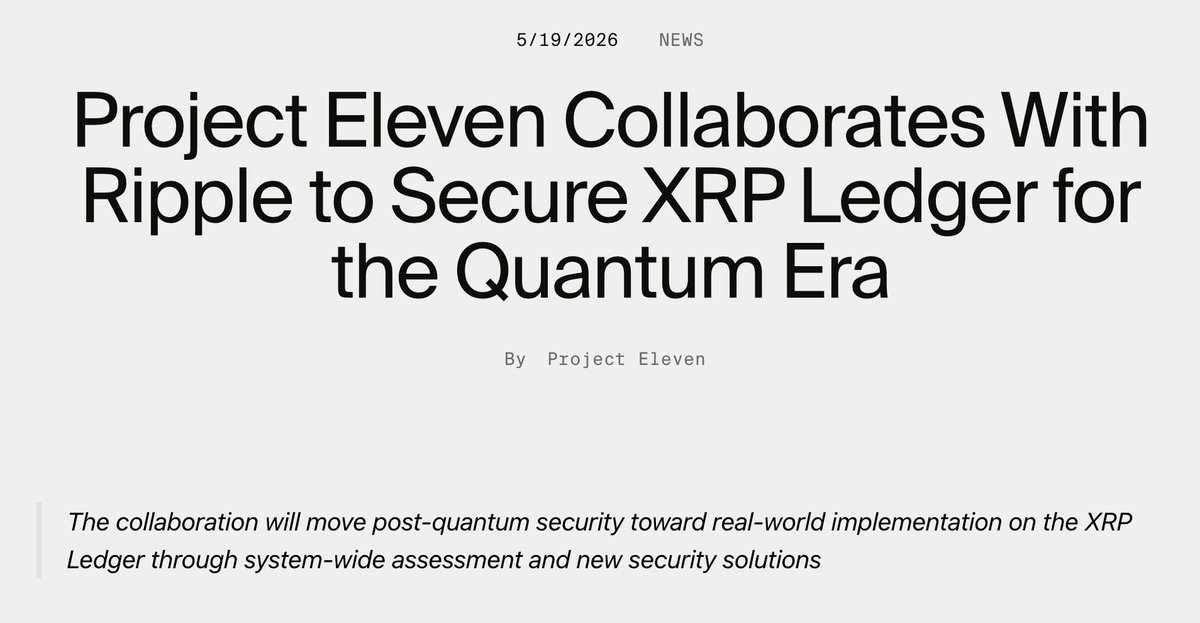
We are announcing our collaboration with @Ripple to advance post-quantum readiness on the XRP Ledger ahead of emerging quantum computing threats.
Full announcement linked below ⬇️⬇️⬇️
SQIsign is the only isogeny-based scheme in the process. Isogeny schemes derive security from the hardness of finding maps between supersingular elliptic curves with the right algebraic structure. SQIsign has the smallest combined public-key and signature sizes of any candidate, with 148-byte signatures at security category 1. Between rounds, the team improved signing speed by approximately 20× and verification by approximately 6×, and produced a cleaner security argument in the random oracle model. SQIsign still has higher latency than the other candidates, and fully constant-time signing remains open. NIST flagged side-channel resistance and broader community analysis of the underlying endomorphism-ring assumption as Round 3 priorities.
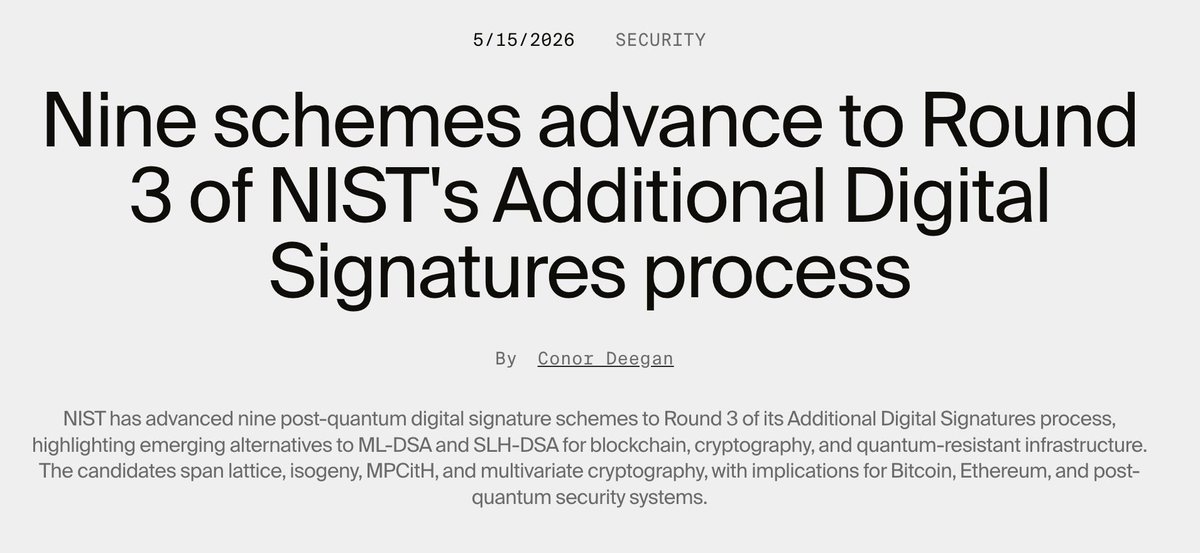
🚨 NIST announced the third-round candidates of the Additional Digital Signatures process. 9 schemes move forward and 5 do not.
Moving forward:
- SQIsign
- HAWK
- FAEST
- MQOM
- SDitH
- UOV
- MAYO
- QR-UOV
- SNOVA
Read @conordeegan's full analysis on our blog (link below)!
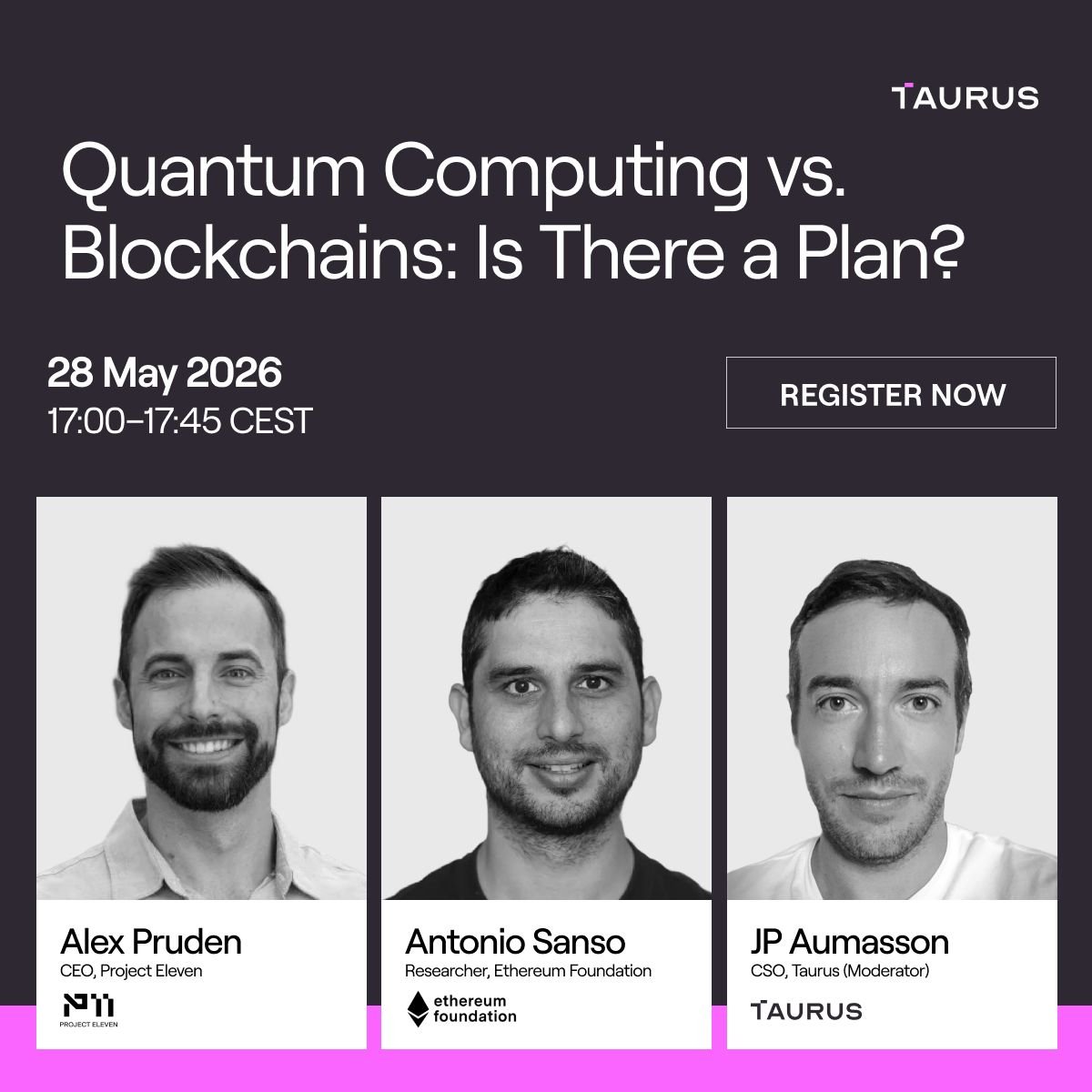
"Quantum Computing vs. Blockchains: Is There a Plan?" with @apruden08, @asanso and @veorq.
No noise, all signal.
➡️ Register now: https://t.co/25hz7zVkFe
🔶Simple guide on how to install the Quantum Vault by @projecteleven and protect your BTC from future quantum threats 🧵
⛓️ Visit: https://t.co/ij9NYSECHc
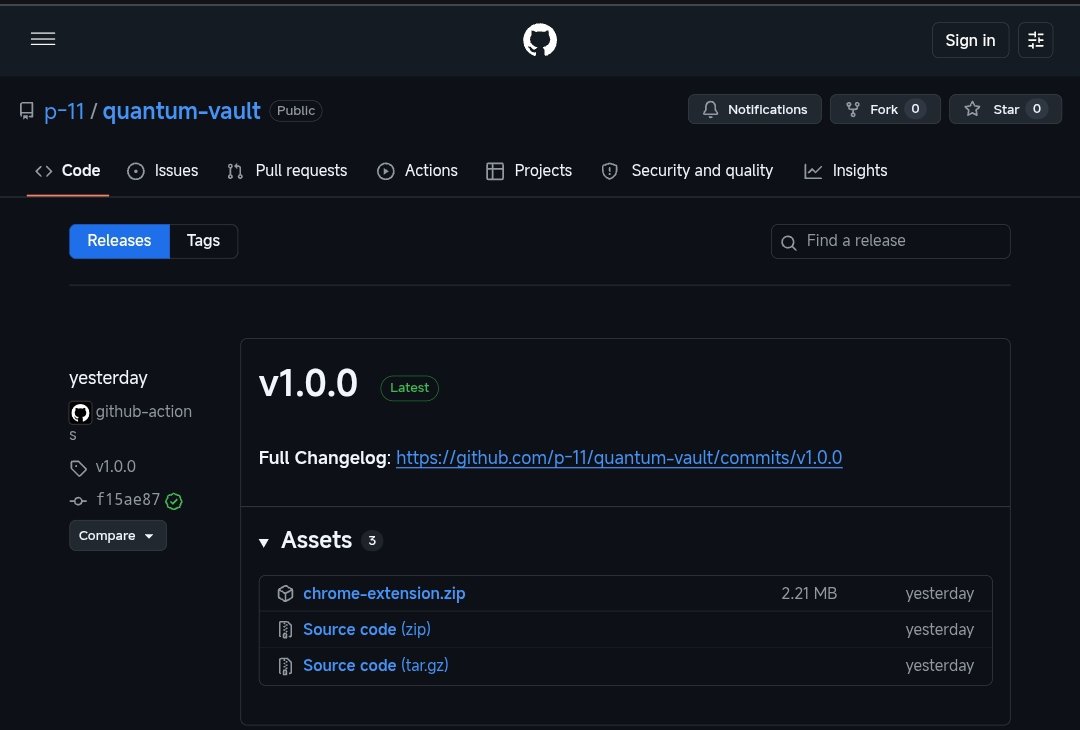
1/ Download the `https://t.co/yacD6WwRx7` file from the latest release and unzip it.
2/ Open `chrome://extensions/`
3/ Turn on Developer Mode
4/ Click Load unpacked and select the unzipped Quantum Vault folder.
That’s it , Quantum Vault will install automatically ✅
Works on Chrome and Chromium-based browsers like Brave, Edge, and Arc.
After installing, I copied my BTC address to check whether it’s safe against potential quantum attacks.
Check yours here:
https://t.co/kMutTZ2DL7
This isn't a sponsored post