@KarnekarAnand@IndianTechGuide dear अगर तुम olympiad mcq applied को applied कह रहे हो वो भी applied जो एक कमरे के अंदर एक कुर्सी पर बैठ कर, तो तुमको life में बहुत कुछ सीखना है बच्चे ,बहुत कुछ देखना है ,कोई बात नहीं गलती तुम्हारी नहीं है सिस्टम की है. your are even not know even 5 % of life. BE READY MY CHILD
'भारत की पढ़ाई अब भी रट्टा फोकस है’, मार्सेलस इन्वेस्टमेंट मैनेजर्स के फाउंडर सौरभ मुखर्जी ने एक पॉडकास्ट में एजुकेशन सिस्टम पर सवाल उठाए. उन्होंने कहा कि यहां क्रिटिकल थिंकिंग पर कम ध्यान दिया जाता है. साथ ही, उन्होंने दावा किया कि कई मामलों में 12वीं पास लोग ग्रेजुएट्स से ज्यादा कमा रहे हैं और हर 100 ग्रेजुएट्स में सिर्फ 3 को ही नौकरी मिलती है.
https://t.co/wGB7jQZFwV
@Rishabhh005 rishabh bhai ek chart banaye long tem bull market ka -kya 2008 ke baad se longer time frame mein jo bull mrket chala tha aaj tak,kya wo bhi khatam ho raha hai --2020 waala to khatam ho hi raha hai -1980 se koshish kijiye -in a very long term time frame wave theory
@sandipsabharwal@TanishqJewelry The financial allocation for wedding shopping remains unchanged, with a notable alteration in the type of jewelry acquired: lower-carat items are now favored over the previously purchased 22-carat necklaces and rings.
@sandipsabharwal@TanishqJewelry No, sir. Slight modification: Tanishq has begun manufacturing 8-carat jewelry. Please visit any Tanishq store and observe the customers purchasing; you will notice that lower-carat jewelry is currently in trend, with 14-carat and 18-carat pieces being particularly popular.
You will continue to suffer if you have an emotional reaction to everything that is said to you. True power is sitting back and observing things with logic. True power is restraint. If words
control you that means everyone else can control you. Breathe
and allow things to pass.
Pvt sector will work for 10,000 p.m and govt employees want min salary of 69,000 p.m ? For what ? For asking bribes ? Most of them don't even know to use computers..
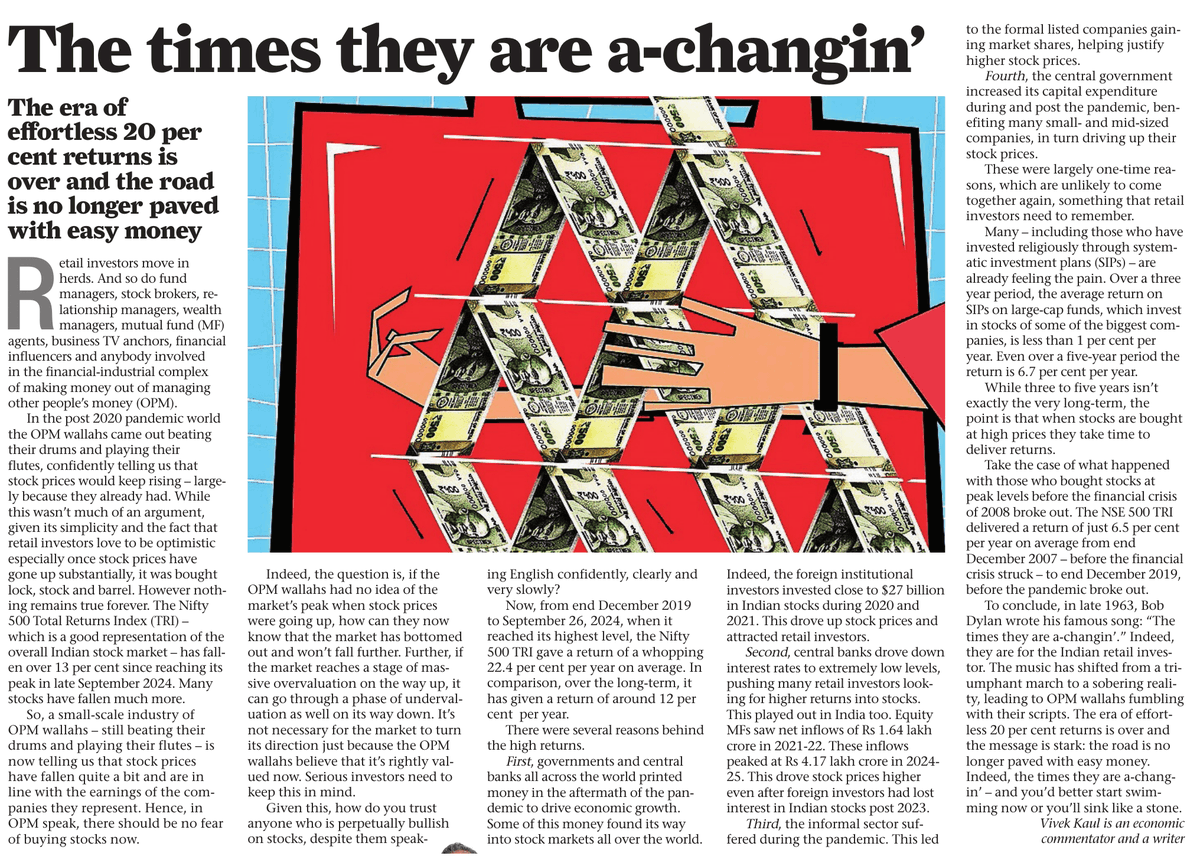
The times they are a-changin’
My Paisanomics column in the Mumbai Mirror.
A small-scale industry of those in the business of managing other people's money (OPM) – still beating their drums and playing their flutes – is now telling us that stock prices have fallen quite a bit and are in line with the earnings of the companies they represent.
Indeed, the question is, if the OPM wallahs had no idea of the market’s peak when stock prices were going up, how can they now know that the market has bottomed out and won’t fall further.
Further, if the market reaches a stage of massive overvaluation on the way up, it can go through a phase of undervaluation as well on its way down.
It’s not necessary for the market to turn its direction just because the OPM wallahs believe that it’s rightly valued now.
Given this, how do you trust anyone who is perpetually bullish on stocks, despite them speaking English confidently, clearly and very slowly?
Valuation – or the price at which you buy stocks – remains the biggest risk.
Take the case of what happened with those who bought stocks at peak levels before the financial crisis of 2008 broke out. The NSE 500 TRI delivered a return of just 6.5 per cent per year on average from end December 2007 – before the financial crisis struck – to end December 2019, before the pandemic broke out.
Over a three year period, the average return on SIPs on large-cap funds, which invest in stocks of some of the biggest companies, is less than 1 per cent per year. Even over a five-year period the return is 6.7 per cent per year.
While three to five years isn’t exactly the very long-term, the point is that when stocks are bought at high prices they take time to deliver returns.
https://t.co/lGInMMEolv
Every $10 increase in crude adds roughly $12–15 bn to India’s annual import bill. But this correlation is convex, at higher prices, deficit rises sharply.
India consumes far more oil than it produces. The gap must be imported and paid for in dollars.
India crude consumption is about 5.3–5.5 mbpd while domestic production is ~0.6 mbpd. Import dependence is 85%. Petroleum imports are 25 to 30% of total imports.
Looking at the remarkable success of Iran's tech in missiles, drones, infrared tracking etc, I am convinced it's because they don't have a stock market. Their engineers build real products instead of food & lipstick apps for 500x PE.
India's real teji will start when India has a 5-10 year bear market, and people go back to building real businesses instead of the fluff that gets billions of dollars of mkt cap these days.