There's a verse people reach for when they don't know what to say at a funeral. It gets said gently, at the edge of a hospital bed or in a text message after a miscarriage, and it almost always lands the same way as a lid. As a polite instruction to stop grieving now.
Romans 8:28.
"All things work together for good."
But Paul wrote that sentence inside the most honest chapter in the Bible about pain, and if you read what surrounds it, the verse stops functioning as a lid and starts functioning as a floor.
Start about ten verses earlier. Paul says the sufferings of this present time aren't worth comparing to the glory coming, and then, instead of moving on, he sits down in the suffering and describes it at length. He says creation itself was subjected to futility. Not sin. Futility. The sense that things don't work, that effort dissolves, that everything beautiful is quietly coming apart.
Romans 8:20.
And he says creation is groaning. The word he uses is the sound of labor: a woman in the middle of childbirth, no epidural, no guarantee. That's the world, according to Paul. Not broken in a tidy way. In labor.
Romans 8:22.
Then he turns it on us. We groan too, he says, inwardly, while we wait for our bodies to be redeemed. Paul had the Spirit. Paul had seen the risen Christ with his own eyes. And Paul says he still groans. He doesn't present this as a failure of faith or a phase to grow out of. He presents it as the normal condition of a Christian who is paying attention.
Romans 8:23.
And then the strangest verse in the chapter. We don't even know what to pray for, he says. Not that we pray badly. That we don't know what to ask. So the Spirit prays underneath us, with groans too deep for words.
Romans 8:26.
Three groans in eight verses. Creation groans. We groan. God the Spirit groans.
That is the room verse 28 is standing in.
And in that room, the sentence means something entirely different from what the card says. Paul does not write that all things are good. He does not write that everything happens for a reason. The Greek verb is synergeō, to work together, to labor alongside, and the picture is not of events being secretly fine underneath. It's of God actively at work inside the wreckage, doing something with material that is genuinely wreckage.
There's a textual detail worth knowing here. In some of the oldest manuscripts we have, including one from around 200 AD, the word "God" appears as the explicit subject of that verb. God works. Not the circumstances. Not the universe. Not karma with a Christian accent. A person, working in things that are not good, toward an end that is.
And Paul tells you what that end is. He doesn't leave it vague. The very next verse defines the good: to be conformed to the image of His Son.
Romans 8:29.
That's the promise. Not that the diagnosis reverses. Not that the marriage is saved, the job comes back, the child recovers. The promise is that you will come out of it looking more like Jesus, which is a much heavier thing to be told, and a much better one.
Read on, and Paul makes it explicit that he isn't talking about a comfortable life. He lists what he expects: trouble, hardship, persecution, famine, nakedness, danger, sword.
Romans 8:35.
And then he quotes a psalm, one where the writer is accusing God of sleeping through a slaughter, and applies it to himself and his readers without softening it.
Romans 8:36, Psalm 44:22.
He is writing to Christians in Rome. Within roughly a decade, Nero will use some of them as torches in his garden. Paul himself will most likely be executed in that city. He knew what he was promising and what he wasn't.
So here's the honest version.
This verse was never meant to be handed to someone as a way of ending a conversation. It was written by a man who groaned, to people who were about to lose everything, about a God who does not stand outside the wreckage explaining it.
He is in it. Working. In the thing you would undo if you could.
You are allowed to grieve it and trust Him at the same time. Paul did both in the same paragraph.
The hymn, “Lift High the Cross,” contains an image that is rooted in the Old Testament and reflected in the book of Revelation:
“All newborn soldiers of the Crucified
Bear on their brows the seal of him who died.”
On their brows, their foreheads, Christians bear the seal of Christ. Where does this image come from?
One place is Ezekiel 9, one of the chapters we read today in Bible in One Year.
Ezekiel sees a man with a writing case who is commanded to go through Jerusalem and “put a mark on the foreheads” of those who grieve over the abominations committed in the city (9:4). Those bearing this mark are spared from the judgment that follows.
The Hebrew word translated “mark” is tav, which is also the name of the final letter of the Hebrew alphabet. In the ancient Hebrew script, the tav could be shaped like an X or a cross.
This idea of being shielded by a mark goes back even further to the Passover. The Israelites marked the doorposts and lintels of their homes with the blood of the Passover lamb. When the LORD saw the blood, he passed over those homes and spared them from the destroyer (Exodus 12:7, 13, 23).
Then, in Revelation, this imagery appears again. God's servants are sealed on their foreheads before judgment falls (Revelation 7:3). Later, John sees the Lamb standing on Mount Zion with his people, who have “his name and his Father’s name written on their foreheads” (14:1). Finally, in the new creation, God's servants “will see his face, and his name will be on their foreheads” (22:4).
From Passover to Ezekiel, to Revelation runs the same beautiful imagery: God marks his people as his own.
We belong to the Lamb. We bear the name of God for we are baptized in the name of the Father, Son, and Holy Spirit (Matt. 28:19).
We are, as the hymn puts it, marked with “the seal of him who died" for us, the Passover Lamb of God who takes away the sin of the world.
The Gospel does not promise that God exists to make your earthly life comfortable.
It promises something far greater: reconciliation with God through Christ.
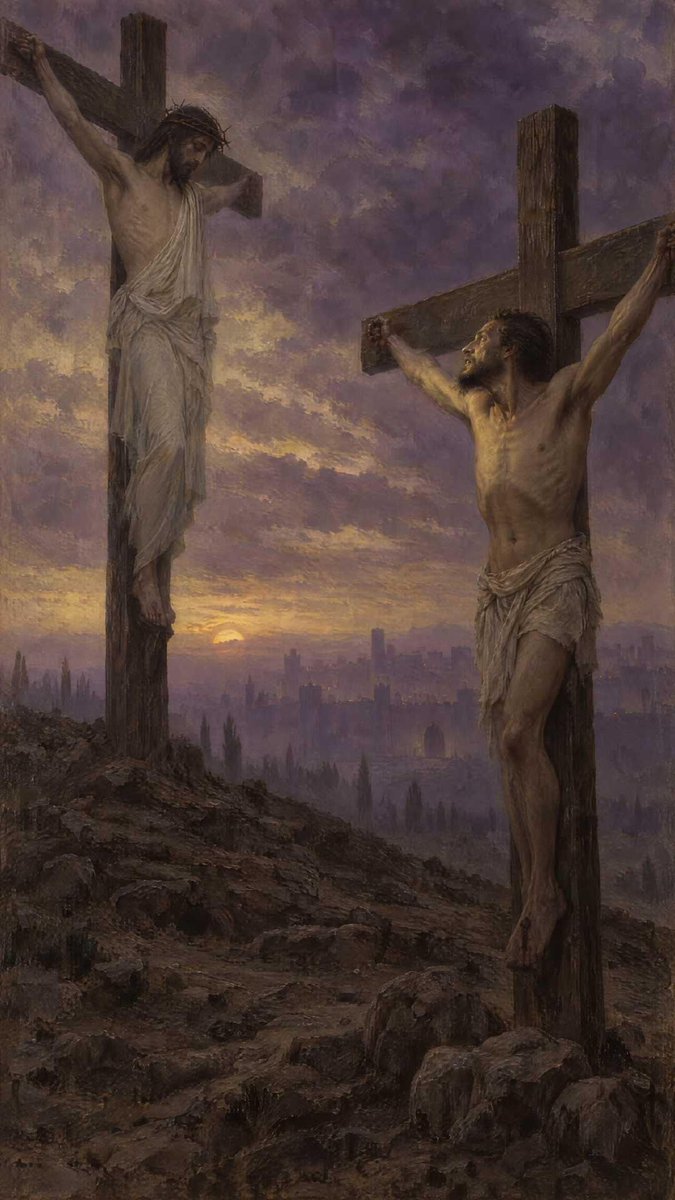
The first person Jesus promised heaven to was a criminal who spent part of that morning cursing Him.
Matthew 27:44. The thieves also, who were crucified with him, cast the same in his teeth.
Both of them. Plural. Matthew and Mark both say that the two men dying beside Him joined the crowd and mocked Him.
Then something happened to one of them.
Nobody preached to him. Nobody gave him a tract. He watched a man get stripped, nailed, mocked by priests, gambled over by soldiers, and somewhere in those hours he changed his mind about who was hanging in the middle.
Luke 23:40. Dost not thou fear God, seeing thou art in the same condemnation?
He turns on his own partner first.
Then: And we indeed justly; for we receive the due reward of our deeds.
He doesn't minimize it. Doesn't blame Rome. Doesn't say he fell in with the wrong crowd. He says: I earned this cross.
Then: but this man hath done nothing amiss.
The only man in Jerusalem that day who publicly declared Jesus innocent was a condemned criminal with nails in his wrists. Pilate had said it and then washed his hands. Peter had said it and then denied it. The disciples had scattered.
A thief said it out loud from a cross and couldn't run.
Then he says the sentence that should stop you cold.
Lord, remember me when thou comest into thy kingdom.
Look at what he's looking at while he says it.
A man who can't move. Naked. Bleeding out. Nailed to wood between two criminals. No army. No crown. No miracle. The sky going dark and His own mother sobbing at His feet.
And this man calls Him Lord and says kingdom.
Everyone else that day used the word king as a joke. The soldiers jammed thorns on His head and knelt down, mocking: Hail, King of the Jews. The priests shouted Let Christ the King of Israel descend now from the cross. Pilate nailed a sign above His head in three languages: THIS IS THE KING OF THE JEWS, and meant it as an insult to the whole nation.
Everybody in the story said the word. One man believed it.
And think about the faith required. Every other person who trusted Jesus in the gospels had evidence. They saw blind eyes open. They saw a dead man walk out of a tomb. They watched Him still a storm.
This man saw none of it. He saw Jesus fail. He saw Him lose, publicly, completely, in the most humiliating way the Roman Empire could engineer.
And he looked at total defeat and said: I want to be in your kingdom.
That's the greatest act of faith recorded in the Bible, and it came from a man who had hours left to live.
Now look at what he asked for.
Remember me.
That's all. Not save me. Not take me with you. Just when you come into whatever it is you're coming into, think of me. He asked for a thought. A memory. The smallest thing a man can ask.
And look at the answer.
Luke 23:43. Verily I say unto thee, To day shalt thou be with me in paradise.
He asked to be remembered someday. Jesus said today.
He asked for a thought. Jesus said With me.
He asked to be included. Jesus said paradise.
Now that word. Paradise.
In Greek it's paradeisos. It isn't originally a religious word at all; it's an old Persian term for a walled garden, an enclosed park belonging to a king.
And when Jewish scholars translated the Hebrew Bible into Greek, that's the word they chose for one specific place.
Genesis 2:8. And the LORD God planted a garden eastward in Eden.
Paradeisos. The garden.
So read the promise again with that in your ears.
A man is dying for his crimes, and the Son of God tells him: today you'll be with me in the garden.
The garden humanity was thrown out of. Genesis 3:24: God placed cherubim at the east of the garden of Eden, and a flaming sword which turned every way, to keep the way of the tree of life.
An angel with a burning sword stood at that gate for the whole Old Testament. Nobody got back in. Not Abraham. Not Moses. Not David.
And the first human being told he was going back in was a convicted criminal, and the announcement was made by a man bleeding to death three feet away from him.
The sword came down on the wrong man, and the gate came open.
Now count what the thief had.
No baptism. He was nailed to a cross; he wasn't going anywhere near water.
No good works. His hands were fixed to wood. He could not physically do one single thing for God for the rest of his life.
No restitution. Whoever he stole from never got it back.
No church. No membership, no giving, no service, no years of faithfulness.
No time. He had hours.
He had nothing. He came with empty hands, an honest confession, and one sentence of faith.
And he is the only person in the entire Bible that Jesus personally, verbally, by name guaranteed would be with Him in paradise that same day.
The man we are most certain is in heaven did the fewest works of anyone in Scripture.
That should wreck your arithmetic.
Because you've been keeping a ledger. Years of church against years you were gone. Prayers against failures. The version of you people see against the one you actually are. You've got some idea that there's a number you have to hit before God will look at you and you're behind on it, and you know it.
The thief had nothing on his side of the ledger but a lifetime of theft and a morning of mockery.
Jesus didn't ask him for anything else.
And notice: Jesus never told him to clean up first. Never said if you had more time. Never asked what he'd stolen or from whom. The man asked to be remembered, and Jesus handed him the garden.
If you're reading this thinking you're too far gone, or too late, or too dirty, or that you'd need years to get right before God would want you.
He saved a man who had six hours left and couldn't move his hands.
He can do something with what's left of yours.
Say what the thief said.
Remember me.
Our priority as believers isn't primarily about escaping suffering; this present world has so much of it in store for us.
It's about glorifying God despite our sufferings.
Sometimes this happens by demonstrating God's power over afflictions.
Sometimes this happens by demonstrating godly virtues of patience, peace, joy and love despite the hostilities.
Sufferings are inevitable, but we must "steward" them properly to the Glory of God.
Biblically, all the problems of men on earth are low quality problems anyways! So, dear brother, still carry them to him regardless!
“For our light affliction, which is but for a moment”
2 Corinthians 4:17b KJV
The most dangerous lies about you often begin with something true.
Yes, you failed...the lie is that your failure still gets to tell you who you are.
Here's a question every guilty heart needs to hear: “Who will bring charges against God’s elect? God is the one who justifies” (Romans 8:33).
Paul never answers by pretending the sin was small and he never says we were misunderstood or basically good people. He points us to the verdict God has already given in Christ.
Conviction tells the truth about sin and leads us back to Jesus. Condemnation keeps reopening a case Christ has already settled.
Paul says it is closed. Christ died. He rose again. He is at the right hand of God interceding for His people.
That means my peace does not depend on whether I feel forgiven every morning. My place with God rests on what Jesus has already done. Grace never makes sin small. It tells me Christ’s payment was enough!
I do not have to rewrite the past to live free from it. I can call the sin what God calls it and still believe the cross answered for it completely.
Maybe the memory returns tonight or maybe it catches you in the car again next week. Let it remind you where to look. You do not have to fear what Christ has already carried.
Your past may still remember what happened. God remembers what Christ did about it.
The memory may come back, but the case does not reopen.
At the moment Jesus died, three of the four Gospels stop describing Golgotha and cut, without warning, to a scene half a mile away, inside the temple. Matthew, Mark, and Luke each record it with almost the same words: the curtain of the temple was torn in two, from top to bottom. No one on the hill could have seen it. It happened behind walls, in a place only priests could enter. And yet the Gospel writers considered it so important that they interrupt the death of the Son of God to tell you about a piece of fabric.
To understand why, you have to understand the veil. God's instructions for it go back to Exodus: a curtain of blue, purple, and scarlet yarn and fine twisted linen, with cherubim woven into it, hung to divide the Holy Place from the Most Holy Place, the Holy of Holies, the room where the presence of God dwelt above the ark. The cherubim were not decoration. The last time cherubim stood as a barrier in Scripture was at the gate of Eden, with a flaming sword, after Adam and Eve were driven out. The veil was Eden's gate, rebuilt in cloth. It said one thing: you cannot come in here.
By Jesus' day, the temple was Herod's vast rebuilt structure, and the curtain matched its scale. Josephus, the first-century Jewish historian, describes the temple's great veil as a Babylonian tapestry of blue, scarlet, purple, and linen, embroidered with a panorama of the heavens, an enormous hanging some sixty feet high. Later rabbinic tradition, recorded in the Mishnah, claims the veil was a handbreadth thick, woven from seventy-two cords each of twenty-four strands, and that it took three hundred priests to immerse it when it needed cleaning. Those numbers are probably rabbinic exaggeration, and it is honest to say so. But even discounting them, we are describing something the size of a building's wall, thick, heavy, and woven by expert hands. It was not a bedsheet. No man could tear it. And Mark is precise: it tore from top to bottom. From the top, sixty feet up, where no hand could reach, downward. Whatever tore the veil did so from God's side of it.
Now consider who was allowed past that curtain. One man. Once a year. On the Day of Atonement, the high priest, and only the high priest, passed through the veil into the Holy of Holies carrying the blood of a sacrifice, to sprinkle it before God for the sins of the nation. Every other day of the year, every other person alive, was kept out on pain of death. The high priest of the year AD 30 was Caiaphas, the man whose bones now lie in a museum drawer. That was the whole system: one mediator, one day, one room, and a curtain that stood every other hour of every other day announcing that God was here and you were not permitted to approach.
Then, at three in the afternoon on a Friday outside the city, Jesus cried out, "It is finished," and breathed His last. And in the temple, in the middle of the afternoon sacrifice, with priests at their duties, the barrier ripped open from the top down, and the Holy of Holies stood exposed to anyone standing in the Holy Place. For the first time since Sinai, a human being could look straight into the place where God dwelt, and nothing stood in the way.
The letter to the Hebrews, written to Jewish Christians who knew the temple intimately, explains what the Gospels only show. It calls the old system a shadow and says the high priest entering once a year with the blood of animals was pointing forward to something. Then it says this: "We have confidence to enter the holy places by the blood of Jesus, by the new and living way that he opened for us through the curtain, that is, through his flesh." Read that slowly. The curtain is His flesh. When His body was torn on the cross, the veil was torn in the temple, because they were the same barrier being removed by the same death. The high priest brought blood into the Holy of Holies once a year, and had to come back next year. Jesus, Hebrews says, entered once for all, with His own blood, and then did something no high priest ever did: He sat down. There was no more work to do.
There is a strange witness to that afternoon from an unexpected source. The Talmud, the vast collection of rabbinic writings compiled centuries later, records that "forty years before the destruction of the temple" a series of ominous things began happening in the sanctuary: the lot for the LORD on the Day of Atonement stopped coming up in the priest's right hand, the crimson thread that was supposed to turn white as a sign of forgiveness stopped turning white, the westernmost lamp of the menorah kept going out, and the great temple doors began opening on their own at night, so that a leading rabbi rebuked them, warning that they were foretelling the temple's destruction. The temple was destroyed in AD 70. Forty years before is the year 30, the year of the crucifixion. This is a rabbinic source, not a Christian one, written by men who did not believe in Jesus and drew no connection to Him. It should be handled carefully, since the Talmud was written down long after the events. But according to Judaism's own memory, from that year onward, the signs of atonement in the temple stopped working, and no one could say why.
The torn veil pointed two directions at once. It announced that the way to God was open. It also announced that the temple's purpose was finished. Within a generation, in AD 70, Roman legions burned the building to the ground, exactly as Jesus had wept and warned it would be, and not one stone was left on another. There has been no veil, no Holy of Holies, no Day of Atonement sacrifice since. The system that ended on that Friday afternoon was dismantled by history forty years later, and it has never returned. What replaced it is a man, seated at the right hand of God, and a door that does not close.
People think that the cross is where a good teacher was killed by his enemies. But at the instant of His death, the one room on earth that God had walled off from humanity was flung open from the inside. Nobody stormed the temple. Nobody broke down the door. God tore the curtain Himself, and He tore it downward, toward us.
This is what it means for you. There is no longer a room you cannot enter and no priest you must go through. The curtain that separated you from God did not wear thin over time; it was ripped in half by His own hand, at the cost of His own Son's body. Hebrews draws the conclusion for you: "Let us then with confidence draw near to the throne of grace." Not creep near. Not earn your way near. Draw near, with confidence, because the way is open and it is never going to close again.
The veil is torn. Walk in.
Jesus is the great High Priest who opened the way, once for all. Thank You, Jesus.
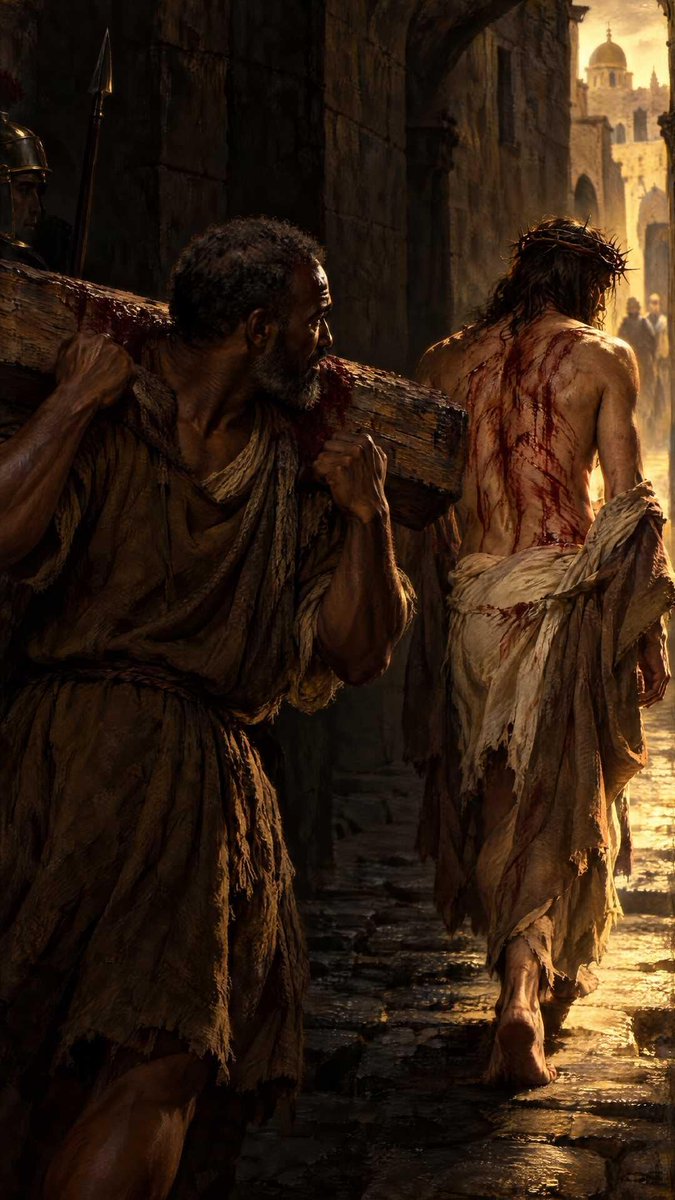
The man who carried the cross for Jesus didn't volunteer.
He was grabbed.
Mark 15:21. And they compelled one Simon the Cyrenian, who passed by, coming out of the country, the father of Alexander and Rufus, to bear his cross.
Picture it. A man walking into Jerusalem from the fields, minding his own business, and a Roman soldier's hand lands on his shoulder. You. The beam. Now.
Cyrene was in North Africa, modern Libya. Over a thousand kilometers from Jerusalem. Simon had made that journey for Passover, the holiest week of the year, and on the biggest morning of the feast he took the wrong street.
Now look at the word Mark uses. Compel.
In Greek it's angareuō. It comes from the old Persian courier system: a royal messenger could stop any civilian and requisition his horse, his cart, his back. Rome kept the custom. A legionary could grab any man on the road and make him carry the army's load, no questions asked. It was the most hated power the occupier had.
You've heard that word before. Jesus used it.
Matthew 5:41. And whosoever shall compel thee to go a mile, go with him twain.
Same verb. Angareuō.
Jesus stood on a hillside and told a crowd: when the soldier grabs you and makes you carry his load, don't just go the one mile the law requires. Go two.
Two years later, a soldier grabbed a man who had never heard that sermon and made him carry the Preacher's own cross.
Then Luke adds his detail.
Luke 23:26. On him they laid the cross, that he might bear it after Jesus.
After Jesus. Behind Him. Following.
Now flip back fourteen chapters in the same book. Luke 9:23. If any man will come after me, let him deny himself, and take up his cross daily, and follow me.
Luke wrote both sentences. He knew exactly what he was doing. Jesus preached take up your cross and follow me and the first human being in history to do it literally was a stranger from Libya who was forced.
Think about what Simon actually carried.
By the time the soldiers grabbed him, Jesus had already been scourged. Roman whips had lead and bone in the tips. His back was open. He'd been carrying the beam on it. The wood was wet.
Simon put that wood on his own shoulders. And walked behind Jesus, close enough to watch His back, the back Isaiah had written about seven hundred years earlier. I gave my back to the smiters.
He went to Golgotha with the blood of Christ soaked into his clothes.
Not a disciple. Not a believer. Not a volunteer. Just the man closest to the wrong soldier at the wrong moment.
And then Mark does something strange.
He names Simon's sons. Alexander and Rufus.
Why? Mark doesn't name the thieves on the cross. He doesn't name the centurion. He doesn't name the servant girl who broke Peter. But he stops the crucifixion narrative to tell you who Simon's kids were.
There's only one reason a writer does that.
His readers knew them.
The early church was unanimous that Mark wrote his gospel in Rome. And Paul, writing to the church in Rome, ends his letter with a list of greetings.
Romans 16:13. Salute Rufus, chosen in the Lord, and his mother and mine.
Rufus. In Rome. A man Paul singles out as chosen. And a mother Paul says had mothered him too.
Many scholars think that's Simon's son and Simon's wife.
If they're right, and it is the simplest explanation for Mark's detail, then here is what happened to the man who was grabbed on the road.
He went home to a wife and two boys, with another man's blood on his coat, and something he saw on that hill went through the whole household. Thirty years later his sons are known by name in the church in the capital of the empire. His wife is looking after the apostle Paul like a son.
Simon never says a word in the Bible. We have no record of his conversion, no sermon, no prayer. We only have the fruit. Two boys the church knew. A mother Paul loved.
He was forced to carry the cross one mile.
His family carried it for the rest of their lives.
Now you.
You didn't volunteer for the thing on your back either. Nobody does. You were walking in from the country, minding your own life, and a hand landed on your shoulder. The diagnosis. The child who needs more than you have. The grief you're still standing in. The debt. The parent who can't remember your name.
Ask Simon how it felt on Friday morning. Worst luck of his life. Ruined his Passover. A stranger's blood on his shoulders.
Ask him by Sunday.
The thing you were forced to carry is the only reason his name is in the Bible.
And notice where he was standing while he carried it.
Luke told you. After Jesus.
The forced cross is never carried alone. You're behind Him. He's already walked that road with a worse version of the same beam, and He's in front of you right now, close enough to see His back.
You didn't choose it.
Pick it up anyway.
He's in front of you.
What the world needs to see about us as Believers is not our wealth, worth or beauty. The good things in our life is not enough evidence of God’s existence.
They need to see without doubt that we have been with Jesus in our priorities and passions!