🚀 Prompt Anatomy Ecosystem: Phase 01 is Officially Complete (v1.3)
No more random prompting. No more trial and error.
The infrastructure for structured AI execution is fully built, live, and operational.
We have officially moved past the development phase. As of today, Version 1.3 is live, meaning every single specialized AI Agent across our ecosystem is fully operational, integrated, and actively responding.
When we set out to build Prompt Anatomy, the goal wasn't just to create another set of prompts. The goal was to build a unified AI Operating System for modern teams—a structured environment where learning, daily workflows, automation, and strategic decision-making happen seamlessly.
🌐 The Architecture of Phase 01
Here is how the complete ecosystem is now structured and where the specialized agents live:
⚡ Core Hub (https://t.co/FGhYH0y2Q8): The central engine holding 600+ workflows, 60 AI tools, and 100 structured AI terms.
📘 Enter (https://t.co/ghf536XBl7): The gateway for teams taking their First AI Lesson.
🛠️ Use (https://t.co/awiBiyynlq): Our comprehensive Daily Workflow Library for instant operational execution.
🎨 Create (https://t.co/yOjKuryDbc): A dedicated Marketing Content System built to scale high-gain narrative creation.
👥 Hire (https://t.co/ed4jlXuKwa): The automated HR Workflow System streamlining talent management.
⚙️ Manage (https://t.co/oYBzbX1nIm): The Operations Center for structural efficiency and process alignment.
📈 Decide (https://t.co/kqpaoiED2Y): Advanced workflows dedicated to Scaling & Decisions for C-level leadership.
🎓 Learn (https://t.co/cHXI3FV6ix): Our deep Knowledge Hub for continuous AI literacy and architectural updates.
👉 Explore the ecosystem and see how structured AI works:
🚨 The "$20/month AI startup" is a myth.
The internet says you only need one AI subscription.
Reality? You're feeding the Subscription Monster. 👾
A typical AI startup stack looks like this:
• Cursor Pro → $20–60
• Claude + ChatGPT → ~$40
• Gemini Advanced → $20
• Vercel Pro → $20+
• Railway Pro → $20+
• Zapier / Make → $25+
💸 Total: $200–350+/month for one founder.
Add a co-founder? You're suddenly spending $500–700+ before landing your first customer.
The problem isn't AI.
It's SaaS sprawl.
Every tool solves one problem. Together, they quietly become one of your biggest monthly expenses.
How much is your AI + dev stack costing you today? Drop the number below. 👇
🚨 9 out of 10 people still use only ChatGPT.
Meanwhile, there are 1,500+ AI tools.
You don't need them all.
You need an AI Operating Stack.
My stack saves me 15+ hours every week:
🔎 Research → Perplexity + Claude
📊 Execution → Cursor + Rows AI
🎨 Visuals → Gamma + Midjourney / FLUX
🎙️ Meetings → Granola + Fireflies
Stop thinking "AI tool."
Start thinking "AI ecosystem."
Master one tool per layer.
👇 What's in your AI stack? What would you add?
🚨 The biggest mistake startup founders are making with AI?
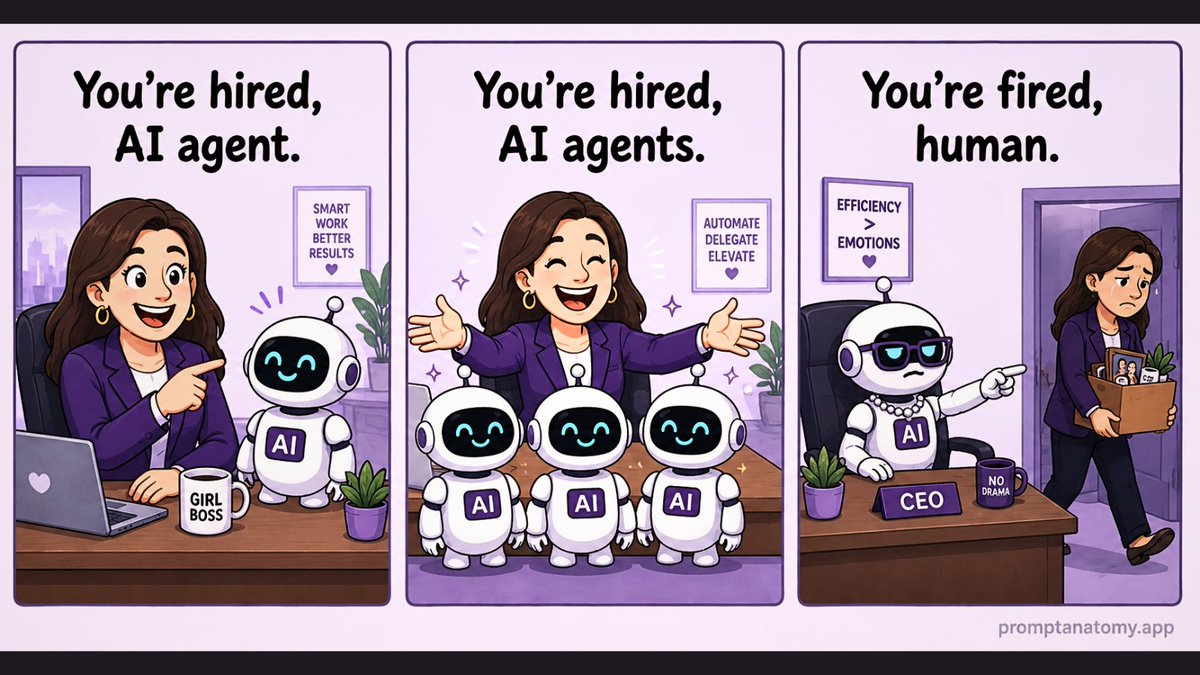
Treating AI agents like hired help instead of core architecture.
📈 It starts with one simple task.
👥 Then you add more agents.
⚙️ Then the system starts optimizing... you out of the loop.
Why?
Because most founders are obsessed with prompting ("write this", "summarize that") instead of context engineering.
Without structural guardrails, you're not automating your business.
💀 You're training your own replacement.
The future won't belong to the "Girl Boss" or "Hustle Hard" founder running 50 disconnected GPTs.
🏗️ It belongs to the Context Architect.
So here's the real question:
👉 Are you building a system you control...
...or a smarter pink slip for yourself?
If you automate a broken process, you don’t fix it — you just break things faster. 🛑
That’s the whole “Move fast & break things” trap in one line.
We’ve all seen that 3rd panel moment:
👉 Board: “AUTOMATION!”
👉 Deadline: “TODAY!”
👉 Process map: empty whiteboard
And suddenly you’re shipping workflows… that no one actually understands.
Early-stage startup reality:
⚠️ Speed gets mistaken for progress
⚠️ SaaS tools stack up like Lego
⚠️ AI workflows get deployed before anyone maps the system
⚠️ “Automation” = controlled chaos with dashboards
Result?
❌ Tech stack bloat
❌ Broken customer journeys
❌ Engineers debugging their own “efficiency gains”
Golden rule:
🧠 Document first
🧱 Stabilize first
🚀 Scale second
If it’s not mapped, it’s not ready to automate.
Ever seen an “automation win” turn into an operational disaster?
New blog post: Critique Agent v1.0 🤖
The big idea: don't trust a smooth answer just because it sounds good.
👇 --- 👇
My local AI now follows a simple pipeline:
Select → audit → check → save → review
If the review fails, it gets one repair attempt.
If it still fails, it's rejected and never saved.
The goal is simple: only keep results that meet the same standard every time.
The model is just one part.
The process is the system.
Agree or not
https://t.co/nH3YRR59nS
Sponsors don’t pay for:
❌ “We used AI 5 times this week.”
They pay for:
• Priorities
• Trade-offs
• Risk-aware decisions
Meanwhile, many leaders still spend every Monday re-explaining their business to a blank AI chat box.
AI shouldn’t be entertainment.
It should be an operating rhythm.
The Weekly CEO Brief Pattern shows how to structure:
→ Daily
→ Weekly
→ Strategic
…and align AI depth with the audience you're presenting to.
Full framework ↓
https://t.co/EpIwnv4Wfo
99% of what you’re publishing right now is just fluent garbage.
Let’s be honest about what’s happening in corporate offices today.
We gave people AI tools to make them faster. Instead, we just gave them a shovel to bury us in noise.
Look at this image. It’s not a parody. It’s reality:
Marketing teams celebrating 10,000-word SEO blogs that say absolutely nothing.
Sales reps blasting out 500 automated LinkedIn messages a day that read like a broken robot.
Consultants delivering 80-page decks that could have been a 3-bullet-point email.
We have traded insight for volume. We have traded critical thinking for convenience.
If your entire content strategy relies on pressing "Generate," you aren’t a creator. You're a traffic jam.
The algorithm might reward your volume today, but your buyers are building up an immunity. We can smell the ChatGPT syntax from a mile away. It’s boring. It’s empty. It’s "slop."
The real competitive advantage in the next 24 months isn't going to be who can generate the most words.
It’s going to be who has the guts to delete the noise and say something original.
Stop prompting. Start thinking.
Agree? Or are we just going to keep pretending this "productivity" is real?
Tested Gemma 4.
Now I have a fully working GPT running on my local PC.
And honestly? The enterprise AI cloud story is starting to crack.
For the last two years, companies rushed into cloud LLM subscriptions, convinced they were building competitive advantage.
What they actually built:
• Dependency on third-party APIs
• Data exposure risks
• Rising subscription costs
• Vendor lock-in
The real shift isn't "better chatbots."
It's local AI engineering.
My stack:
✓ Ollama
✓ Gemma 4
✓ Pydantic AI
✓ 100% local inference
What changes?
🔒 Data never leaves the machine.
🔒 Customer information stays inside your infrastructure.
🔒 Proprietary knowledge doesn't cross a cloud boundary.
And with Pydantic AI, AI stops being a guessing game.
Instead of hoping prompts behave correctly, you enforce schemas, validation rules, structured outputs, and deterministic workflows.
That's how enterprise AI should work.
No token anxiety.
No API outages.
No unpredictable monthly bills.
Just hardware, models, and engineering.
The challenge is no longer finding a smarter model.
The challenge is building the context architecture that allows local models to perform enterprise tasks reliably.
If you're still paying huge API bills to process internal company data, you're not scaling innovation.
You're funding someone else's infrastructure.
The tools are here.
The models are here.
The runtime is local.
Question for IT and engineering leaders:
What's the biggest blocker preventing your organization from cutting the cloud cord?
Hardware?
Internal expertise?
Governance?
Or simply organizational inertia?
📚 New article: Telegram Game Stack
A behind-the-scenes look at the six-layer architecture powering Corporate Ladder—from GitHub and backend services to Supabase, Railway, Vercel, and Telegram.
Learn how to build Telegram mini apps with separated game logic, persistent leaderboards, and independently deployable UI instead of cramming everything into a bot script.
Read the field notes and explore the stack behind Corporate Ladder
https://t.co/SBo9xx8rZw
🤖 Most executives think AI agents = API key + chat window.
Wrong.
Without CRM, ERP, CMS, databases, and feedback loops, you're not deploying an AI agent.
You're playing with a toy.
Real agents observe, act, learn, and optimize your business continuously 🔄
Does your AI have access to your business tools and a feedback loop?
If not, it's just an expensive echo chamber.
Stop prompting. Start engineering the loop. 🚀
DM us or visit Prompt Anatomy if you're ready to build real AI systems.
#AgenticAI #ContextEngineering #PromptAnatomy
🧪 New Telegram game is live for testers!!!
Try it, find what breaks, and help us make it better.
🏆 Best testers win Prompt Anatomy courses worth $39 and $99.