The AI skills gap isn't one problem — it's four: prompt illiteracy, template dependence, context blindness, and treating the first output as the answer. Naming yours is step one to closing it.
Find yours, free - https://t.co/VWkq4ENVT8
#AIskills
Auto-rewriter tools hand you a better prompt and teach you nothing — next task, same problem. The alternative isn't a better output; it's understanding why it worked, so the skill compounds.
See the difference -
https://t.co/VWkq4ENVT8
#PromptEngineering
The AI-education market is on track to 5× — $4B to $20B by 2027. Most of that spend will teach people to type wishes into a box and hope. The skill that actually compounds is structure.
Learn the part that lasts - https://t.co/VWkq4ENVT8
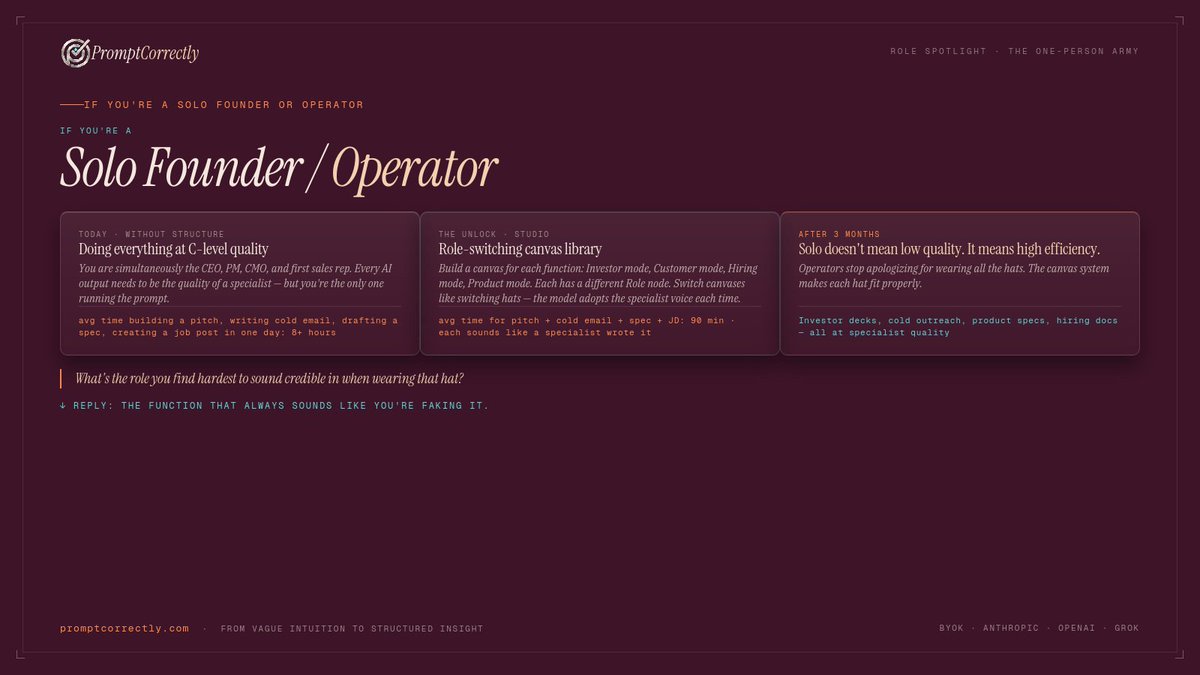
Being a one-person company means being the CEO, the marketer, and the first sales rep — usually before lunch. The fix isn't working faster. It's giving each role its own structure so every hat sounds like a specialist wrote it.
Build your role library - https://t.co/VWkq4ENVT8
Most prompting advice is folklore repeated until it sounds true. Ours comes with citations — every technique traces to a paper you can actually read.
See the sources https://t.co/VWkq4ENVT8
The model doesn't charge you for thinking clearly �� it charges you for everything you say to get there. Cut the noise, keep the answer, pay a tenth.
Try a lean prompt
https://t.co/VWkq4ENVT8
#PromptEngineering
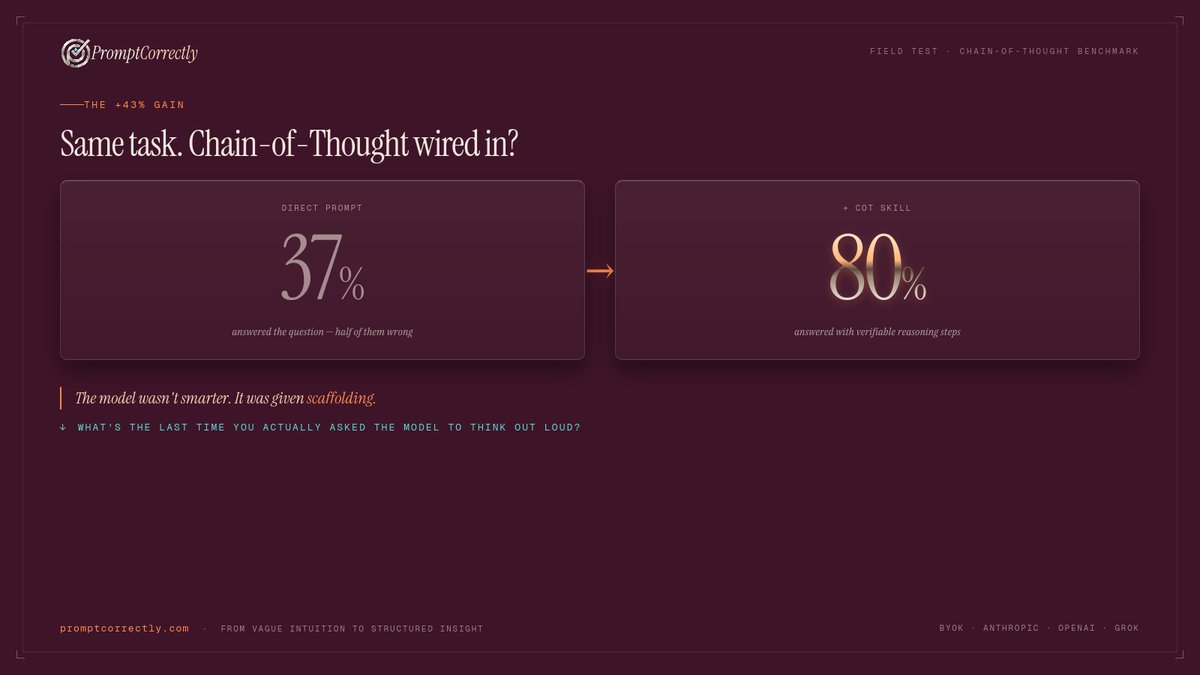
Same model. Same Task. One was told to think step by step - the other wasn't. 37% > 80% . Structure isn't a hack. It's the whole game. See what your AI does with it .
https://t.co/IiOXWcDyf9
#AItools
(Context vs Prompting)
New terminology, same underlying discipline.
"Context engineering" is getting more attention in 2025 than "prompt engineering." The distinction: context is what the model knows, prompting is how you specify what you want. You need both. One doesn't replace the other.
Which does your team think about more: context or prompts?
The model is strongly inclined to follow it — because of RLHF training — but the mechanism is inclination, not hard constraint. Understanding this explains why Studio's Skill configurations outperform session-level instructions.
A chat wrapper gives you a nicer interface for the same paradigm: type, get response.
Studio gives you a composition environment: architect a reasoning structure, wire together nodes with different cognitive functions, run a system. These are not the same category.
Most people don't realize they're choosing between them.
Category 1: does it for you. Output improves. Skills don't. Remove the tool: back to baseline.
Category 2: teaches you. Output improves AND skills improve. Remove the tool: still better than before.
We host on @Hetzner_Online . European data sovereignty by design.
German data center infrastructure. GDPR by default. No exposure to US CLOUD Act jurisdiction. This wasn't a default decision — it was a deliberate one for professional users with confidentiality requirements.
The AI education market is projected to reach $20B by 2027 .
The question worth asking: how much of that market is producing actual skill — and how much is producing the feeling of skill?
What's the best AI course you've taken that actually changed how you work?