At Prompt we call these abnormally externalized proteins (AEPs). Our surfaceomics platform systematically discovers the AEPs that show up on cancer cells but not healthy cells, providing a rich and novel source of targets for ADCs, T-cell engagers and more.
Surface proteomics has long dismissed as noise any intracellular proteins that turn up on the cell surface. A new paper from the Bertozzi lab adds to the evidence that some of these signals are real.
Floyd et al. proximity-mapped 85 surface antigens on T and B cells and found some unexpected “maverick proteins”: mitochondrial, nuclear and ER proteins on the cell surface.
https://t.co/Yo6jdFwsnw
Excellent article from leading life sciences VC Bruce Booth. He argues the AI revolution will exacerbate a decades-old problem in drug discovery: competitive crowding around the same handful of known targets.
At Prompt, we’re pioneering a solution. We uncover first-in-class, truly novel targets to realize the full potential of AI-driven drug discovery.
The Fruits of AI Drug Abundance: Indigestion In The Near Term
While the long term impact of AI is likely transformational, in the near term more drugs against known targets will likely exacerbate the crowding challenge dragging down industry R&D productivity
https://t.co/ynj0uqZ4MS
Interest in cell surface proteomics for drug discovery continues to grow.
Genentech’s new nanoMAPS platform enables surfaceome profiling from just 100–500 cells: https://t.co/pKdNa72CF5
A provocative preprint describes a radical new way some RNAs may be translated 3' to 5', creating an alternative universe of "backward translated" proteins.
We already know that mRNA expression is a poor predictor of protein levels. This preprint reinforces our conviction that there is no substitute for measuring proteins directly.
By directly measuring the proteome, our discovery platform helps ensure that unexpected proteoforms (including backward-translated proteins and rare PTMs) aren't left hiding in plain sight.
🤔
“Here we present evidence that eukaryotic circular RNAs (circRNAs) can serve as templates for 3' to 5' backward translation (BT), yielding polypeptides with distinct sequence and structural features not found in canonical proteomes.”
https://t.co/0e8pUWPUh7
How do we meet this challenge?
With a high-throughput, massively parallelized workflow to find all the protein-drug pairs that kill cancer.
This is why we built Prompt Therapeutics.
Finding the right protein-drug pairs — fast.
All the biologics for cancer. Promptly.
A tumor cell contains ~10,000 different proteins. Many of these are perturbed in cancer, but only a tiny fraction have the right properties to be antibody drug targets— i.e. highly expressed on tumor cell surface, not expressed on healthy cells, important for tumor survival, etc.
The numbers are rough and variable, but they’re in the right ballpark. So what can this exercise tell us?
There is a huge opportunity: based on what we know about cancer, we expect there to be 100s of different biologic drugs waiting to be found.
But there is a huge challenge: these treatments are hidden among ~200,000 other combinations of protein targets and drug types that won’t work: they will kill no cells, or all cells, or the wrong cells.
Drug development often focuses on the same old targets, and nowhere is this more true than in oncology: 100+ types of cancer & 70,000+ human protein isoforms, but only eleven (11!) solid tumor proteins targeted by FDA-approved biologics
why don’t our medicines work?
mostly, we don’t know what biology to target. we don’t know which cells or molecules to manipulate to make a patient healthy.
the clearest sign of this is crowding around known targets. smart teams continually decide that new targets are so sparse, they’d rather take on tons of commercial risk hitting the same genes.
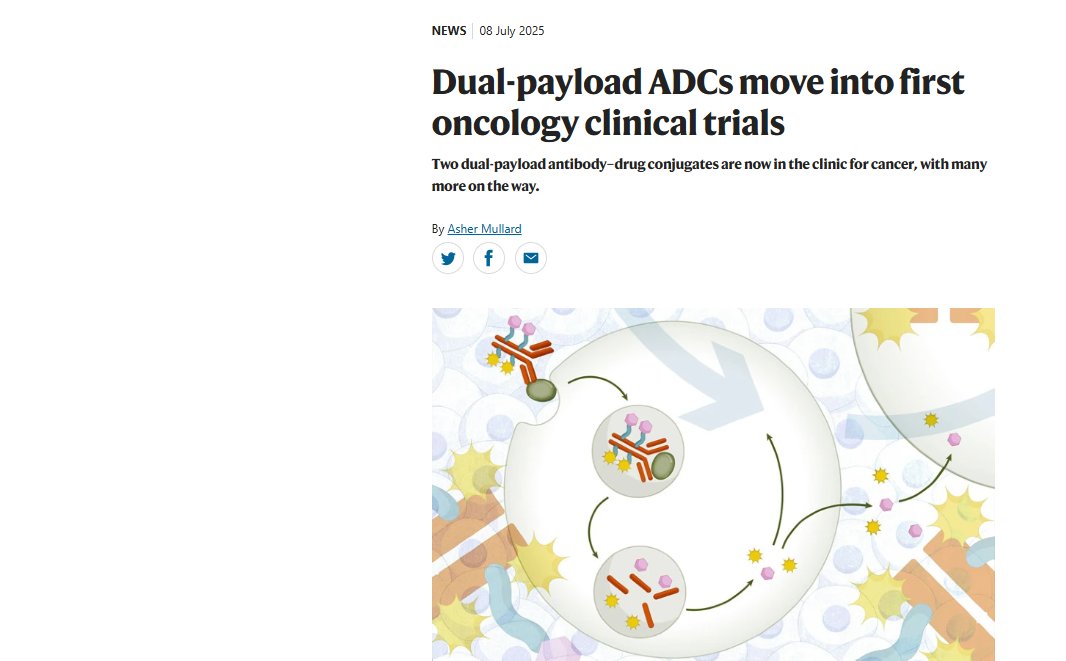
Unlocking the potential of multi-payload ADCs will require new, parallelized solutions to efficiently search a multi-dimensional optimization space -- and match targets to payload solutions at supercharged throughput
Dual-payload antibody-drug conjugates move into first oncology clinical trials https://t.co/EEk3J6SsIh
A rapidly growing cohort of companies are exploring if two different warheads may be better than one on ADCs, potentially unlocking durable anticancer efficacy
Hello! We are Prompt Therapeutics, and we are making cancer drug discovery a high-throughput process. Follow our account to learn more about how we generate new therapeutic antibody programs at an unprecedented rate.