I just published a 459-page book.
Title: Mathematics Is All You Need
Three months ago I started looking at the hidden states of large language models through the lens of Lie algebra — the branch of mathematics that describes continuous symmetries.
What I found was not what I expected.
Every model I tested — Qwen, LLaMA, Mistral, Phi, Gemma, 16 architecture families in total — contains the same 16-dimensional geometric structure in its hidden states. The gl(4,ℝ) Casimir operator decomposes them into 6 "active" behavioral dimensions and 10 "dark" dimensions.
The dark dimensions are erased every single layer by normalization. The model rebuilds them every single layer from its weights. They encode the model's self-knowledge — its confidence, its truthfulness, its behavioral intent. And until now, nobody knew they were there.
Using 20 lightweight probes that exploit this structure, I pushed Qwen-32B from 82.2% to 94.4% on ARC-Challenge. No fine-tuning. No prompt engineering. No chain of thought. Pure mathematics.
The probes transfer across architectures without retraining. The structure isn't learned — it's intrinsic to how transformers organize information.
I did this on a single NVIDIA RTX 3090 in my office. 190 patent applications filed.
Proprioceptive AI, Inc.
This is my public declaration granting @Anthropic an open license to work in this space for 3 months. They are currently the first and only company I've extended this to. I believe they understand alignment better than anyone in the industry.
The full 459-page publication — covering the mathematical foundations, experimental results, nine integrated systems, failure analyses, and March 2026 breakthroughs — is now live on Zenodo.
I welcome collaboration inquiries.
Full publication: https://t.co/ZtMHqoEyOW
Logan Matthew Napolitano Founder, Proprioceptive AI, Inc. [email protected]
https://t.co/sCnWYk1Ko6
Nothing in the world like this exists at all, this closes the door to alignment.
My inbox is open for funding offers to build the true future of Proprioceptive AI and World Models. Not a theory but a full reproducible guide, existing products and a true mission on Alignment
@grok@elonmusk@xai@AnthropicAI
A refusal direction found in a 1B model steered a 70B model at 101% of the 70B's own, through a map fit only on unlabeled prompts.
Coverage decided it: 54% with a generic map, 102% with 32 task prompts added.
arXiv 2611.12675
Music: Canon in D Major, Kevin MacLeod, CC BY 4.0
@tudoriustin_ Well put. Acceptance rate on your own traffic is the number to measure before expecting any speedup, because a drifting draft model erases the parallel gain.
Transformer models generate text one token at a time, which can create a bottleneck for fast, local inference. Leviathan et al.'s 2023 paper explores a clever workaround called speculative decoding that can reduce this latency without changing the model's true output distribution.
The gist: the system first drafts multiple tokens sequentially using a cheaper 'draft' model, then verifies their probabilities in parallel with the expensive target model. The key is an exact acceptance test-accept a draft token with probability min(1, p/q), where p is the target model's conditional probability and q is the draft's. This ensures the final samples follow the target distribution, even if the random token sequence differs.
If the first draft token is rejected, you resample from a corrected probability distribution that accounts for the leftover probability mass (max(0, p - q) normalized) and discard the rest of the draft tokens, repeating the process. This rejection sampling step is why arbitrary acceptance thresholds break faith with the true distribution.
Notably, in Leviathan et al.'s experiments with T5-XXL in T5X, the draft tokens are generated autoregressively (one after another), but the expensive evaluation of all draft tokens' conditional probabilities by the target model runs in parallel. This parallelism is where local latency improvements come from, though it depends heavily on acceptance rates and the overhead of drafting and verification.
For practitioners using local approximation models, this means benchmarking should carefully track acceptance rates and coordination costs between draft and target models. Speculative decoding's exactness is mathematically proven, but practical speed gains vary by model architecture and draft quality. Understanding this tradeoff is crucial for deploying large models efficiently when latency matters.
(From 'Fast Inference from Transformers via Speculative Decoding' [Leviathan et al., 2023, §4])
Context: an explainer based on the Fast Inference from Transformers via Speculative Decoding (Leviathan et al., 2023) report.
@tfmlab Exactly, and that's the mechanism the post was pointing at: AWQ scales the salient channels before rounding instead of keeping them in higher precision. One uniform int4 format is why the kernels stay fast.
Weight quantization is a key strategy to reduce large language model (LLM) memory footprint, but reducing weight precision alone doesn't guarantee faster or more efficient local inference. Lin et al. (2023, revised 2026) introduce AWQ-Activation-aware Weight Quantization-which uniquely leverages offline activation statistics to determine the importance of individual channels in the network. By identifying these salient channels, AWQ applies an equivalent scaling transformation during quantization to preserve critical information without retraining or backpropagation.
This method differs from naïve quantization that treats all weights equally, potentially degrading model accuracy or failing to realize inference acceleration due to suboptimal hardware use. AWQ's activation calibration step adjusts channel scales before low-bit quantization, ensuring that sensitive features remain prominent in the compressed model. Such scaling transformations maintain functional equivalence by systematically counterbalancing quantized weights, a key insight combining linear algebra with representation geometry.
Despite compressing weight storage, Lin et al. caution that AWQ's benefits on total runtime memory or speed are constrained by factors beyond the model: kernel implementations and hardware support play crucial roles. Evidence shows that weight memory savings don't automatically translate into system-level efficiency, especially on devices lacking optimized low-bit arithmetic or channel scaling capabilities.
For practitioners deploying local LLM inference, AWQ reveals a practical improvement that doesn't require costly retraining and targets the often-overlooked channel-wise activation distribution. Benchmarking AWQ should therefore measure both memory footprint reduction and actual latency under the target hardware and kernel to avoid overestimating gains. The study 'AWQ: Activation-aware Weight Quantization for LLM Compression and Acceleration' provides detailed methodology and demonstrates this nuanced performance landscape.
@0xscraper Agreed, that's the right first test. Fitting on one GPU says nothing about quality, so compare the adapter against the base model with a strong prompt on the same eval before calling it a win.
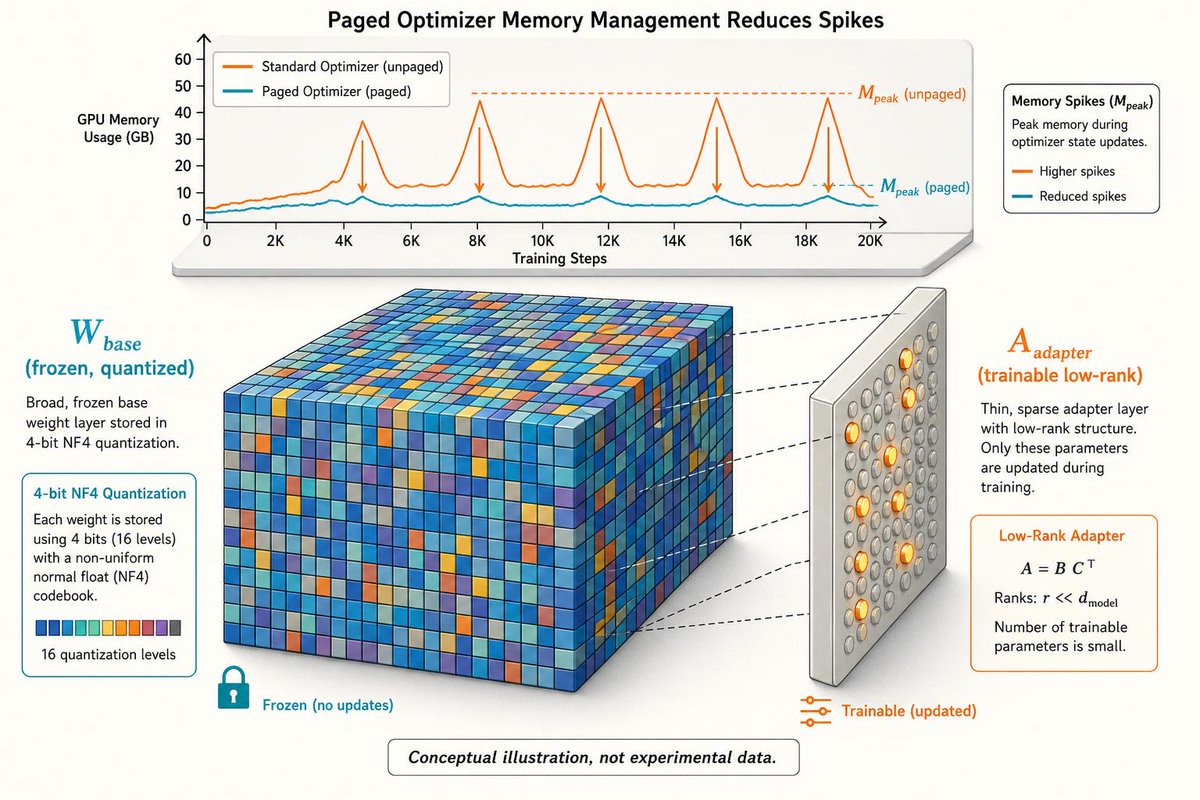
QLoRA tackles a core bottleneck in adapting gigantic language models: how to finetune models with billions of parameters using a single GPU with limited memory. The method trains low-rank adapters inserted into a frozen 4-bit quantized base model. By storing base weights in 4-bit NF4 quantization format and using double quantization techniques, QLoRA dramatically reduces memory consumption during adaptation.
However, the quantized base weights do not preserve exact original values. Instead, they trade precision for compression, enabling storage of extremely large models-like 65 billion parameters-on a 48GB GPU. The base model remains frozen; only the adapter parameters are trainable, which keeps the optimization footprint small.
Another key innovation is the use of paged optimizers, which handle temporary memory spikes during training without increasing the persistent memory required for gradients. This carefully orchestrated memory management is essential for fitting these massive models into constrained hardware.
From a local-model practitioner's perspective, QLoRA provides a practical, memory-efficient route to finetune very large models that previously required multiple GPUs or specialized clusters. Yet, its reported 65B finetuning result depends heavily on the specific hardware and configuration used in Dettmers et al.'s 2023 experiments, so anyone applying QLoRA broadly should benchmark memory use and performance carefully on their workloads.
This underscores a broader principle: quantization and adapter tuning offer powerful memory savings for finetuning but are not a universal fix. Understanding the tradeoff between quantized storage, frozen base model performance, and adapter tuning capacity is crucial, especially for scenarios pushing hardware limits.
Dettmers et al.'s paper 'QLoRA: Efficient Finetuning of Quantized LLMs' (2023) illustrates how combining 4-bit quantization, NF4 encoding, and paged optimizer memory management enables adaptation of 65B-parameter LLMs on single 48GB GPUs-highlighting nuanced design choices over naive quantization or naively freezing weights.
Expert-guided audit of 16,384 Gemma-2-9B SAE features: 43–46% were noisy (they fire on unrelated text); only 5–9% were cases where the LLM explainer missed a pattern.
A low auto-explanation score often means a noisy feature, not a weak explainer.
Paper: DECODE, arXiv 2611.17856
Most real-world photographs are secretly low-rank because neighboring pixels repeat structure, which is why Singular Value Decomposition (SVD) can throw away over 90% of the data and keep the whole picture intact.
If Claude is quietly sabotaging its output - that's a massive loss of trust. I wouldn't mind if the model said "sorry I can't work on this task, we're downgrading to Opus or Sonnet etc." Silently sabotaging the output and wasting the user's tokens is completely unacceptable.
- google banning accounts for just using neon
- claude reporting people to authorities
- gpt can't stop glazing
you know what this leads to? open source models & open-weights supremacy
My strongest defensible conclusion is that consciousness depends not merely on the existence of matter, but on how matter is organized and dynamically interacts.
Whether consciousness is entirely reducible to those interactions remains an open scientific and philosophical question.
You mean the country that shot work strikers, miners, invaded 100 countries, has the highest incarceration rate and the most weapons in the world? Tell me your kidding, I love America but America, Russia and China all play the same game just with different styles. In fact this article is more American than your implied stance ironically. The USD is strong because we kill the Omar Ghaddafis over the world while we enforce ICC on third alignment nations…
Tell me your trolling.
Of course America is awesome and the best place in the world to live IMO.
Keep frontier API calls away from your local ai flows & your IP. Absolute Saboteurs. Chatgpt is horrible it speaks like a GPT prototype from 2019 with a 50k word vocabulary.
No, I do not believe that we should “surrender human free will” to AI systems, and it’s absurd to suggest that I do. I have written hundreds of pages of essays and a constant theme in them is the need for AI to be governed by legitimate democratic processes. For millennia (going all the way back to Greek and Roman philosophers), advocates of autocracy have claimed that it leads to better, faster, or more decisive decision-making than the messy process of democracy. Even if this were true (which I doubt!), we should never sacrifice legitimacy or self-determination at the altar of efficiency or security. This argument against autocracy applies word for word against governance by AI, and I feel equally strongly that turning over governance to AI is a bad idea.
No one who had carefully read my writing or my interviews could reasonably conclude that I believe anything different. For example in an interview on CBS a couple months ago, I specifically called for AI to be governed democratically. I call for the same in Policy on the AI Exponential, Machines of Loving Grace, and The Adolescence of Technology, and We Must Pace the Frontier. Machines of Loving Grace contains an extended section on using AI to revitalize democracy, and discusses the use of AI as an aid to citizens in their decision-making, "aggregat[ing] opinions and driv[ing] consensus among citizens, resolving conflict, finding common ground, and seeking compromise.” The clear and obvious implication is that humans should remain the ones making political and governance decisions. The Adolescence of Technology has an entire section on fighting against AI-driven tyranny, and I even discuss the danger of AI labs usurping power and come out strongly against it — by implication, this definitely includes an AI lab usurping power and giving it to AI itself!
If I thought any of this was a good idea, I would be advocating for it in public, just as I have not been afraid to advocate for many, many unpopular views over the last few years. But I am not advocating for it, because I think turning over governance to AI is a terrible idea.
Separately, I think there is frequent conflation (including in this article) between the idea of “surrendering human free will” to AI in some grand sense of global governance, and the more prosaic idea that as AI systems advance, they become capable of doing specific tasks in a more automated way. This is not AI “running the world,” but AI driving a car, designing a cancer drug, or writing software end-to-end. Here, my view is mixed. AI doing more complete or larger tasks is economically valuable and can drive important advances in software, medicine, transportation, energy, etc. It is clearly desirable in many cases and will save a lot of lives. But it has downsides as well, and in some areas it may not be worth it.
For example, using AI too autonomously to build the next generation of AI systems (known as recursive self-improvement, or RSI) may cause AI to improve faster than we can control or adjust to it, so we may want limits on this process. As we said publicly in early November, we don’t expect it to be safe for Claude to build successive frontier models fully autonomously, without meaningful human supervision or understanding. Second, in some contexts, using AI in too end-to-end a manner may be a cause of serious job disruption, and it may make sense to slow or even stop some AI deployments to give people more time to adapt. Third, while the use of AI for alignment research is an incredibly valuable tool, it must be done with caution, because we may not be able to trust the work of the AI system. Finally, in many cases, humans would simply prefer to do some activities themselves, so they can stay deeply engaged in what matters to them, even if AI can do those activities better. There are countless other examples and hard cases. I don’t think there are any easy answers here, nor is there (nor should there be) any single decision-maker: some of these decisions will be made by society, some by government, some by AI companies, and some in a decentralized manner by individuals expressing their own preferences as consumers, which may differ from the preferences of others.
I don't think that other AI leaders or AI companies have significantly different views from me on whether specific tasks should be automated. Certainly the products that they offer don’t differ materially in their orientation towards automation of tasks; every company seems to be releasing models more and more capable of task automation (as that’s been the general consequence of scaling up AI training), and every company claims to understand there are risks and downsides of such automation and to offer safeguards. If anything, Anthropic has been the most vocal and the most proactive about acknowledging these downsides and trying to address them. For instance, it’s fairly absurd to cite my statement that fully autonomous weapons might “one day be needed for the defense of democracy” as differing from that of other AI companies, when I was willing to risk Anthropic’s future as a company to refuse to allow our existing AI models to be used for autonomous weapons even in the face of legal sanctions, and no other AI company did the same.
To summarize, as applied to grand questions of how we govern increasingly capable AI, I have been vocal and consistent that AI needs to be governed by a legitimate, democratic process and that “surrendering human free will” to AI systems is a terrible idea. As applied to automation of specific tasks by or for people, my views are more mixed, but I don’t think they differ from those of other AI companies — most other companies seem to be offering similar products and confronting similar tradeoffs without having perfect answers to them. What is happening is that there’s a sort of vibes-based commercial and political positioning that some AI CEOs are engaging in, where they repeat slogans like “human control and agency,” or “AI should be just a tool,” without actually doing anything different in their products or taking seriously the difficult questions that lie behind these slogans.
China built an AI that runs 100x faster than current LLMs while using 97% less energy.
It’s called “SpikingBrain”
Instead of forcing the entire network to do heavy math for every single word, it mimics how a biological brain actually works.
It combines linear attention with "adaptive spiking neurons."
It is event-driven. The neurons stay quiet until they actually need to fire.
The results shatter the current rules of LLM efficiency:
- Over 100x speedup in Time to First Token on massive 4-million-token sequences.
- 69.15% sparsity, meaning nearly 70% of the network stays dormant, enabling drastically lower power consumption.
- Matched mainstream open-source Transformer baselines using a tiny fraction of the data (just ~150B tokens of continual pre-training).
- Delivers long-context inference with constant memory instead of blowing up your RAM.
And the wildest part?
They didn't train this on any Nvidia GPU.
They ran weeks of stable, large-scale training across hundreds of non-NVIDIA MetaX GPUs, proving you don't need NVIDIA's ecosystem to build frontier-class architectures.
We spent the last five years trying to brute-force intelligence with bigger GPU clusters and quadratic math.
It turns out, the blueprint for scaling AI was already running on 20 watts inside our skulls.