Sherwood starts with a 5–10% buy/sell tax.
Hold. Stake. Bond.
Build your Loyalty Score and reduce your sell tax all the way down to 1%.
The system is simple: reward long-term holders while making quick selling less attractive.
And the tokens collected through the tax system won’t just sit idle.
They’ll be used to strengthen the protocol in one way or another.
We already have 7,724 USDG in the treasury + 48.3 $ROBIN collected through the tax system.
Soon, we’ll announce the first token we plan to acquire with collected taxes, putting the treasury to work and generating yield for the protocol and its holders.
The flywheel is just getting started.
(🏹;🏹)
We’re Sherwood DAO building
on Robinhood Chain.
This was just the beginning. We are bringing DeFi, yield, gamified staking, and exposure to onchain stocks & RWAs to the ecosystem through $ROBIN.
Early days. Big forest ahead.
More on the future of the protocol soon.
A new feature is coming.
missed a fat bag on robinhood:0x39dbed3a2bd333467115de45665cc57f813c4571, being drained 1week ago
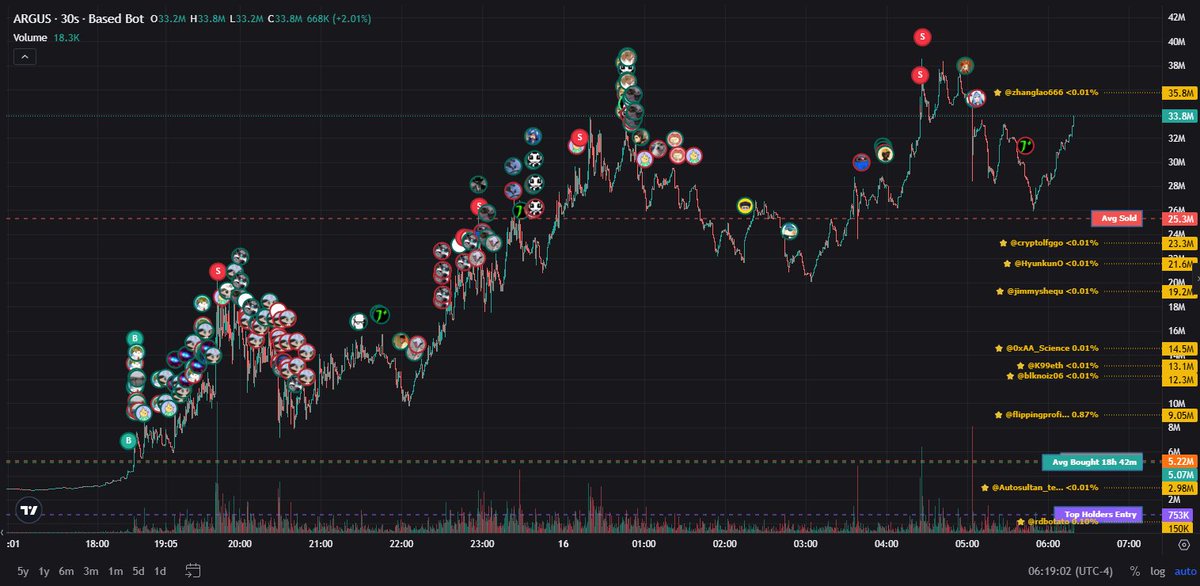
said fuck it and took the shot on $ARGUS
+$60k later, still holding 30% of my bag
thank god 🙏
Probably.
“OHM fork” describes $NET’s ancestry more than its current model.
The reserve / bond / rebase engine is clearly OHM-derived, but @NetNetCap is now using that engine as the base layer for something much broader: yield-bearing reserves, an RWA sleeve that isn’t even counted in RFV, and a credit layer where the fund can borrow against tokenized equities.
That’s the real evolution.
It went from a token with a treasury to a treasury actively deploying capital across an onchain financial stack.
And I think future reserve-backed models should study that part closely.
The treasury shouldn’t just sit there as passive backing. The goal should be to make the capital productive, generate new revenue, strengthen the balance sheet, expand what the protocol can do, and feed that value back into the same system.
That’s how you start closing the loop instead of relying on emissions forever.
Calling $NET an OHM fork isn’t exactly wrong.
It’s just becoming increasingly incomplete.
Crypto was never supposed to be just about finding the next pump and jeeting a few days later. The bigger this industry gets, the more important the long-term view becomes.
Look at what’s happening around us. Fintechs like Revolut have become massive financial intermediaries, yet even they can still face serious incidents involving sensitive customer data. At the same time, banks and traditional finance are moving deeper into crypto, stablecoins and tokenized assets. More assets, more payments and more financial activity are slowly moving onchain.
That contrast matters. We’re moving toward an increasingly digital financial system, but the more centralized it remains, the more we’re reminded of the risks around custody, data, access and control. That’s exactly why decentralized infrastructure matters more, not less.
Governments are also paying much closer attention to crypto than they were a few years ago. That makes sense. This industry moves enormous amounts of capital, creates new wealth outside traditional financial channels and is building infrastructure that can reduce our dependence on banks and centralized intermediaries. Of course, there are legitimate reasons to regulate crypto, from fraud and money laundering to consumer protection and financial stability. But there’s a bigger reality too. Crypto changes how capital can move, who gets access to markets and how much control traditional institutions have over financial activity.
That doesn’t mean every crypto protocol deserves trust. Quite the opposite. As crypto becomes a bigger part of global finance, these protocols will need to be scrutinized much more seriously. Treasuries, reserves, governance, revenue, security, transparency and risk management will matter more than ever.
Some of these protocols may not remain purely speculative tokens forever. They could eventually become part of the investment infrastructure people use every day. Right now, it’s mostly crypto-native investors paying attention to treasury growth, reserve backing, tokenized equities and onchain financial primitives. Tomorrow, that audience could be much bigger.
And what Robinhood is doing right now shows how quickly the line between traditional finance and onchain finance is starting to blur. Vlad Tenev isn’t just talking about putting stocks on a blockchain anymore. Robinhood Chain is being built around real-world assets, with tokenized stocks that can trade 24/7, live in wallets and potentially be used across DeFi as collateral or in lending markets.
Robinhood now wants to go even further by making stock tokens look more like traditional equity ownership, including voting rights and the ability to redeem them for the underlying shares. That’s where this gets really interesting.
If a tokenized stock can eventually be held directly onchain, traded 24/7, used as collateral, plugged into financial protocols and gradually gain rights closer to those of a traditional share, the distinction between TradFi and onchain finance starts to matter a lot less.
At that point, crypto isn’t simply trying to recreate traditional finance anymore. Traditional finance is starting to adopt crypto rails.
More traditional investors are already paying attention to tokenization and onchain markets. If that trend continues, the people here today are watching part of this infrastructure being built before most of the world fully understands how important it could become.
That’s why I think the obsession with short-term price action misses the bigger picture. You, me, everyone here, we’re still early to something that could become much bigger than another crypto cycle.
And that’s also why protocols like $NET interest me. I’m not interested in NetNet because I need the token to pump tomorrow. I’m interested because they’re building a treasury around tokenized equities while that entire market is still in its early stages.
If Robinhood Chain becomes a major venue for tokenized assets and NetNet keeps growing its balance sheet alongside that expansion, the thesis becomes much bigger than a short-term trade.
It’s the same reason I’m watching newer experiments like @SherwoodDAO_. Not because every protocol will win. Most probably won’t. But the ones that survive, manage risk properly, build real reserves, stay transparent and earn long-term trust could end up being some of the investments people wish they had paid attention to much earlier.
We might be among the first wave taking them seriously. We definitely won’t be the last.
Long term matters. Probably more now than ever.
And Sherwood is very well positioned to be one of the pioneers in this sector.
The day when small investors, together, can genuinely influence the future of a real company is much closer than we think.
Our launch is coming soon.
Not today
most likely tomorrow.
Let the (🏹;🏹) begin.
Tick tock. 2 hours 30 left.
7,875.32 / 9,000 USDG
Just over $1K left before the gates of Sherwood can open.
$ROBIN, where are you?
We’re gonna need you to open the gates of the forest…
Tell me you brought some gold with you... Enough to get us launching tonight?
Robinhood Chain is waiting 🏹
To those who have been following us from the beginning, and to those who trusted us through everything: this post is for you.
We could have walked away after V1, but we didn’t. In the wild, mistakes happen. Some are costly, some can feel unforgivable, but often they are part of the path. You fix them, understand exactly where things went wrong, learn from them, and once you’ve crossed that ground once, you know where the traps are. That’s where Sherwood is today. Trust was tested, lessons were learned, and we chose to rebuild rather than disappear.
Now the question is simple: are you willing to take that bet with us while the $ROBIN bonding curve is still open, knowing that if the soft cap isn’t reached, participants are refunded and V2 does not launch? Or do you stay on the sidelines and risk watching the opportunity disappear altogether?
We’ve already seen what reserve-backed models like $NET can become once momentum, treasury growth and attention begin compounding. And those who were actually there for Sherwood V1 know the potential wasn’t imaginary. Before the router issue changed the story, a lot of people were on track to be very happy with how things were moving. You don’t have to take our word for it. Look at the chart yourself:
https://t.co/Xf0YDpIpJe
One execution mistake shouldn’t erase an entire thesis, especially when that mistake is now understood, corrected and much easier to avoid the second time around. Most of you have been in this market long enough to recognize when something has potential, even when the path hasn’t been perfect.
Sherwood is still building on Robinhood Chain, still pushing the same long-term thesis, and still trying to open the gates of the forest again. There’s only a little over $1K left to fill before we get there. With you or without you, we’ll push until the final minute.
And to those who stayed when staying was hardest, remember one thing: the loyal will be rewarded. That is not something we added after V1. It has been part of Sherwood from the beginning and it remains part of the thesis until the end.
Robinhood Chain. $ROBIN.
Hard to give you a reason not to buy $NET if you understand what you’re buying.
The main risk imo is simply entry and valuation. $NET already proved the model and had a massive run, so you’re not buying with the same asymmetry the earliest holders had.
That’s also why I’m watching the next iterations of the reserve-backed / OHM meta on Robinhood Chain.
Vlad Tenev is clearly pushing the vision of bringing more financial markets onchain, and if Robinhood Chain becomes a real hub for tokenized assets, the protocols building early around that infrastructure could have serious upside.
@brim_hq is taking a different approach with real revenue, reserve assets and direct pro-rata redemption.
@SherwoodDAO_ is closer to the $NET playbook, but V2 is trying to improve some of the mechanics around loyalty, staking and long-term participation. $ROBIN is still at the presale stage, so obviously much higher risk, but you’re also looking at a completely different point on the risk/reward curve.
I own $NET, but I’m not ignoring what’s being built around it either.
The next winners probably won’t all look exactly like $NET, but they may come from the same broader thesis.
anyone who thinks a tool can tell you if a text is AI written or not with 100% certainty is fucking retarded
these detectors are literally just checking text against basic metrics like perplexity/ sentence burstiness to spot predictable patterns BUT
modern LLMs are trained explicitly to match human language distributions…when your model's entire objective is to minimize the statistical gap between its outputs and actual human writing, the overlap becomes massive
that makes binary classification an absolute nightmare, sincce human and AI text distributions basically sit on top of each other now, pulling a threshold out of thin air guarantees a mountain of false positives &false negatives
Shareholders,
553 Wallets have placed 9,140 trades via the dial up desk.
We've paid out $161,800 to traders in just 31 hours.
Trade 10 pairs with 1,000,000x leverage today at https://t.co/nAMOODKRWC
but its just another fork anon
⚠️ Beware of scams!
Fake PloPlo mint websites are circulating. Please do not trust unofficial links or DMs.
The only official mint link is:
🔗 https://t.co/xHMgIWsTKm
Stay safe, Friends. 🛸