can reduce friction, encourage experimentation, and give applications more room to grow.
A blockchain ecosystem needs more than users. It needs builders who can turn ideas into useful products.
Make building easier, and you create more room for innovation.
Why should developers have to start from zero every time they explore a new blockchain?
This is one reason EVM compatibility matters.
The Ethereum Virtual Machine (EVM) provides an environment for executing smart contracts. When a blockchain supports EVM compatibility,
developers can work with familiar Ethereum-based programming tools and development workflows.
@dac_chain adopts an EVM-compatible Layer 1 approach, giving developers a more familiar starting point to build and experiment.
This matters because easier development environments
Sometimes, progress comes down to showing up consistently.
@dac_chain is giving Interstellar operatives another reason to stay active.
Complete seven consecutive daily check-ins to unlock the weekly badge, then mint it for 500 Quantum Energy,
There's also a daily base crate where users can spend their accumulated QE for a chance at rewards.
I like how these activities encourage people to keep exploring the platform rather than simply showing up once and disappearing.
That's what makes understanding its tokenomics important.
A launch might bring attention, but the real question is how the token fits into the network's long-term development.
Before getting caught up in a TGE, it's worth understanding what you're actually looking at.
$DACT isn't designed to be just another ticker in the market.
It has a role within @dac_chain's broader ecosystem, supporting governance, staking, node activation, and participation.
The closer a project gets to TGE, the more important it becomes to understand what the token actually represents.
With DAC, $DACT is designed for more than market activity.
Its role extends to ecosystem participation, governance, staking, and node activation
within the broader DAC economy.
A token launch can create attention, but meaningful utility and a functioning ecosystem are what give the project something to build on afterward.
As DAC moves toward its next major token milestone, understanding the purpose behind $DACT matters
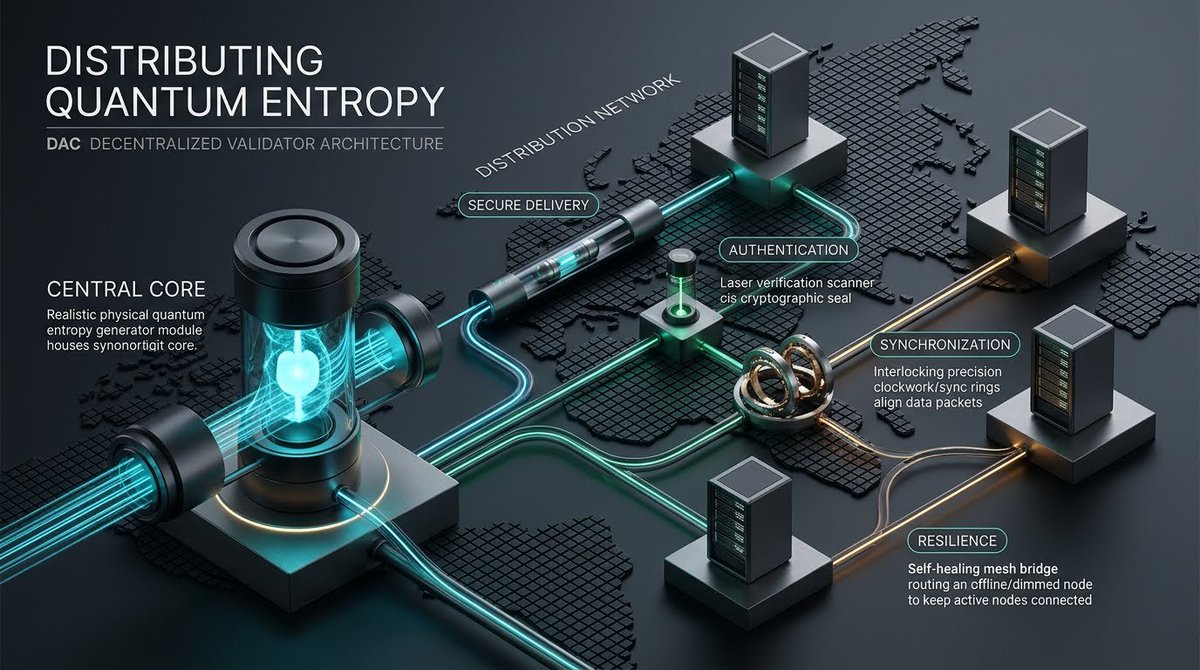
How is it authenticated? How is it protected in transit? How can the network ensure the right participants receive the right material?
These details may seem small, but they can determine whether a promising cryptographic design works reliably at network scale.
Quantum security isn't just about generating better randomness. It's also about what happens after that randomness is generated.
DAC's Quantum Entropy approach brings another important consideration into focus: secure delivery of encryption material to validators.
It determines if a security model can operate reliably in a decentralized environment.
Generating unpredictable entropy is one achievement. Making its distribution secure & dependable is another.
The strength of a security architecture depends on every layer working together.
Quantum randomness can strengthen a security design, but distributing it across a decentralized network introduces another layer of complexity.
DAC's Entropy-Padded Transaction approach relies on encryption material that must be handled appropriately by the validators involved
⚙️ Synchronization: How does the network ensure participating validators have the correct material when processing transactions?
🌐 Resilience: What happens when a validator goes offline, joins late, or experiences a communication failure?
These aren't just technical details.
It's about creating an environment where new applications can emerge and practical solutions can find their place on-chain.
Give builders the right foundation, and let innovation take it further.
Great ideas are everywhere. The right infrastructure helps turn them into working products.
For developers, choosing a blockchain involves more than comparing transaction costs.
They need familiar tools, reliable execution, room to experiment, and an ecosystem
where their applications can grow.
@dac_chain's EVM-compatible Layer 1 provides a familiar starting point for developers already working with Ethereum-based development tools.
But the opportunity goes beyond writing smart contracts.