Protofire x @wirexapp!
We are partnering to bring non-custodial card payments to blockchain projects.
Two tracks: deploying Wirex BaaS infrastructure onchain, and integrating Wirex card payment solutions with projects across the space.
Tokenized RWAs just crossed $30B. That measures how much value has been put on-chain. It says nothing about how much of it anyone can actually trade.
TVL and liquidity get read as the same signal. They aren't. One says an asset has been represented as a token. The other says there's a buyer, a price, and a way out when you want it. Much of today's tokenized value scores high on the first and near zero on the second.
Most tokenized treasuries mint through the issuer and redeem through the issuer, with little trading in between. If the only buyer is the issuer at redemption, that's not a secondary market. It's a redemption line.
And it won't be uniform across asset classes. Treasuries, equities, commodities and FX already have deep off-chain markets, so they arrive on-chain with a price and people who know how to make one. Private credit, real estate and one-offs don't. Tokenizing them doesn't create demand that never existed.
@dillonhanson12 from @DIAdata_org makes this point during the Protocol Roundtable: expecting every tokenized asset to reach deep on-chain liquidity is a real bottleneck. Issuance has matured much faster than the market structure that makes an asset tradable.
A tokenized asset with no compliant venue to trade still has value. But it's a redemption mechanism, not a market.
What do you see as the biggest obstacle to building real secondary markets for RWAs?
WE’VE REACHED ≈$2B IN ANNUALISED CARD SPEND VOLUME! 🚀
July’s $160M+ in onchain card spend pushed our annualised run-rate to ≈$2B in just 8 months since launch.
We reached $1B in 131 days, the fastest in the industry. Roughly 110 days later, that run-rate had nearly doubled.
In April, KelpDAO's bridge released 116,500 rsETH with no ETH behind it.
The exploit wasn't the interesting part. What the attacker did next was.
They didn't sell. They deposited the fake rsETH into Aave and borrowed real WETH against it. A minting bug on one bridge became up to $230M in potential bad debt on a lending market that did nothing wrong.
Trace the chain:
Exploit → collateral of uncertain value → bad debt → frozen reserves, LTV to zero, withdrawals halted → confidence drops → capital leaves markets that were never touched.
Somewhere in that sequence, bad debt stops being a protocol's accounting problem and becomes a depositor's problem.
Stream's xUSD showed the same mechanic from another angle. Hardcoded collateral prices let borrowers draw full value against a token trading far below par. The damage reached deUSD and spread across Euler, Morpho, Silo, and Gearbox. Markets that looked isolated were linked through shared collateral.
So if you issue a token that gets accepted as collateral, the question has moved.
Audits, monitoring, and risk parameters address whether a failure happens. They say little about what happens after. That's where a protection layer belongs.
Parametric coverage is one approach. Define the trigger in advance, a redemption freeze, NAV deviation past a threshold, oracle failure, a bridge outage, and coverage activates when the condition is met. It won't stop an exploit or undo every downstream effect. It absorbs financial impact at the moment audits have nothing left to offer.
This is the problem products like RWArmor are built around.
If your token is accepted as collateral somewhere, what does your protection story look like the day its integrity breaks?
If your PoS network has strong fundamentals but thin LST penetration, your staked capital is working at half capacity.
Protofire builds the liquid staking infrastructure that fixes it, including a plug-and-play Cosmos LST for EVM-execution chains.
Our Field CTO, Diego Torres, on how it works 👇
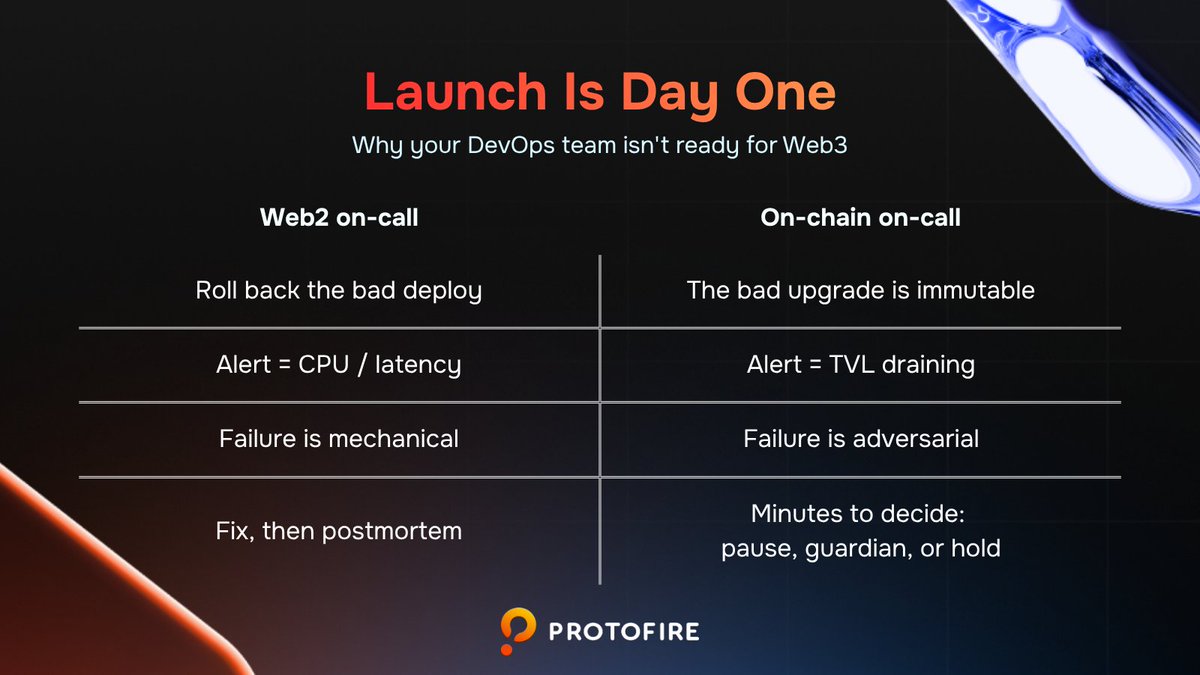
Your product went live on a public chain. Who's on watch tonight?
When an institution goes on-chain, the product becomes live money on infrastructure that never closes. The team behind it works business hours and usually isn't web3-native. That gap is where the exposure sits.
A normal ops team is built for systems you control: something breaks, you roll back, restart, review in the morning. On a public chain, an upgrade can't be un-shipped, an oracle can deviate at 3am, and a dependency can be exploited while your office is dark.
Detection tools help, and you should keep them. They tell you something is wrong. What they can't answer is who acts on the alert, with what authority, in what order. An alert nobody owns at 3am is a timestamp for the post-mortem.
Closing the gap by hiring means six or more senior web3 engineers for a real rotation, from the scarcest talent pool in the industry. You wouldn't run core banking without an ops function. Live money on a public chain deserves the same posture.
We run that layer: 24/7 monitoring, incident response, key and upgrade operations, inside an authority matrix where you keep the product, the funds and the regulatory perimeter. We don't make incidents impossible. We make sure they get answered.
Live on a public chain, or a go-live on the calendar? Let's talk about who's on watch.
4/ The best part: you grow volume without chasing new users. The people already on your platform just get room to act.
Buildable now. If it's on your roadmap, we run a 30-min Architecture & Pilot-Fit Audit. DM open.
3/ That's not the only path.
Let users borrow against the position they're opening and size up inside your buy flow, embedded in your app on mobile and desktop. Keep the lending in an isolated market, and the risk sits on the position instead of the protocol.
Most of the capital in crypto sits in Bitcoin, and almost none of it does anything. Testnet III is where that starts to change. Worth watching who's building on it.
Alpen’s partner integrations are now underway on Testnet III.
More than 21 launch partners across infrastructure and apps are preparing to integrate ahead of mainnet.
The ecosystem for Bitcoin-native financial infrastructure is assembling.
Issuing a tokenized asset is the easy part. Building the secondary market where it actually trades is the hard part.
Proven: Protofire built the on-chain core behind Swarm Markets. 50+ pairs, 7,000+ KYC'd wallets, <$1M → $15M+ monthly volume in 6 months.
Live now: that dOTC, productized on BNB Chain. Non-custodial, atomic settlement, dynamic pricing.
100+ deployments. 20+ ecosystem partnerships. Five years.
Still the most prolific @Safe deployer in the ecosystem. The work now runs under @DewPointLabs.
Building a chain and need production-grade infrastructure from day one? https://t.co/S4T4Gbl377
Five years ago today, our team signed its first Safe deployment and support agreement.
22 July 2021. One chain. One contract.
A thread on what five years of Safe infrastructure actually looks like, now carried by @DewPointLabs.
🧵
2025: a trusted canonical @Uniswap v3 deployer.
Safe infrastructure. Uniswap v3 liquidity layer.
2026: licensed @Blockscout partner, with years of prior Blockscout deployment and indexing experience.
Blockscout Explorer. One team, one point of contact, same quality and delivery standards across all products.