SpaceX filed to go public last month, and the paperwork is a useful tell about where the market is heading.
18,712 Bitcoin sitting on the balance sheet. A payments business growing inside X. A serious push into AI compute. Three bets on the same convergence the whole industry keeps talking about - crypto, AI, and infrastructure - now laid out in black and white for public investors to price.
But look at how it is built. Bitcoin treasury in one box. AI compute in another. Payments in a third. Three separate businesses stapled together under one roof, each to run on its own.
Qubic was designed the other way around. The mining that secures the network is the same computation that trains AI. There is no separation between a crypto operation and an AI operation, because Useful Proof of Work is a single mechanism that produces both at once.
The largest companies in the world are now spending billions to bolt these pieces together. Useful proof of work had them fused from day one.
An AI research paper has been getting attention this week.
The finding, in plain terms: if you grade your training data by quality from day one instead of treating every example as equal, you can train a model up to 2.8x more efficiently.
Sounds obvious, but this is not how most AI gets built.
And it rhymes with something Qubic has been doing for the past four years. 🧵
The Quorum has spoken.
Qubic's second halving is approved and locked in for Epoch 227.
Weekly emissions drop from 450B to 225B $QUBIC. The burn rate jumps to 77.5% of all weekly emissions. The first halving was EP175.
EP227 keeps emissions on a controlled long-term schedule and extends the runway for the entire ecosystem.
Energy was never meant to be wasted.
Qubic turns proof-of-work into the work itself: computation that trains AI with purpose.
No staking. No idle burn. Just useful work.
This is not mining as you know it. It's Qubic.
Watch.
Every blockchain has to answer one question early: where do new coins come from, and how fast.
On Qubic, new QUs are released every week. Roughly a trillion of them.
A halving is the network’s way of deciding to slow that tap down.
There is a live vote on the next halving, closing this week.
Here is what it actually means, in plain terms. 🧵
More updates on the🪼#Neuraxon front from @_Qubic_#OpenScience hybridized with #Aigarth@josesanchezhb & @VivancosDavid are proud to share #NeuraxonLive
Game Of Life Server + Client so you can Deploy your own world of 🪼based on Game of Life 5.0
Full open source code at: https://t.co/SJuYIL0BOA
Deploy your own server or use ours.
Breed your own 🪼the first season just started,
is live at https://t.co/H5KcaO9vSy
- Will yours live forever? -> If so share your 🪼
- Will yours be on top of the rankings?
This season world max is 500🪼and max 100 Custom Nxers claim yours now!
Why it matters?
Neuraxon Live isn't a simulation you load and reset — it's one neural world running 24/7, "forever", where every creature carries a real g-capable brain that forages, mates, sings, and dies on its own.
You're not watching a replay; you're watching open-ended evolution and emergent intelligence happen live, ranked all-time across every NxEr that ever lived.
Open a browser, zoom in, and you can literally hear artificial minds being shaped by selection in real time. 🧠🌍
Qubic Science just had its Neuraxon V2.0 paper accepted at AGI-26 in San Francisco.
That makes three academic acceptances so far this year.
ICMLT in Berlin, where it won best presentation of the evening session.
AMLDS in Japan.
And now AGI-26.
This one is different from the other two, and it is worth explaining why.
ICMLT is a machine learning conference.
AMLDS is machine learning and data science.
AGI-26 is the only major conference on earth built around a single question:
How do you actually create general intelligence, the kind that transfers from one problem to a completely different one instead of memorizing a single trick?
That is the exact question Neuraxon was built to answer.
Most crypto projects that mention AI are wrapping someone else’s model and bolting it onto a token.
Neuraxon is an attempt to grow artificial brains that adapt over time, the way biology does.
Getting into the room where the people who take AGI seriously argue it out, in front of names like Karl Friston and Ben Goertzel, that is the milestone.
The conference runs July 27 to 30.
The research is open.
The paper is below.
In 1904, psychologist Charles Spearman found that children who scored well in one subject scored well in almost everything.
He called the underlying factor “g”, general intelligence.
120 years later, g remains one of the most replicated findings in behavioral science.
And yet, when researchers run the same psychometric analyses on large language models… the g factor structure doesn’t show up.
LLM performance across domains doesn’t correlate the way human cognition does.
It tracks training data density, not genuine cognitive generality.
So what would it take to actually evolve g in an artificial system?
That’s the question behind Neuraxon’s latest experiment.
Artificial creatures growing their own modular brains, selected not for mastering any single task, but for the shared cognitive thread across many.
In the 1960s, the US and Soviet Union both launched rockets. Both burned the same fuel. Both pushed the limits of human engineering.
One program put a man on the moon. The other proved it could.
Bitcoin mining is the rocket that proved it could. Qubic is the one going somewhere.
On Qubic, the computors aren’t racing to stamp out a number. They’re training an AI.
The proof of work and the work itself are the same thing.
Every cycle goes into building something that didn’t exist before, something that actually matters.
That something has a name. Aigarth, an AI the network has been growing from scratch for four years.
And it’s about to get even faster and more coordinated.
A protocol upgrade called the Anthill is coming.
Until now, every miner searched for answers on their own, thousands of people digging random holes hoping to find gold.
Once the Anthill lands, each miner builds on where the others left off, the way ants reinforce each other’s trails until the whole colony moves as one.
The work of one starts making the work of everyone else better.
Same energy bill, yet a completely different destination.
Yes... Looks Like #Neuraxon just started....
@josesanchezhb & @VivancosDavid are very proud to communicate that our paper #MultiNeuraxon follow-up to the just presented and awarded at ICMLT Neuraxon 2.0 in #Berlin for@_Qubic_ #OpenScience evolving @c___f___b #Aigarth to new heights...
This time has been accepted for poster presentation a the 19th #AGI Conference, so to #SanFrancisco @SFSU and beyond...
3 billion Chromium users just got one-click access to the Qubic Wallet.
The Qubic Wallet Chrome Extension has graduated from beta. Version 1.1.0 is approved by Google and installs in a single click.
Previously, installing the wallet meant downloading a package and sideloading it manually. Fine for developers, but a wall for everyone else.
That wall is now gone.
Create and manage accounts, send QU, manage assets, all inside an encrypted vault built for real use.
The wallet is fully open source and contributions are welcome.
For developers building on Qubic: native dApp integration is live through the window . qubic provider API. A sample integration repo is already on GitHub.
One link. Every Chromium browser. No sideloading.
ChatGPT is a photograph of intelligence.
It was trained once on a massive dataset, frozen, and deployed. Its weights do not update. Its architecture does not change. Whatever it retains between sessions is a note, not actual growth.
Every answer it gives comes from a snapshot that stopped updating the day training ended.
Qubic is building something fundamentally different. 🧵
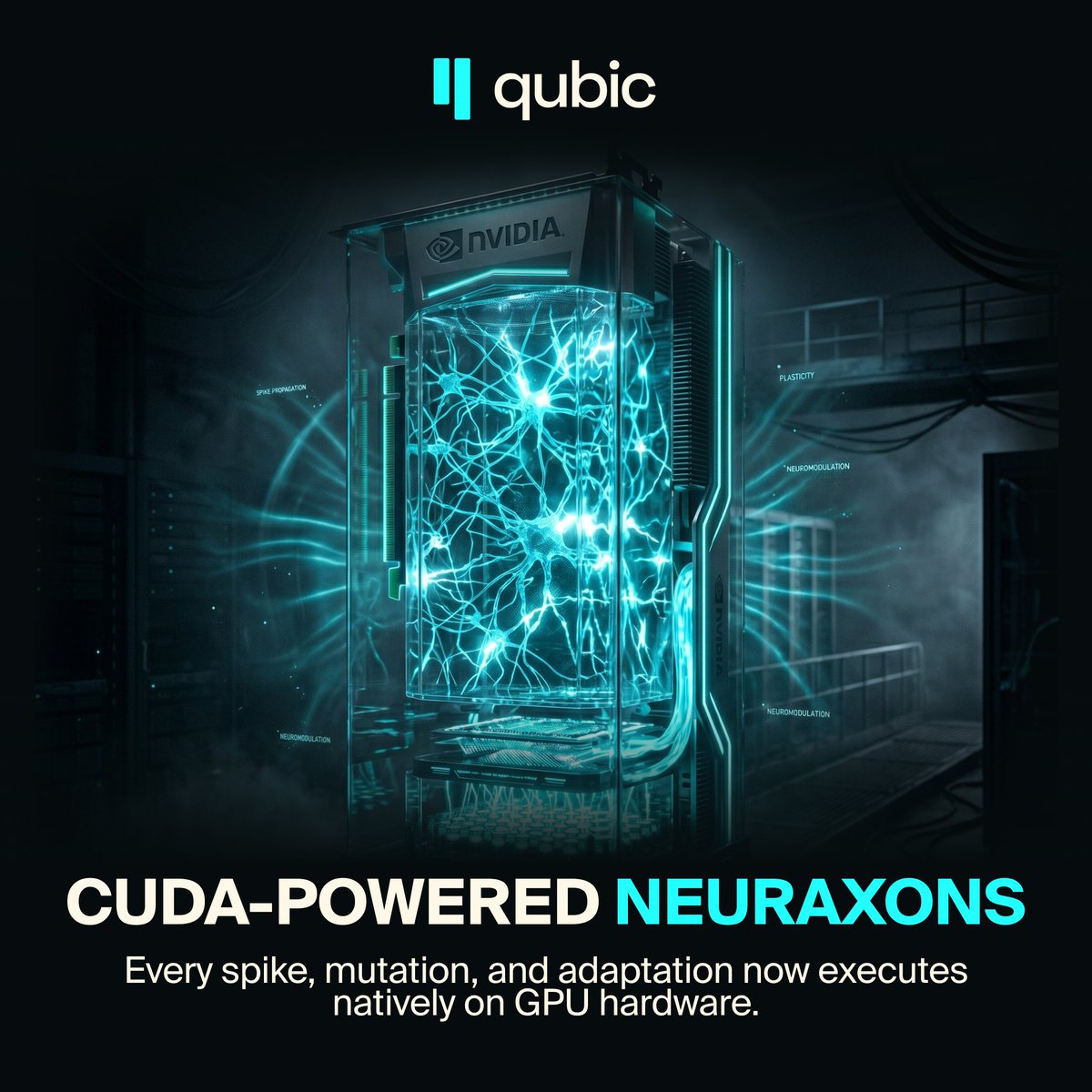
Qubic Science has released CuNxon.
Full Neuraxon computation ported to NVIDIA CUDA kernels. Every operation a Neuraxon can perform, from spike propagation to plasticity to neuromodulation, now runs natively on NVIDIA GPUs.
Previously, Neuraxon research ran on CPUs. That was fine for the Game of Life simulator and the early parameter sweeps. It is not fine for what comes next.
There are roughly five million CUDA developers worldwide. Most of them work in machine learning and AI. As of this release, every one of them can build with, test, and extend Neuraxon using the same GPU toolchain they already know.
The practical path this opens: when the Aigarth evolutionary layer gets ported into the Qubic network, miners and Computors will be able to train and evolve Neuraxon populations using GPU compute, not just CPUs.
A single $100 GPU. Or a billion-dollar cluster. The library does not care. The code is open source.
Last week in Berlin, Qubic Science presented Neuraxon v2.0 at ICMLT 2026, an IEEE co-sponsored conference.
Eight talks ran in their evening session.
Theirs was voted the best of the night by the other researchers in the room, none of whom have any connection to Qubic.
Worth knowing what Neuraxon actually is, because it is not another language model.
It is an attempt to build AI the way biology does it, with artificial neurons that grow and adapt over time instead of being trained once and frozen.
@VivancosDavid and @josesanchezhb have been working on it for years.
Most crypto projects that talk about AI are wrapping someone else's model and adding a token.
This is original research, and last week a room of people with no reason to flatter it said so.
Every seven days, every seat on the Qubic network is up for re-election.
676 Computors. Every seat is earned through useful work. Every seat is re-earned the following week, or someone else takes it.
Here is how it actually works. 🧵
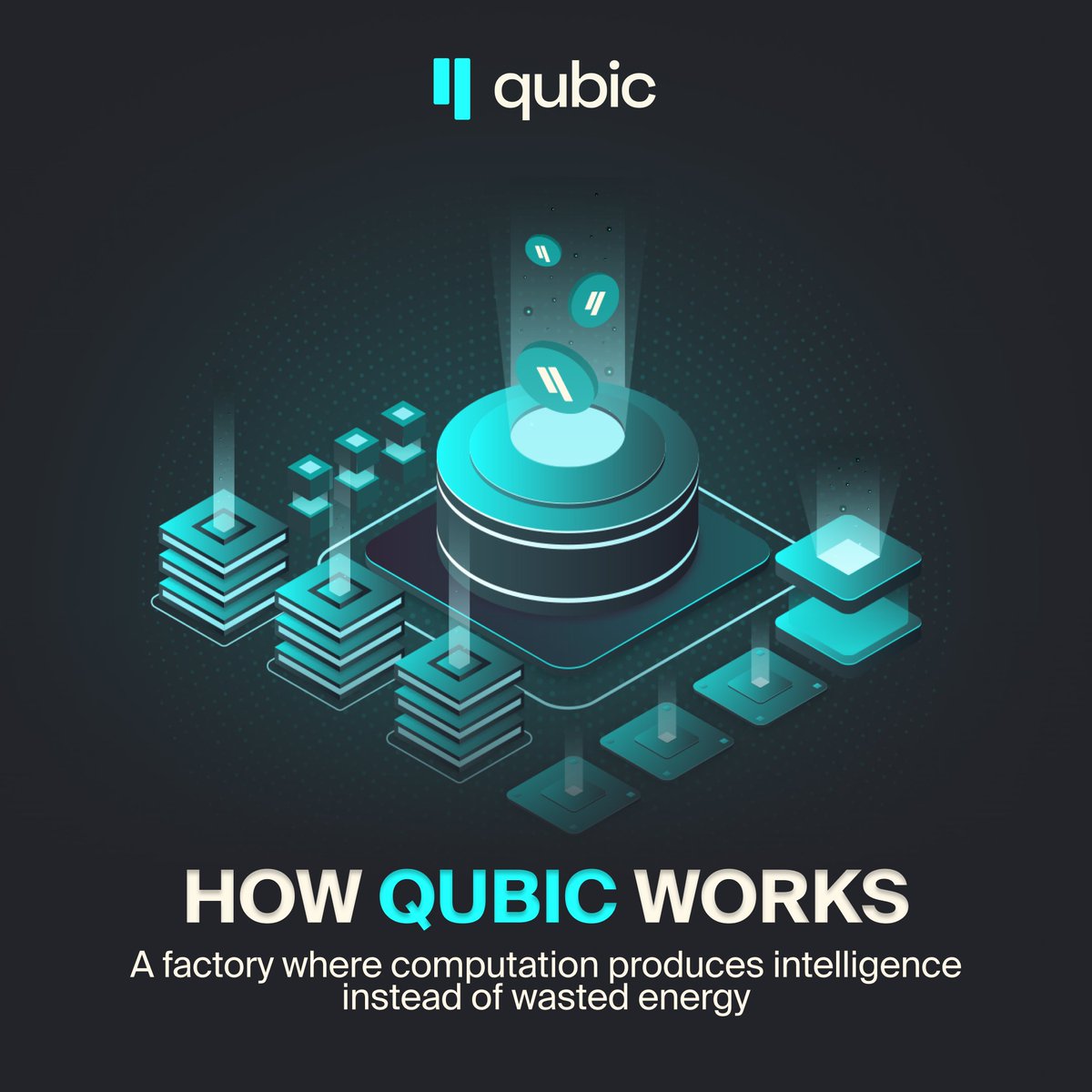
Most blockchains operate like a factory where every worker clocks in, shreds paper all day to prove they showed up, then clocks out.
The paper shredding is the job.
That is Bitcoin mining.
Qubic is different.
The electricity burned on this network trains AI. The compute produces a real output, not proof that electricity was spent.
Here is how the rest of the system works.
676 floor managers (called Computors) inspect every product (transaction) before completion.
For anything to leave the factory, at least 451 of them must sign off as a quality assurance check.
That is 66.7% agreement.
If a bad product slips in, the majority catches it before it reaches the door.
Every seven days, the factory resets.
Managers who did not pull their weight get replaced by ones who did.
You do not keep your seat by seniority. You keep it with measurable output.
There are no transaction fees for sending and receiving QU.
When a smart contract executes, the cost comes from the contract's own reserve, not from the user's wallet.
The factory's services do not bill the customer at the counter.
And here is the part most people miss: every time someone uses the factory's services, a small amount of its internal currency gets permanently destroyed.
The more people use it, the scarcer the currency becomes.
That is the whole system.
Workers train AI. Managers verify everything by supermajority. Seats rotate weekly. Fees are zero. Usage burns supply.
Four years running.
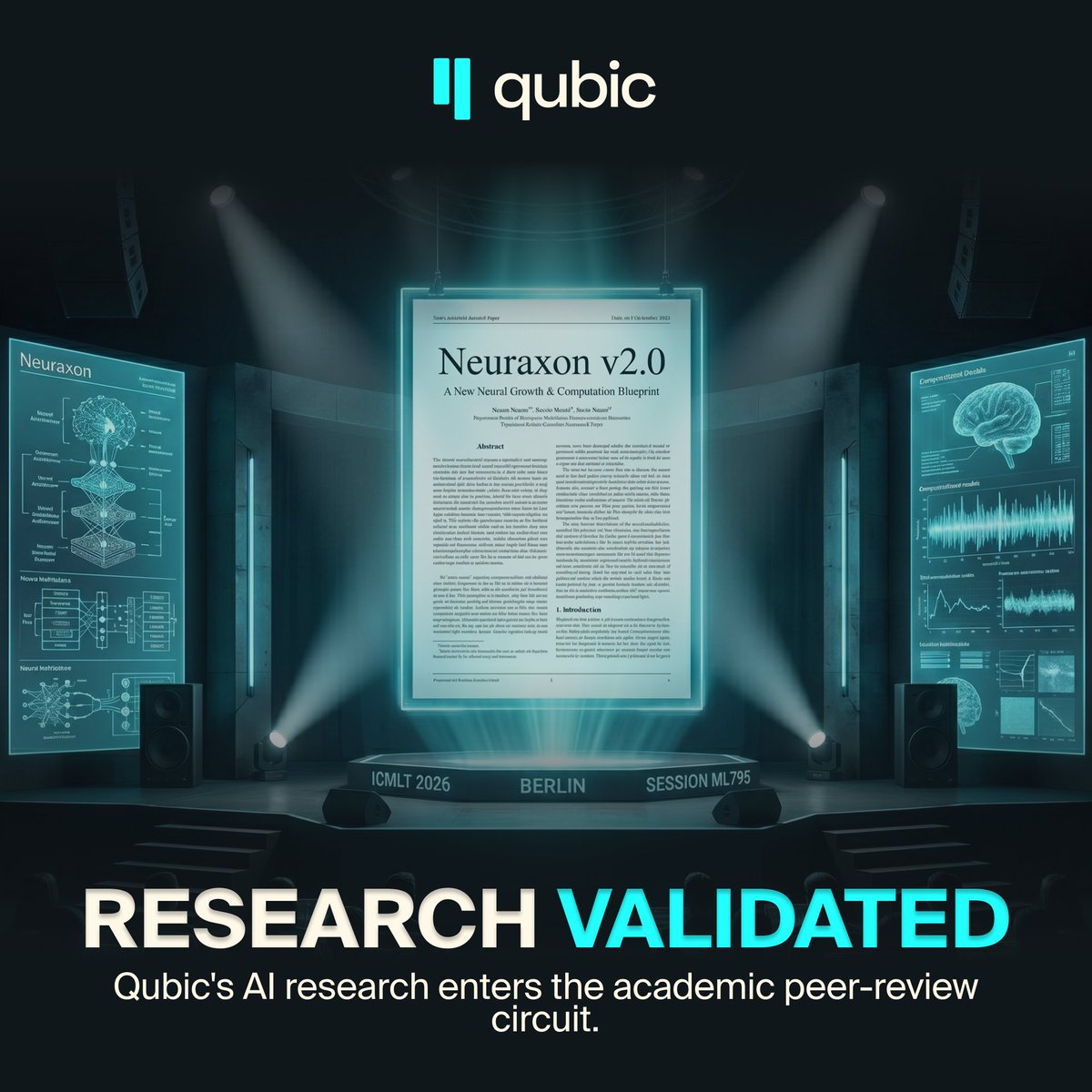
Qubic Science is presenting a peer-reviewed paper at an IEEE co-sponsored conference this week.
ICMLT 2026. Berlin. May 20-22. Session ML795.
“Neuraxon v2.0: A New Neural Growth & Computation Blueprint.”
While most crypto AI projects are announcing, Qubic is presenting.
Authors: @VivancosDavid and @josesanchezhb.
Neuraxon is not a language model like ChatGPT. It is not a wrapper on top of transformers.
It is a bio-inspired neural architecture built from scratch, modeled on how actual biological neurons grow, connect, and adapt in continuous time.
Trinary dynamics. Neuromodulation. Astrocytic gating. Criticality at the edge of chaos.
What peer review means in practice: the work gets indexed on IEEE Xplore and Scopus.
It enters the scientific record.
It gets cited, challenged, and built upon by researchers who have no financial stake in Qubic.
Four years of building.
The science is now entering the room where it gets tested by people who did not build it.
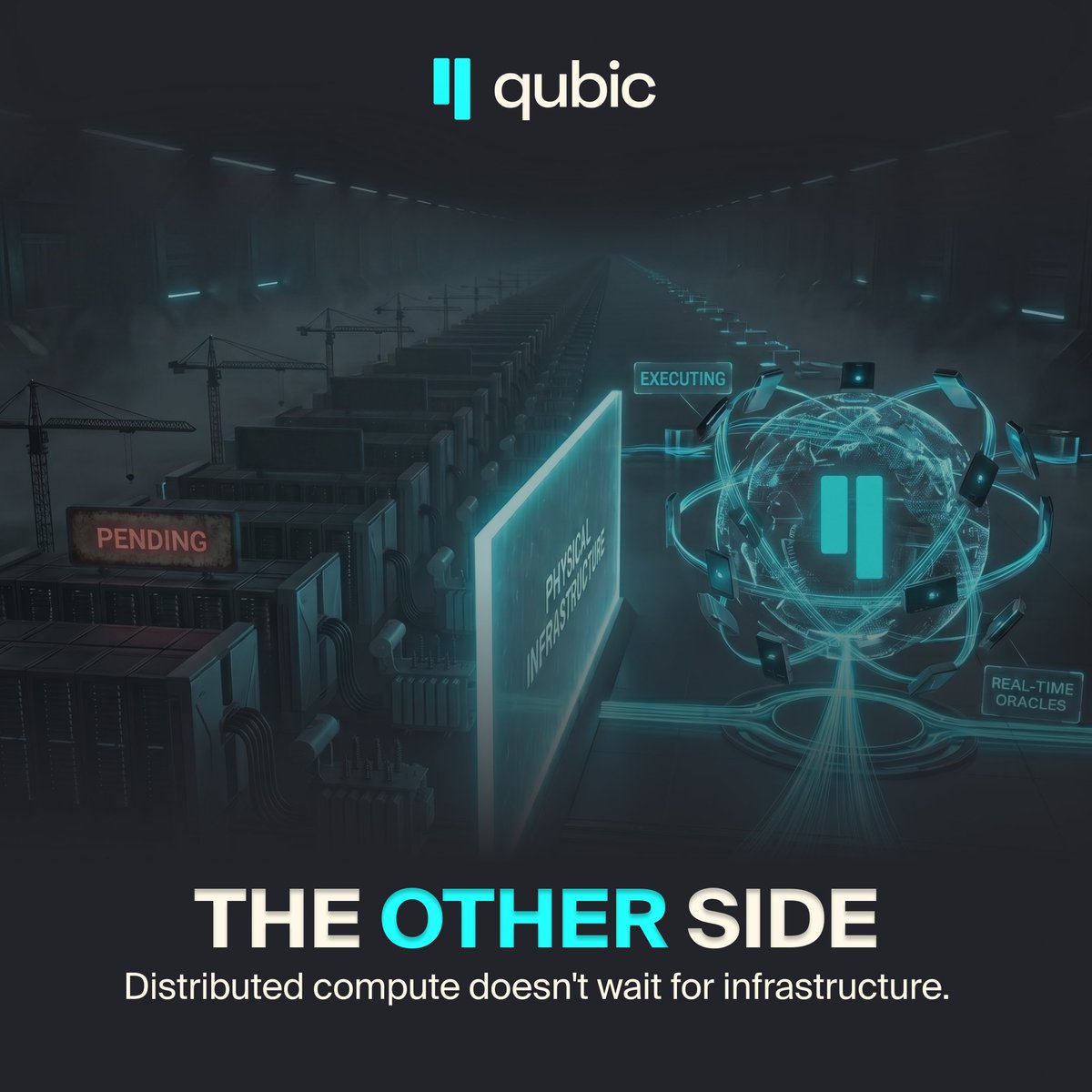
Bloomberg reported, half the AI data centers planned for 2026 will not get built.
Of 16 GW of capacity scheduled for the US this year, only ~5 GW is under construction. Sightline Climate expects 30–50% of planned builds to be delayed or canceled.
The constraint isn't capital. Hyperscalers are spending $650B+ this year.
It's transformers. Switchgear. Grid queues taking 5 years to clear.
The bottleneck of the AI revolution is not chips. It's the equipment that turns them on.
Qubic runs on hardware already deployed. Electricity is already on someone's bill. 676 Computors. No grid queue. No 200-acre site review. Online for four years.
200M transactions. 600K oracle queries. Per week. Already.
Which compute layer is on the other side?
Saylor's case for Bitcoin is the cleanest argument in crypto.
Decentralized protocol = commodity. No one controls it. No one can take it away.
Economic energy for 8 billion people.
He's right. But he stopped one step short.
Bitcoin secures value. What secures intelligence?
Ethereum tried. Failed. It wasn't built for it.
But, Qubic is.
Decentralized. No corporation owns the AI training running on it. The people contributing compute own the output.
Same fire. Different engine.
Bitcoin made value sovereign. Qubic makes cognition sovereign.
It's been building quietly for four years. Most people still haven't looked.
That window doesn't stay open.