Priest in Charge of the West Highland Region in the Diocese of Argyll & the Isles, SEC. All views my own based on study of scripture, reason and tradition.
“Women talk more than men”
In a recent study it was found that when women talked 15% of the time (and men 85% of the time), men perceived it as equal participation. And when women talked 30% of the time, men perceived it as women dominating the discussion.
Ed Davey has written to Education Secretary Bridget Phillipson demanding she WITHDRAW official EHRC guidance protecting female-only spaces in toilets and changing rooms.
Let that land.
The Equalities and Human Rights Commission — a statutory body — has produced legally grounded guidance telling employers and public bodies that biological men should not access women’s single-sex spaces.
This is not opinion.
This is not politics.
This is the settled legal position following the Supreme Court’s landmark ruling on the meaning of “woman” under the Equality Act.
And Ed Davey wants it gone.
His stated reason?
The guidance is not “compatible with long-standing British values.”
British values.
He used those words to argue AGAINST protecting women’s single-sex spaces.
The same Liberal Democrats who lecture the country about tolerance, inclusion and human rights are now lobbying a Labour minister to tear up statutory guidance that protects every woman in Britain who walks into a changing room, a refuge or a hospital ward.
This is not a fringe position within the Lib Dems.
Their leader wrote the letter.
The party has chosen its side.
It is not the side of women.
Repost if you think women’s single-sex spaces should be protected.
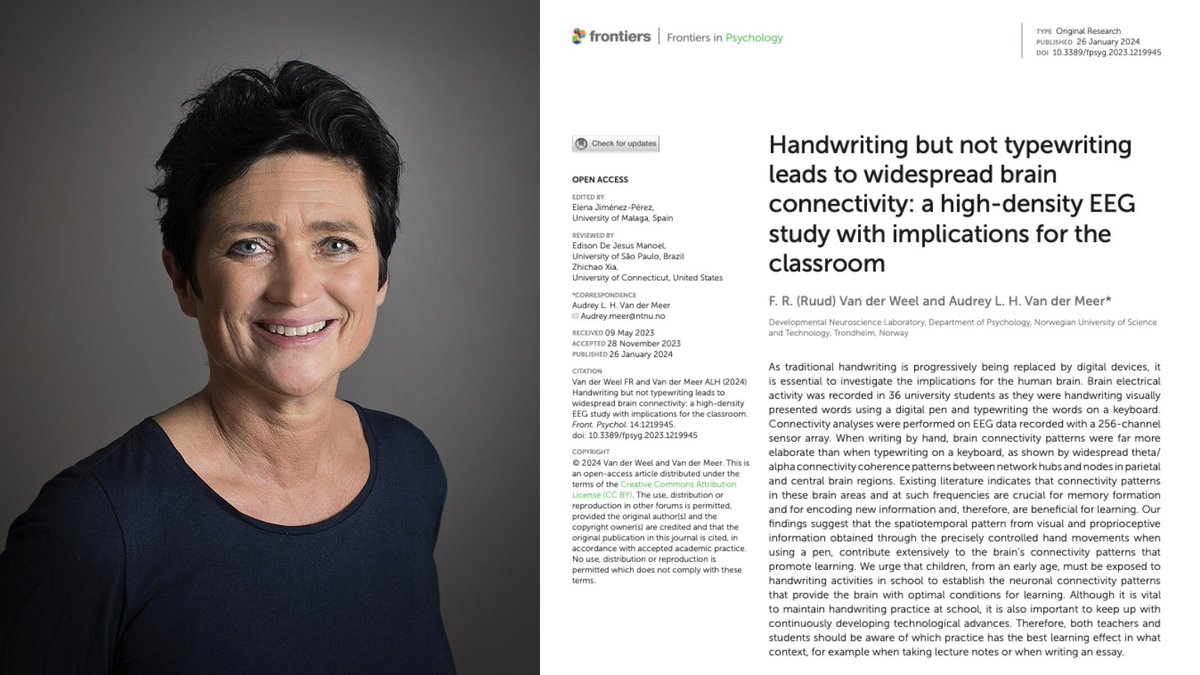
A Norwegian neuroscientist spent 20 years proving that the act of writing by hand changes the human brain in ways typing physically cannot, and almost nobody outside her field has read the paper.
Her name is Audrey van der Meer.
She runs a brain research lab in Trondheim, and the paper that closed the argument was published in 2024 in a journal called Frontiers in Psychology. The finding is brutal enough that it should have changed every classroom on Earth.
The experiment was simple. She recruited 36 university students and put each one in a cap with 256 sensors pressed against their scalp to record brain activity. Words flashed on a screen one at a time.
Sometimes the students wrote the word by hand on a touchscreen using a digital pen, and sometimes they typed the same word on a keyboard. Every neural response was recorded for the full five seconds the word stayed on screen.
Then her team looked at the part of the data most researchers had ignored for years, which is how different parts of the brain were communicating with each other during the task.
When the students wrote by hand, the brain lit up everywhere at once.
The regions responsible for memory, sensory integration, and the encoding of new information were all firing together in a coordinated pattern that spread across the entire cortex. The whole network was awake and connected.
When the same students typed the same word, that pattern collapsed almost completely.
Most of the brain went quiet, and the connections between regions that had been alive seconds earlier were nowhere to be found on the EEG.
Same word, same brain, same person, and two completely different neurological events.
The reason turned out to be something nobody had really paid attention to before her work. Writing by hand is not one motion but a sequence of thousands of tiny micro-movements coordinated with your eyes in real time, where each letter is a different shape that requires the brain to solve a slightly different spatial problem.
Your fingers, wrist, vision, and the parts of your brain that track position in space are all working together to produce one letter, then the next, then the next.
Typing throws all of that away. Every key on a keyboard requires the exact same finger motion regardless of which letter you are pressing, which means the brain has almost nothing to integrate and almost no problem to solve.
Van der Meer said it plainly in her interviews.
Pressing the same key with the same finger over and over does not stimulate the brain in any meaningful way, and she pointed out something that should scare every parent who handed their kid an iPad.
Children who learn to read and write on tablets often cannot tell letters like b and d apart, because they have never physically felt with their bodies what it takes to actually produce those letters on a page.
A decade before her, two researchers at Princeton ran the same fight using a completely different method and ended up at the same answer. Pam Mueller and Daniel Oppenheimer tested 327 students across three experiments, where half took notes on laptops with the internet disabled and half took notes by hand, before testing everyone on what they actually understood from the lectures they had watched.
The handwriting group won by a wide margin on every question that required real understanding rather than surface recall.
The reason was hiding in the transcripts of what the two groups had actually written down.
The laptop students typed almost word for word, capturing more total content but processing almost none of it as they went, while the handwriting students physically could not write fast enough to transcribe a lecture in real time, which forced them to listen carefully, decide what actually mattered, and put it in their own words on the page.
That single act of choosing what to keep was the learning itself, and the keyboard had quietly skipped the choosing and skipped the learning along with it.
Two studies. Two countries. Same answer.
Handwriting makes the brain work. Typing lets it coast.
Every note you have ever typed instead of written went into your brain through a thinner pipe. Every meeting, every book highlight, every idea you captured on your phone instead of on paper was processed at half depth.
You did not forget those things because your memory is bad. You forgot them because typing never woke the part of the brain that would have made them stick.
The fix is the thing your grandmother already knew.
Pick up a pen. Write the thing down. The slower road is the faster one.
This judgment should send shockwaves through NHS and beyond. It is to my knowledge the 1st to decide that allowing trans identifying men into women's workplace facilities is in itself discrimination and harassment against women.
The female sex class has specific needs and issues, and the job of addressing these needs and issues at a political level is almost always given to a female. When such a female chooses not to defend women’s rights, because it would endanger their own personal status, that is worthy of comment.
Of course it’s true that many men are in thrall to gender ideology too, but by definition, being men, they’ve never needed the rights they now seek to dismantle. A woman, though - unless she’s been unusually sheltered from birth - knows from her own life experience how important those hard won rights are, because she’ll have benefited from them. If she then achieves the kind of power and/or economic security that mean she has no personal need for state-run single-sex spaces and services, but uses her platform to decree that women without her protections no longer need what she herself used and took for granted, she is guilty of a particularly egregious hypocrisy.
Yes, the people who call themselves 'trans' exist and they deserve exactly the same rights as everyone else, which, fortunately, they already have in the UK. It would rightly be considered discrimination if a person was refused employment, housing or the vote because they identified as trans.
'Trans women are women' is a thought-terminating cliché. Men are not women. That doesn't mean they're not allowed to present themselves however they like, call themselves whatever they like and believe whatever they like about themselves. It means they haven't changed sex.
If we replace the objective, observable characteristic of sex with the unfalsifiable concept of gender identify, women and girls lose, among other things, their right to fair and safe sport and women-only spaces, including changing rooms, prison cells and rape crisis services.
Women and girls are provably more vulnerable to forms of abuse including sexual assault, harassment and voyeurism in mixed-sex spaces. There is no evidence that trans-identified men don't have exactly the same rates of criminal offending as all other men.
Trans people exist. I have no desire for them not to exist; indeed, I wish them safety, happiness and health. However, 'existence' does not, and should not, mean the violation of other people's right to privacy, dignity and freedom of speech, or the reconfiguration of society to indulge a fallacy.
There is no Woman of the Day today. Instead, I want to explain why I do what I do. No one really knows who first said, “History is written by the victors” but I’d bet you any odds it was a man.
Think of your schooldays and count the number of times you learned about the roles played by women in shaping history, other than regnant Queens and perhaps Marie Curie and Florence Nightingale. Yet women lived, worked, networked, debated, campaigned, organised, invented things and built them too - but you’d never know this if your lessons, like mine, were confined to history books.
For a practical example, just look around you. Fridge, washing machine, dishwasher, ironing board, home security system, call waiting system, car heater and windscreen wipers, even the very first computer algorithm: all invented by women.
Are you surprised? Confined to the house, denied access to higher education, barred from engineering, denied entry to all branches of science and the professions for centuries, those bright analytical minds turned their attention to their immediate surroundings and saw what was needed to free them from domestic drudgery.
In return, history ignored women’s achievements, glossed over them or consigned them to dusty footnotes. If all else failed, their work was credited to - or stolen by - men, the phenomenon known as the Matilda Effect, first identified by feminist Matilda Joslyn Gage in 1870.
In 1993, it was named for her by historian Margaret Rossiter who said, “It is important to note early that women’s historically subordinate ‘place’ in science was not a coincidence and was not due to any lack of merit on their part. It was due to the camouflage intentionally placed over their presence in science.”
Once you see it, you cannot unsee it - the Matilda Effect is everywhere - but now substitute ‘history’ for ‘science’. The proposition still stands. What I try to do is to pierce holes in that camouflage by writing about the almost-invisible women of history who overcame manmade barriers and changed the world.
As a Second Wave feminist, I thought we’d won all the big battles, that it was just a matter of mopping up the resisters and dragging them into the 20th century. I did my bit to redress the balance in an overwhelmingly male environment, but how had I managed to miss the barefaced theft of our words, our spaces and services, our sports? How had we suddenly been reduced to a walking collection of body parts?
It was a wake-up call.
Once I saw, I couldn’t unsee the terrible damage being done to girls and young women who did not conform to the offensive sexist stereotypes being imposed on them by men who mimic women and their inane female cheerleaders. It made me fearful for non-conforming girls: tomboys. They need to see strong women as role models, women who don’t care about performing femininity, women who defy convention and do things their way. If you can see it, you can be it.
So I went digging around in those dusty footnotes, found a little gold and started from there. I found thrilling tales of women who were inventive, resourceful and brave. Then I started sharing what I found more widely, tied to the calendar as Women of the Day.
How do I find them? Often by pure chance. I go looking for one woman, spot a couple more names along the way - women whose stories really resonate with me - and file them away for the right time. Women’s history had been right under my nose the whole time. I just hadn’t realised that you needed to dig a little. The rather unexpected bonus was that in giving them a voice, I found mine.
I am a conspicuously law-abiding woman, a former prison governor, and if you had told me when I retired that one day, I’d be standing outside a police station in protest at the hounding of gender critical women and singing “Go catch some rapists” to the tune of Guantanamera, I’d have advised you to seek immediate medical attention for the effects of the bump to your head.
But here I am, telling women’s stories, and behind the scenes, pursuing a second career as a women’s rights activist. I won’t ever fall asleep at the wheel again.
Tomorrow, I’m off to Cardiff with my Women of Wessex sisters, to protest about @bphillipsonmp’s inexplicable decision to delay laying the EHRC Code of Practice before Parliament — and make no mistake about it. It IS a decision; one that is causing real harm and damage to the rights of women and the protection of children.
Some of you come for the occasional stories of women in history hiding in plain sight, but I hope you stay because you care about fairness and safety for women. For now, I leave you with this thought from the 1949 memoirs of Somerset suffragette Nelly Crocker (1872-1962):
“Modern young women seem unaware of the price paid for their political and social emancipation, and modern historians have greatly ignored the struggle”.
Men who identify as women being platformed by our national broadcaster to speak FOR women is the epitome of misogyny. Badly done @BBCWomansHour which increasingly has little to do with women’s lives and carries few women’s voices.
Woman's Hour on BBC Radio 4 has discussed 'toxic masculinity' against the backdrop of Louis Theroux's Netflix documentary Manosphere with ... a cross-dressing man who talked about the 'misogyny' he experiences
@JournalistJill Incredible isn't it - it costs only £5 for a man to get a certificate to lie about his sex, but £185 for a woman to get one that doesn't.