YouTube Scriptwriter & Strategist.
I help creators build recognizable and bingeable YouTube brands | 20M+ views gen | Sharing tips on building a YouTube brand.
I thought writing a YouTube script would be easy.
In 2023, I found out the hard way just how wrong I was.
My scripts were so bad I almost quit!
Views were low, watch time sucked.
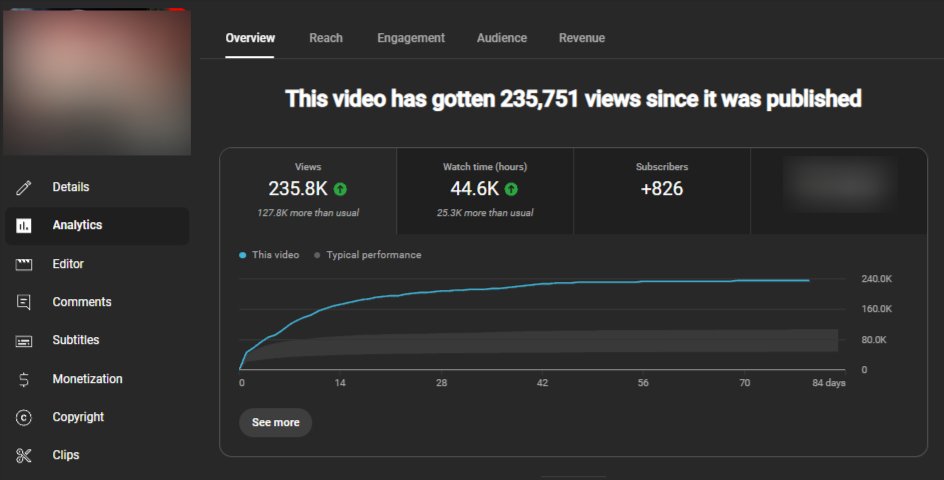
But now, my clients are getting massive view boosts and explosive watch hours (44.6K watch hours)
This video alone brought in 826 new subs.
All this happened when I discovered that:
The best scripts don’t just inform. They make people feel.
So, I changed my approach:
- Added curiosity gaps.
- Layered tension.
- Wrote like a conversation, not a Wikipedia page.
And suddenly, the numbers shot up.
If your YouTube videos aren’t growing, your scripts are probably too safe.
Try this instead:
- Hook first. Make it impossible to click away.
- Keep viewers guessing. Hold back just enough.
-Reward them at the end—make it worth it.
Great storytelling = More views, more sales, more impact.
You don’t need more facts. You need more emotion.
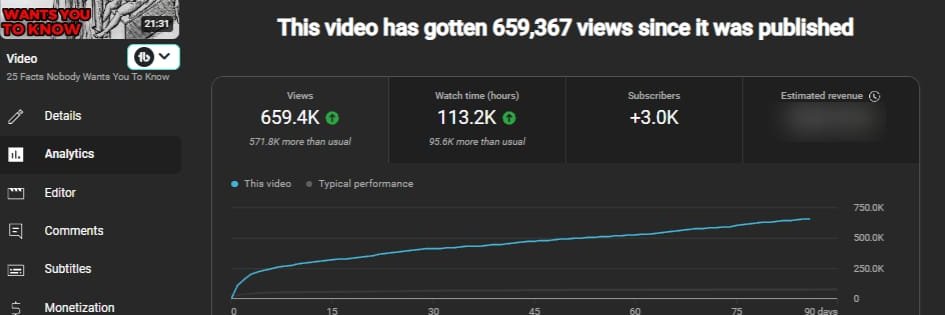
This faceless channel built ~300K subs with just 10 videos.
But their last video hit 4.7M views in 2 months.
If you're under 10K subs, here are 2 things you can steal from this video.
There's nothing new about the format. It's just a list of the "Most Evil Company."
But the built-in tension is why it blew up.
1. EVERY SECTION STARTS WITH A RE-HOOK
An insane origin story, a psychological study, a compelling thought experiment, a banger quote.
Something that pulls you in before the argument even starts.
Like this:
"In 1886, an American Civil War veteran was looking to find a substitute for his morphine addiction. So he mixed together cocaine, caffeine, and sugar syrup into a drink he called Coca-Cola."
The viewer is leaning in before the actual argument has started.
HOW TO DO IT:
Before you make your argument, tell the origin of the thing you're arguing about.
Keep it to 2-3 sentences.
Find the one detail that's strange, specific, or counterintuitive.
That detail is your hook inside the hook.
A personal finance creator doesn't open with "index funds outperform 90% of managed funds." They open with the specific moment a specific person discovered that, and what they did with it.
2. CREATE RANKING-WITH-A-TWIST FORMAT.
In a regular ranking, each entry stands alone. Nike is bad. Here's why. Next.
Here every entry exists in direct relation to the one before it.
The viewer is constantly holding two things in their head simultaneously — what they just learned and what they're currently learning — and measuring them against each other.
Each company is introduced with "but this next one is even worse," which does two things:
•Keeps viewers watching to find out who "wins"
•Makes every segment feel like a payoff.
Lines like this make it explicit:
"But is a little slave labor really that bad compared to companies who have killed millions, caused drug crises, and even tried to destroy the planet?"
So, RE-HOOK AT THE START OF EVERY SECTION and MAKE THE ENTIRE LIST A COMPETITION to find out who is the “best” or “worst”
Here is the thing about viewer satisfaction that changed how I think about YouTube content.
YouTube doesn't push videos because they got clicked. It pushes videos because people were glad they clicked.
Glad means one of three things:
- they were entertained
- they learned something genuinely new
- they had an emotional experience.
One of those three. Ideally all three.
Every scripting decision I make now runs through that filter first.
Here's something nobody tells beginner YouTubers:
The first line of your script is the hardest thing you'll write.
Because it sets the entire tone for what follows.
9 first-line types that actually work:
Question.
Shocking statement.
Story start.
Personal connection.
Statistic.
Challenge.
Quote.
Metaphor.
Proof.
Pick one!
Write it before anything else. The rest flows after.
Everyone talks about YouTube hooks.
But there are just 3 things your hook must accomplish:
— Tease what's at stake
— Three specific punches that create curiosity
— A clear promise of what they'll walk away with
The storytelling framework nobody teaches:
Somebody → Wanted → But → So → Then
Somebody: the character
Wanted: their goal
But: the obstacle
So: what they did about it
Then: the result
Every great YouTube story follows this structure.
Even when it's a business video.
Even when it's educational.
Somebody always wants something. That tension is the whole video.
The open loop is the most underused tool in YouTube scripting.
Instead of: "The next step is writing a great script."
Try: "But most YouTubers will completely neglect what I'm about to show you, and leave it till the very end — when it should actually be first."
One version informs.
The other makes leaving feel impossible.
The body of every great YouTube video follows one skeleton:
Open loop → Why → What → How → Open loop → Why → What → How
The open loop creates tension before each point.
Why earns the viewer's attention.
What gives them the information.
How gives them something to do with it.
Repeat this and retention solves itself.
Most YouTube creators structure their content wrong.
They front-load the heaviest payoff.
Viewer drops off. They blame the algorithm.
The real problem is pacing.
- Early segments build trust.
- Middle segments build tension.
- Late segments deliver weight.
This faceless channel built ~300K subs with just 10 videos.
But their last video hit 4.7M views in 2 months.
If you're under 10K subs, here are 2 things you can steal from this video.
There's nothing new about the format. It's just a list of the "Most Evil Company."
But the built-in tension is why it blew up.
1. EVERY SECTION STARTS WITH A RE-HOOK
An insane origin story, a psychological study, a compelling thought experiment, a banger quote.
Something that pulls you in before the argument even starts.
Like this:
"In 1886, an American Civil War veteran was looking to find a substitute for his morphine addiction. So he mixed together cocaine, caffeine, and sugar syrup into a drink he called Coca-Cola."
The viewer is leaning in before the actual argument has started.
HOW TO DO IT:
Before you make your argument, tell the origin of the thing you're arguing about.
Keep it to 2-3 sentences.
Find the one detail that's strange, specific, or counterintuitive.
That detail is your hook inside the hook.
A personal finance creator doesn't open with "index funds outperform 90% of managed funds." They open with the specific moment a specific person discovered that, and what they did with it.
2. CREATE RANKING-WITH-A-TWIST FORMAT.
In a regular ranking, each entry stands alone. Nike is bad. Here's why. Next.
Here every entry exists in direct relation to the one before it.
The viewer is constantly holding two things in their head simultaneously — what they just learned and what they're currently learning — and measuring them against each other.
Each company is introduced with "but this next one is even worse," which does two things:
•Keeps viewers watching to find out who "wins"
•Makes every segment feel like a payoff.
Lines like this make it explicit:
"But is a little slave labor really that bad compared to companies who have killed millions, caused drug crises, and even tried to destroy the planet?"
So, RE-HOOK AT THE START OF EVERY SECTION and MAKE THE ENTIRE LIST A COMPETITION to find out who is the “best” or “worst”
If you're a YouTube Creator and you want binge-worthy videos, then read this carefully:
You can have:
- Fancy transitions
- Perfect color grading
- Cinematic B‑roll
- Punchy cuts
…but if your story is broken, your video will flop!
Editing is the polish.
Structure is the foundation.
If your video doesn’t:
1️⃣ Hook me in the first 10 seconds
2️⃣ Flow logically from point to point
3️⃣ Build tension & curiosity
4️⃣ Pay it off with a satisfying resolution
…no amount of zooms, cuts, or sound effects will keep me watching.
A well-structured script = a binge-worthy video!
I dropped that after the hook.
But halfway through the video, I start laughing.
The video definitely delivers on the promise, but it's a masterclass at retention.
Breaking false beliefs, super-clear analogies, and a constant loop rehook - study/analogy - stakes/how it affects the viewer.
By the way, the shot makes it feel very personal.
Just its fire!