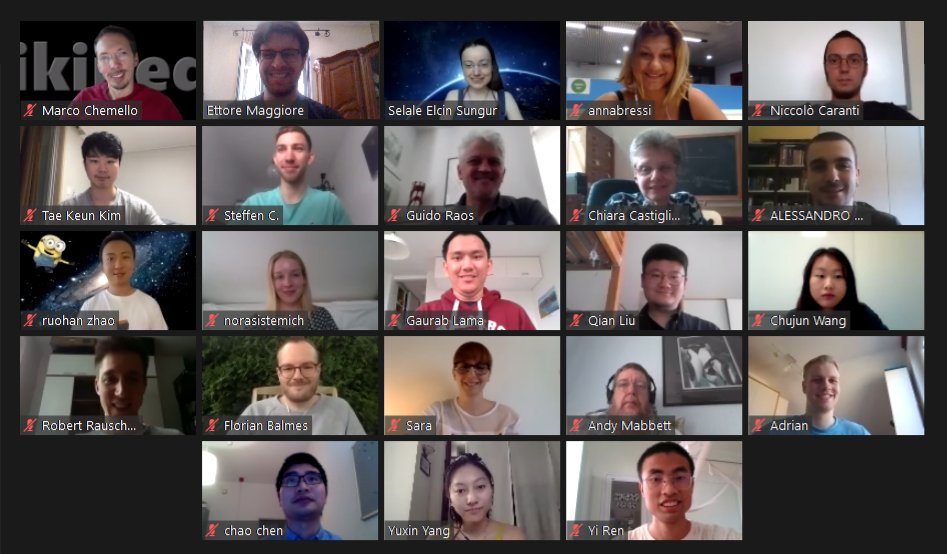
I am researching on the technical and social aspects and challenges of online learning using web conferencing technologies.
Please take a moment to respond and share your experience, and help me spread the survey by engaging and retweeting🙏.
https://t.co/ipN4F0Wt5j
Lots of paragraphs, but nothing to show that the President’s directive was accompanied by concrete measures to improve the hospital’s operational capacity and ensure that people seeking emergency care are not turned away.
You cannot impose an operating standard by fiat on an already strained healthcare facility, fail to provide the resources, personnel, and systems needed to meet that standard, and then expect miracles. Healthcare outcomes are shaped by capacity, not administrative fiat.
Ghanaian doctors move to better-resourced health systems and perform exceptionally well. That should tell us something. The problem is often not the competence or commitment of healthcare workers. Fix the systemic challenges, provide the necessary support, and stop treating individual healthcare workers as convenient scapegoats for broader institutional failures.
The signal that the NITA bill is sending to the very people who are building the tech ecosystem might end up damaging the very ecosystem it intends to regulate.
@MbrohPapa ✍🏾
Over time, painfully and gradually, you learn one of medicine’s cruelest lessons: you cannot save everyone, even when you know exactly what must be done. You stop complaining because repeated cries for change echo back as silence. You learn that continuously sacrificing yourself for a broken system eventually destroys the very person trying to help others survive it.
And so, slowly, pieces of you begin to disappear.
The Ghanaian is told that emergency care is “free,” yet a patient with a massive pulmonary embolism may suddenly require nearly GH₵19,000 for a lifesaving medication that is not covered by insurance. The system repeatedly creates impossible realities that place frontline clinicians in direct conflict with the very people they are trying desperately to save, while those responsible hide behind polished speeches and political comfort.
I still remember using my own GH₵18,000 to buy medication for a dying patient after the family promised they would repay me within two weeks. Three years later, they have blocked my number.
We rarely speak publicly about these things.
Yet society wonders why healthcare workers become emotionally distant over time. How many times can a person bleed emotionally before self preservation begins to resemble cruelty? How many times can someone empty themselves completely before they finally learn to walk away and feel nothing, simply because feeling everything has become unbearable?
Do that ten times.
Then ask yourself what kind of person the system is slowly forcing you to become.
Still, despite all this, you are expected to remain endlessly compassionate, endlessly patient, endlessly caring, even while internally carrying exhaustion, grief, anger, guilt, and disappointment that no one ever sees.
Meanwhile, the same people you struggle tirelessly to save, amidst shortages, broken equipment, dangerous improvisation, exhaustion, and unseen risks, continue to hold expectations built for ideal systems. And when outcomes are poor, their words can pierce deeper than they may ever realize.
How do you administer oxygen when there is no oxygen?
How do you perform an ECG when the machine has been broken for six months?
How do you manage a polytrauma patient where there is no functioning X ray service?
How do you explain that lifesaving investigations must be sent outside the hospital during emergencies because the facility cannot provide them?
And somehow, when these impossible circumstances finally collapse, the blame still finds its way to the clinician standing at the bedside.
If you brought the finest physicians from Harvard into many of our environments, even they would question themselves. Many visitors ask quietly, “How do you do it?”
The truth is that sometimes we no longer know.
Yet a prophet is rarely honored in his own town.
Perhaps one day the system itself will pass through you. Perhaps then you will understand the invisible shield carried by those whose sacrifices are trivialized every time human limitation collides with impossible expectations.
Until then, many of us will continue to fight quietly at the bedside, carrying burdens we were never meant to carry alone.
*Lamentations of Dr PK Mbroh*
Do you see how he the speaker, from Northern Ghana, is dressed? We haven’t just stopped speaking like that. Ghanaians have stopped doing everything like Ghanaians.
Mid-transfer, the oxygen tubing (the literal lifeline for a woman gasping for air), tore! And then came the sound: a long, breathless fooooooo of oxygen leaking freely into the air of a moving van…
https://t.co/tH0IX8AF5o
@jeffwellz@Psampene@dr_bandak@KMAkandoh@thenanaaba@Citi973
Do you see how he the speaker, from Northern Ghana, is dressed? We haven’t just stopped speaking like that. Ghanaians have stopped doing everything like Ghanaians.
What structural difference has @samgeorgegh put in place to eradicate the fake IDs from the 80% already registered people? What shows that his new system will give 100% accuracy, especially when he will be using the same system??
Let’s kick against Reregistration.
Let me show you what to do @samgeorgegh
Get a device to test fake IDs, confiscate them and let those people register correctly.
Nobody is joining the queue again.
@jeffwellz As a doctor, I had to transport a 9month old child for Chest CT scan via an ambulance. I went with them because, I needed to hold on to the ‘voltic bottle improvised c-pap’ myself so I can do the adjustment if the tube slips. This is not the 80s, present day Ghana.
Nothing concerns me with the cancellation, but just a reminder that if they'd followed God's law and honoured the marriage bed, they won't have had this issue.
Remember again today, God is wiser than man. His laws are good for you.