"Minor Collection Dhammapada:
The Buddha’s Path of Wisdom
The Path
Of all the paths the Eightfold Path is the best; of all the truths the Four Noble Truths are the best; of all things passionlessness is the best: of men the Seeing One (the Buddha) is the best.
This is the only path; there is none other for the purification of insight. Tread this path, and you will bewilder Mara.
Walking upon this path you will make an end of suffering. Having discovered how to pull out the thorn of lust, I make known the path.
You yourselves must strive; the Buddhas only point the way. Those meditative ones who tread the path are released from the bonds of Mara.
“All conditioned things are impermanent”—when one sees this with wisdom, one turns away from suffering. This is the path to purification.
“All conditioned things are unsatisfactory”—when one sees this with wisdom, one turns away from suffering. This is the path to purification.
“All things are not-self”—when one sees this with wisdom, one turns away from suffering. This is the path to purification.
The idler who does not exert himself when he should, who though young and strong is full of sloth, with a mind full of vain thoughts—such an indolent man does not find the path to wisdom.
Let a man be watchful of speech, well controlled in mind, and not commit evil in bodily action. Let him purify these three courses of action, and win the path made known by the Great Sage.
Wisdom springs from meditation; without meditation wisdom wanes. Having known these two paths of progress and decline, let a man so conduct himself that his wisdom may increase.
Cut down the forest (lust), but not the tree; from the forest springs fear. Having cut down the forest and the underbrush (desire), be passionless, O monks!
For so long as the underbrush of desire, even the most subtle, of a man towards a woman is not cut down, his mind is in bondage, like the sucking calf to its mother.
Cut off your affection in the manner of a man who plucks with his hand an autumn lotus. Cultivate only the path to peace, Nibbana, as made known by the Exalted One.
“Here shall I live during the rains, here in winter and summer”—thus thinks the fool. He does not realize the danger (that death might intervene).
As a great flood carries away a sleeping village, so death seizes and carries away the man with a clinging mind, doting on his children and cattle.
For him who is assailed by death there is no protection by kinsmen. None there are to save him—no sons, nor father, nor relatives.
Realizing this fact, let the wise man, restrained by morality, hasten to clear the path leading to Nibbana."
https://t.co/bJl8vfbiZ1.
"Kindness doesn’t just help others—it helps us too. It fuels us. Soothes us. Helps us remember that people are good because the best in us brings out the best in others. So spread a little love today, not just because the world needs it, but because you do too.” ~Lori Deschene
"Too lazy to be ambitious,
I let the world take care of itself.
Ten days worth of rice in my bag;
a bundle of twigs by the fireplace.
Why chatter about delusion and enlightenment?
Listening to the night rain on my roof,
I sit comfortably, with both legs stretched out."
~ Zen Master Ryokan
#Buddhism #Buddha #Zen #ZenBuddhism #Enlightenment #meditation #Mindfulness #Quotes #quoteoftheday #MondayMorning #MondayMotivation #Monday
The Gift of The Full Moon ☸️
Today being the Full Moon night, so sacred in Buddhism, let's share a luminous Zen tale. Once, a thief slipped into the simple hut of the gentle Zen Master Ryokan, hoping to take whatever worldly riches he could find. But Ryokan possessed no valuables; instead, he offered the thief his tattered robes. Shocked, the thief fled into the forest.
Standing alone under the bright Full Moon, Ryokan sighed with compassion, whispering, “Poor fellow! I wish I could give him the moon.”
What the Zen Master truly wished was to hand over that precious experience of the present moment - marveling at the sheer wonder of the moonlit sky.
Such a gift would shine far beyond any treasure or clothing, for it captured the priceless essence of here-and-now wisdom. The thief could steal everything else, but not the gentle radiance of a Full Moon’s light, nor the peace that arises from embracing life in all its stillness. 🙏🙏
#buddhawisdom #Buddhism #Buddha #Zen #ZenBuddhism #storytelling #FullMoon #MOON #Peace #SPIRITUAL #MindfulLiving #MindfulMoments #Mindfulness #Mindful #meditation #Meditate
"Relying upon a finger, we see the moon.
Relying upon the moon, we understand the finger.
Moon and finger are neither the same nor different.
… Having seen reality as it is,
there is neither moon nor finger."
Ryōkan
Mindfulness of the Body
“It’s incredible, reverends, it’s amazing, how the Blessed One, who knows and sees, the perfected one, the fully awakened Buddha has said that mindfulness of the body, when developed and cultivated, is very fruitful and beneficial.”
“In the same way, when a mendicant has developed and cultivated mindfulness of the body, Māra cannot find a vulnerability and doesn’t get an opportunity. Suppose a water jar was placed on a stand, full to the brim so a crow could drink from it. These similes recall the absorption similes above. Then a person comes along with a load of water.
What do you think, mendicants? Could that person pour water into the jar?”
“No, sir.”
“In the same way, when a mendicant has developed and cultivated mindfulness of the body, Māra cannot find a vulnerability and doesn’t get an opportunity."
Kāyagatāsatisutta
Bhikkhu Sujato, translation
Don't accept insults, then the negativity remains with them.
Excerpt, dude was abusing and insulting the Buddha
With Bhāradvāja the Rude
At one time the Buddha was staying near Rājagaha, in the Bamboo Grove, the squirrels’ feeding ground.
The brahmin Bhāradvāja the Rude heard a rumor that a brahmin of the Bhāradvāja clan had gone forth from the lay life to homelessness in the presence of the ascetic Gotama. Angry and displeased he went to the Buddha and abused and insulted him with rude, harsh words. When he had spoken, the Buddha said to him: Apparently a reference to the previous Sutta.
“What do you think, brahmin? Do friends and colleagues, relatives and kin, and guests still come to visit you?”
“Sometimes they do, worthy Gotama.”
“Do you then serve them with fresh and cooked foods and savories?”
“Sometimes I do.”
“But if they don’t accept it, brahmin, who does it belong to?”
“In that case it still belongs to me.”
“In the same way, brahmin, when you abuse, harass, and attack us who do not abuse, harass, and attack, we don’t accept it. It still belongs to you, brahmin, it still belongs to you!
Someone who, when abused, harassed, and attacked, abuses, harasses, and attacks in return is said to eat the food and have a reaction to it. But we neither eat your food nor do we have a reaction to it. It still belongs to you, brahmin, it still belongs to you!”
Akkosasutta—Bhikkhu Sujato Translation
If one doesn't practice morality and ethical conduct one will experience disturbances in the mind. These disturbances will come along with you when you sit down to meditate. Which is fine, you can deal with them there, you'll have to. Likewise, if one does practice morality and ethical conduct one will not experience disturbances in the mind and they will not come along with you when you sit down to meditate.
This is one reason the Wise practice morality and ethical conduct.
This is my experience on the matter. Happens every time.
“In the same way, when a mendicant has developed and cultivated mindfulness of the body, Māra cannot find a vulnerability and doesn’t get an opportunity. Suppose a water jar was placed on a stand, full to the brim so a crow could drink from it. These similes recall the absorption similes above. Then a person comes along with a load of water.
What do you think, mendicants? Could that person pour water into the jar?”
“No, sir.”
“In the same way, when a mendicant has developed and cultivated mindfulness of the body, Māra cannot find a vulnerability and doesn’t get an opportunity."
Kāyagatāsatisutta
Bhikkhu Sujato, translation
“To study the Buddha Way is to study the self. To study the self is to forget the self. To forget the self is to be actualized by myriad things. When actualized by myriad things, your body and mind as well as the bodies and minds of others drop away. No trace of enlightenment remains, and this no-trace continues endlessly.”
Eihei Dōgen
If one doesn't practice morality and ethical conduct one will experience disturbances in the mind. These disturbances will come along with you when you sit down to meditate. Which is fine, you can deal with them there, you'll have to. Likewise, if one does practice morality and ethical conduct one will not experience disturbances in the mind and they will not come along with you when you sit down to meditate.
This is one reason the Wise practice morality and ethical conduct.
This is my experience on the matter. Happens every time.
Reminds me of the Talking Heads song,
"Seen And Not Seen"
He would see faces in movies, on TV, in magazines, and in books
He thought that some of these faces might be right for him
And that through the years, by keeping an ideal facial structure fixed in his mind
Or somewhere in the back of his mind
That he might, by force of will, cause his face to approach those of his ideal
The change would be very subtle
It might take ten years or so
Gradually his face would change its shape
A more hooked nose
Wider, thinner lips
Beady eyes
A larger forehead
He imagined that this was an ability he shared with most other people
They had also molded their faces according to some ideal
Maybe they imagined that their new face
Would better suit their personality
Or maybe they imagined that their personality
Would be forced to change to fit the new appearance
This is why first impressions are often correct
Although some people might have made mistakes
They may have arrived at an appearance
That bears no relationship to them
They may have picked an ideal appearance
Based on some childish whim, or momentary impulse
Some may have gotten halfway there
And then changed their minds
He wonders if he too might have made a similar mistake
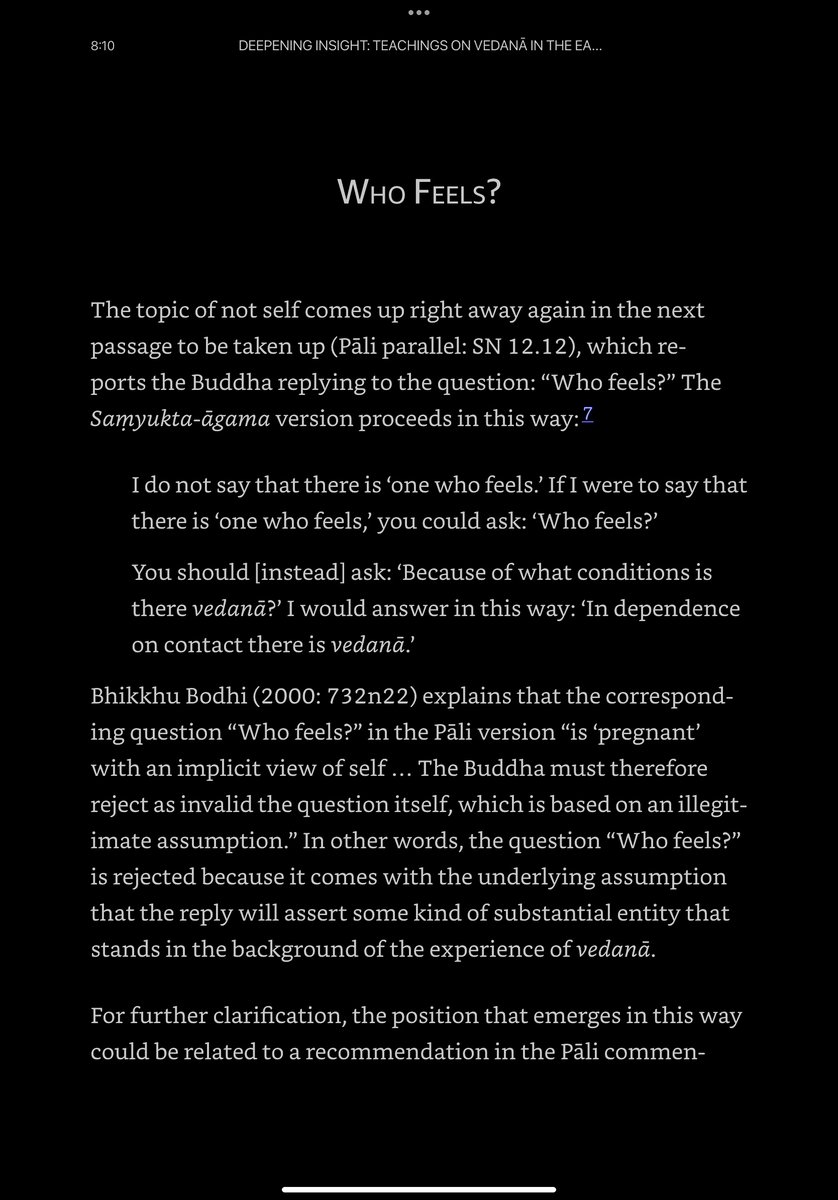
"We’re stuck on feeling like a monkey stuck in a tar trap. They take a glob of tar and put it where a monkey will get its hand stuck in it and, in trying to pull free, the monkey gets its other hand, both feet, and finally its mouth stuck, too."
"Consider this: Whatever we do, we end up stuck right here at feeling and craving. We can’t separate them out. We can’t wash them off. If we don’t grow weary of craving, we’re like the monkey stuck in the glob of tar, getting ourselves more and more trapped all the time."