Sports Psychiatrist MD🇲🇽. Psiquiatra, Psicología del Deporte, Clínica Psicoanalítica de la Motivación. Director Técnico Licencia B FMF ⚽️ 📌Monterrey, NL
Psiquiatra en Monterrey y Psicología del Deporte
📌Centro Médico Ave.
📍Dr. Fernando Guajardo 155, Los Doctores, 64710 Monterrey, N.L
AGENDA TU CITA:
https://t.co/YGyY8CuLeZ
Recuerda que cuando un paciente con colesterol LDL alto refiere "tomar mucho café", conviene preguntarle qué café toma y qué método usa para hacerlo.
El café sin filtrar (como la prensa francesa) tiene cafestol, una sustancia que aumenta los niveles de colesterol LDL en sangre.
Hospital physician practice is toxic. After 15+ years, it completely broke me, and I was really really really good.
I encourage any physician who cares about patients to get out unless ALL the following are true:
* You have power to make whatever medical decisions you deem necessary
* You have all the administrative supports you need
* You are given time and stipend necessary to work on your personal projects
* You can take time off sick, or vacation, or due to family issues, or for child care as you need.
If all 4 aren't true, get out. It will literally kill you (or at least the part of you that matters).
🚨 Your doctor says your LDL is "normal" at 100. But the arteries of a 25-year-old with no symptoms are already building plaque at that level.
The question is no longer whether your LDL is normal. The question is whether it is low enough to stop the damage that started decades ago.
And no, "normal" is not the same as safe.
🔬 Here is what the science actually says.
LDL does not just float harmlessly in your blood. It penetrates the arterial wall. It oxidizes. It triggers inflammation. And that process starts at levels most primary care doctors never flag.
Autopsy studies in young adults show early atherosclerotic lesions in people with LDL levels between 80 and 110. Not 200. Not 160. 80 to 110.
💓 The trial data on aggressive LDL lowering is not subtle.
✅ PROVE IT (atorvastatin): patients who hit LDL below 60 showed measurable plaque regression on intravascular ultrasound.
✅ ASTEROID (rosuvastatin): LDL driven to an average of 61 produced statistically significant plaque regression in 63% of patients.
✅ FOURIER (evolocumab): adding a PCSK9 inhibitor to statin therapy cut major cardiovascular events by 15% over a median of 2.2 years. The lower the LDL, the greater the benefit. No floor was found.
✅ ODYSSEY OUTCOMES (alirocumab): post-ACS patients with LDL pushed below 40 had better outcomes than those kept at 70. Outcomes, not just numbers.
The question is no longer whether lower is better. The question is how early you start.
🩺 I am a cardiologist. I have patients in my practice on combination therapy, statin plus PCSK9 inhibitor, with LDL levels below 30. They have stable plaque. Some show regression on imaging. None have experienced the cognitive side effects or muscle breakdown that wellness influencers keep warning you about.
Because those fears are not supported by the randomized controlled trial data.
🫀 Plaque regression is real. It requires LDL below 70, and the strongest regression signal appears at LDL below 60. Getting there usually requires more than a moderate statin dose. That conversation should happen before a heart attack. Not after.
A patient who starts aggressive LDL lowering at 45 with no symptoms can stabilize plaque, reduce inflammatory burden, and potentially avoid a first cardiovascular event entirely. That is the difference between a preventable MI at 58 and living to see your grandchildren.
⚠️ What will not get you there:
❌ Nattokinase will not save you.
❌ Red yeast rice at influencer doses will not save you.
❌ Vitamin K2 will not reverse plaque.
The tools with the strongest data are unsexy, require a prescription, and require your participation.
❤️ Bottom line:
LDL of 100 is not fine. It is average for a sick population.
The regression trials involve tens of thousands of patients and consistent findings across independent research groups. This is settled biology.
Get your LDL measured. Know your number. If you have risk factors, push the conversation with your doctor past "your cholesterol is normal." Ask what it takes to get below 70. Ask about PCSK9 inhibitors if statins alone are not enough.
The damage is happening silently. The window to stop it is now.
What is your LDL right now? Do you know?
#Cardiology #HeartDisease #HeartHealth #CardiovascularHealth #LDL #Statins #PlaquRegression #PCSK9 #PreventiveCardiology #MetabolicHealth
🚨NUEVO: Artículo de posición de la American Heart Association sobre el consumo de cafeína y su relación con la enfermedad cardiovascular☕️♥️.
👉🏽1) El consumo moderado de cafeína (hasta 400 mg/día o aproximadamente 3-5 tazas de café de 8 oz) está asociado con (sigue abajo👇🏽):
Perfiles psicológicos de futbolistas que veremos en el Mundial 2026:
🥉 Buenos
* El disciplinado (cumple siempre)
* El trabajador silencioso
* El especialista táctico
* El líder tranquilo
Ganan partidos.
Pero rara vez cambian la historia.
🥈 Muy buenos↓↓
La depresión resistente al tratamiento es una depresión mayor que no mejora de forma adecuada tras probar al menos dos antidepresivos distintos, bien pautados y durante el tiempo suficiente.
¿Y si esto pudiera solucionarse con un IMPLANTE?
Best antipsychotic for #depression? This analysis has caveats. Here's a highlight:
▪ Lumateperone/aripiprazole rank high for efficacy
▪ Lumateperone's tolerability is poor short-term, better long-term
▪ Whether they work long-term is uncertain
More:
https://t.co/vubLLhFYyv
Harvard scientists ran a simple test. They put adults under blue light for 6 hours one night, then under green light at the same brightness the next. Blue light pushed their bedtimes back by 3 hours. Green pushed them back by 1.5. And in kids, the same lights hit about twice as hard.
The reason comes down to a tiny patch of cells at the back of every human eye. These cells have one job. They tell your brain whether it is day or night. They wake up most when light hits a very specific shade of blue, the same shade phone screens and modern bulbs are loaded with. When those cells fire after dark, the brain stops making melatonin, the chemical that pulls you toward sleep.
Red light barely sets off those cells at all. A 2025 study from the University of Zaragoza put people under red lamps and blue lamps for three hours at night. Under blue, their melatonin stayed scraped to the floor. Under red, it climbed back up to more than three times higher. Same brightness. The color did all the work.
Children get this worse than adults. Two reasons. Their pupils are bigger, so more light gets in. And the lens inside a kid's eye is still glass-clear, where adult lenses slowly yellow with age and filter blue out naturally. A 10-year-old's body clock is roughly twice as sensitive to evening light as a 45-year-old's. A bedside lamp that feels harmless to a parent can be wrecking a kid's sleep clock at the same time.
Then there is the lag. Once the brain catches a dose of blue light, the wake-up signal it sends out keeps echoing for 3 to 4 hours after the lights go off. So a kid on an iPad at 9pm can still be wired at midnight even if you took the iPad away at 9:01.
Modern LED bulbs and screens are tuned to roughly 6500 Kelvin. That is sunlight at noon. Old incandescent bulbs sit around 2700, mostly red and yellow with almost nothing in the blue range. To a human eye, a red-lit room is just about as close to no light at all as you can get. The brain reads it as nighttime.
The fix is boring. Use warm bulbs at 2700 Kelvin or lower in any room a kid spends evenings in, switch off phones and tablets two hours before bed, and if a night light is needed for bathroom trips, make it red or amber. The science was pinned down to the exact color of light back in 2001.
Recomendaciones de estilo de vida para la salud cardiovascular con evidencia.
- Aceite de olivo extravirgen, nueces, almendras (Predimed)
- Dieta baja en grasas saturadas (amplia evidencia).
- Fibra Psylium
- El mejor peso posible
- Ejercicio
- Dieta con suficientes
1/2
A psychologist recently explained something interesting why 90s kids developed different thinking patterns than Gen Z, largely because of games. Back then, no autosaves, no hints, just three lives. Games like Super Mario Bros. and Prince of Persia taught: fail, restart, keep going you had to earn progress. Games like Tetris and The Legend of Zelda trained maps and patterns, building memory, navigation, and patience. Finish a level turn off the console. No infinite dopamine. Play was social: one couch, one screen, real conflict and cooperation.
Today, games like Fortnite and Roblox are endless, with autosaves and reward systems that keep you playing. They hold attention but don’t train completion the same way. The difference is simple: 90s kids built focus and tolerance for failure, while today’s players are shaped by constant stimulation. What do you think about this?
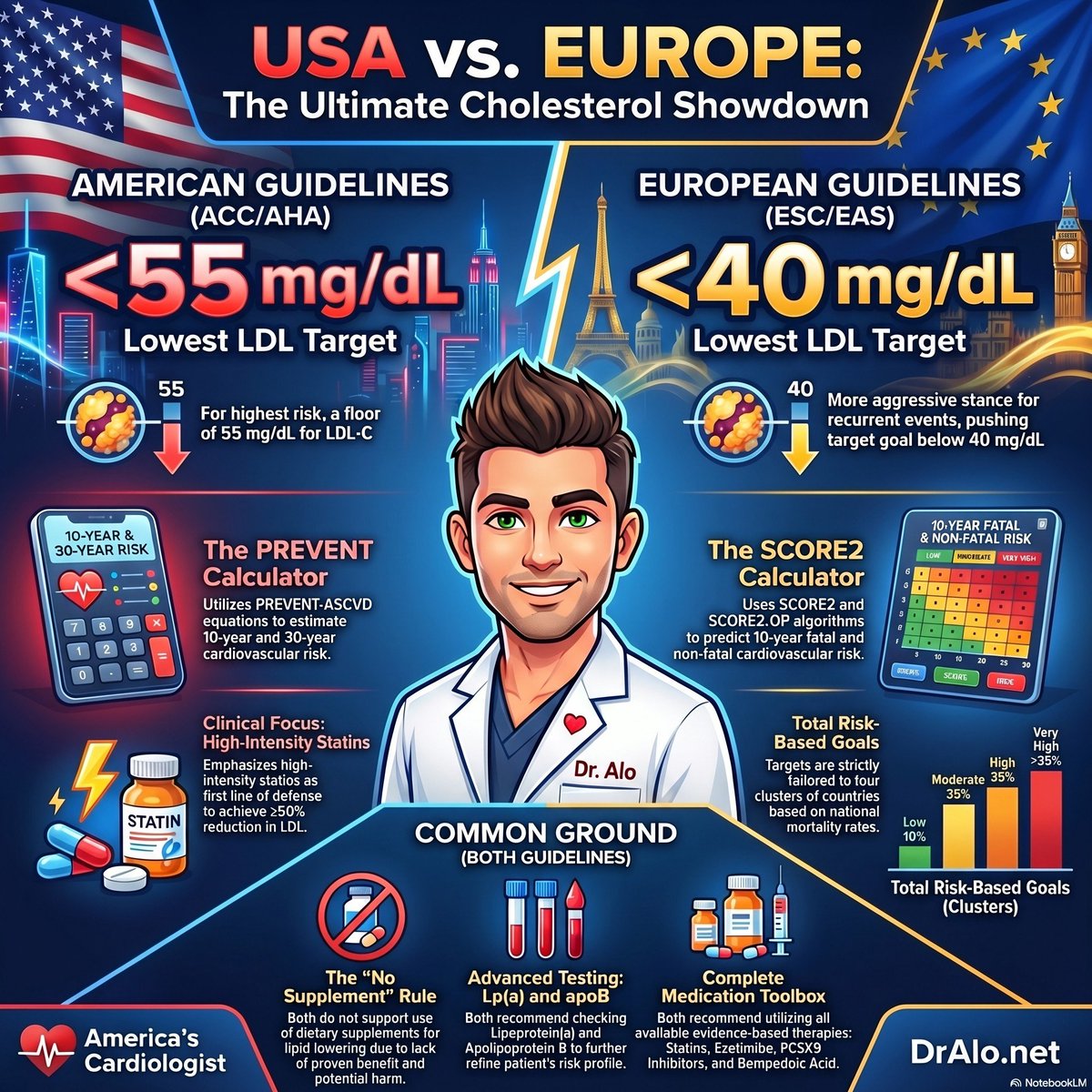
ACC vs EAS Guidelines
🚨 The cholesterol guidelines just changed and here's what you need to know. The U.S. just released its biggest update since 2018, and Europe updated theirs too.
Both are now more aggressive, more personalized, and more aligned than ever.
📊 New risk calculator. The U.S. now uses the PREVENT equations, which estimate your 10-year AND 30-year heart risk. Younger patients who look "fine" on short-term risk may actually need treatment now.
🎯 LDL targets are BACK in U.S. guidelines. If you've had a heart attack or stroke, your LDL goal is under 55 mg/dL. Not "lower." Not "better." Under 55. And if you're not there, escalate your treatment. Under 40 for repeat offenders.
🫀 CAC scores now have a formal treatment ladder. Score of 300? Treated like someone who already had a heart attack. Score of zero? Reasonable to hold off on meds and recheck in 3-7 years. (I disagree here)
🔬 Lp(a) testing is now a top-level recommendation for ALL adults, at least once in your lifetime. 1 in 5 people carries elevated levels and has no idea. It dramatically raises your risk of heart attack and aortic valve disease. Ask your doctor for it if it has never been checked.
💊 New drugs enter the picture. Bempedoic acid is now formally recommended for people who can't tolerate statins. Inclisiran, a twice-yearly injection, enters U.S. guidelines for the first time. And olezarsen gets a top-tier recommendation for severe triglyceride disorders.
🚫 Supplements for cholesterol? Both the American AND European guidelines now formally say no. Fish oil, red yeast rice, berberine, garlic, turmeric, plant sterols. None of them lower LDL meaningfully. The SPORT trial proved it head to head against a low-dose statin. Save your money and talk to your doctor.
⏰ Treat earlier. For adults in their 30s and 40s with high LDL and a strong family history, waiting until your 10-year risk looks scary is waiting too long. Atherosclerosis builds silently for decades before it strikes.
Your checklist:
✅ Get your Lp(a) checked
✅ Know your LDL goal
✅ Ask about a CAC scan if you and your doctor are on the fence about starting medication
✅ Skip the supplements
✅ If you have heart disease, LDL under 55 mg/dL is the target
https://t.co/TjJt9kK7I9
☝️LDLc is cumulative. Not episodic.
👉 Atherosclerosis = lifetime exposure to apoB particles
👉 The artery integrates risk → “plaque-years”, not snapshots
👉 Same LDLc today ≠ same risk (depends on decades of exposure)
📍What the curves show:
•Higher lifelong LDLc → earlier, steeper risk
•Lower lifelong LDLc → delayed disease, flatter trajectory
•Earlier reduction beats late intensity
📍 Modifiers don’t replace LDLc:
•Diabetes, hypertension, smoking → shift the curve left
•They accelerate injury, but LDLc remains the substrate
☝️Bottom line:
If you wait for “high risk” to act, you’re late.
Treat exposure, duration, and trajectory—not just LDLc.
🔗 https://t.co/fXon8xqOAd
@society_eas@nationallipid
Cuando tomas antibióticos, se afecta tu microbiota (flora) intestinal, lo que puede tener serias consecuencias.
La recuperación a la normalidad puede tomar años, sobre todo con antibióticos como la clindamicina o las quinolonas (Cipro, levofloxacino).
No hay que tomar antibióticos como si fueran antigripales o dulces. Deben tener una precisa indicación.
https://t.co/sf7BeAhBgF
The desire to be known is one of the most replicated findings in all of psychology. And the research on what happens when you suppress it is brutal.
In 1995, psychologists Roy Baumeister and Mark Leary published a paper called “The Need to Belong.” It’s been cited over 21,000 times, which makes it one of the most referenced papers in the entire field. Their conclusion was blunt: the drive to form and maintain relationships is as basic to humans as food or shelter. Take that away, and people start to deteriorate. Thinking gets worse. Mood collapses. Health follows.
And the health part isn’t metaphorical. In 2010, a researcher named Julianne Holt-Lunstad at Brigham Young combined the results of 148 separate studies (a method called meta-analysis, basically the gold standard for settling scientific debates) and found that strong social connections increase your odds of survival by 50%. Her 2015 follow-up put hard numbers on the flip side: social isolation raises your risk of dying early by about 29%. Loneliness, by 26%. Those numbers land in the same range as obesity and physical inactivity. You’ve probably seen the “loneliness is like smoking 15 cigarettes a day” comparison. Holt-Lunstad herself has said that line oversimplifies her data, but the core finding holds.
Your body treats isolation like a threat. Chronic loneliness floods your system with cortisol (the hormone your body releases when it’s stressed). Stay in that state long enough and it triggers inflammation throughout your body, weakens your ability to fight off infections, and starts damaging the insulation around your nerve fibers, the coating that lets different parts of your brain talk to each other quickly. Lonely people show changes at the genetic level too: the genes responsible for fighting viruses become less active while the ones that drive inflammation become more active. In 2025, the WHO found that roughly 1 in 6 people worldwide experience loneliness and declared it a global public health priority.
Here’s the part I keep coming back to. The philosophical traditions this tweet vaguely waves at actually teach the opposite of what it’s claiming. Stoic apatheia (their term for freedom from destructive emotions) was never about pulling away from people. The Stoics taught that engaging with your community is central to living well. Same with Buddhism. Non-attachment doesn’t mean you stop caring about people. A 2010 study out of UC Davis built a psychological scale to measure non-attachment and found something that surprised even the researchers: people who scored highest on it had more compassion, more kindness, and better relationships. Less depression. Less anxiety. Non-attachment means you stop white-knuckling specific outcomes. You don’t stop loving people.
Maslow got here too, right at the end. Most people know his pyramid of human needs, the one that puts self-actualization (reaching your full individual potential) at the top. But in 1969, a year before he died, he quietly added a level above it: self-transcendence. He described it as moving past your own ego and identifying with all of humanity. The peak of human development, in Maslow’s final thinking, was deeper connection to everyone around you.
A 2025 study combining data from 26 separate studies and over 68,000 students found that programs designed to build a sense of belonging improved mental health for about 1 in every 3 people. Thirty years of research say wanting to be understood might be the thing keeping you alive.
Criterios diagnósticos de migraña sin aura:
- Mínimo 5 episodios
- Duración de 4-72 horas
- Que cumpla 2/4 de las siguientes características:
・Unilateral
・Pulsátil
・Intensidad moderada-grave
・Empeora con actividad física
- Asociada con mínimo 1 de los siguientes:
・Náuseas y/o vómitos
・Fotofobia Y fonofobia
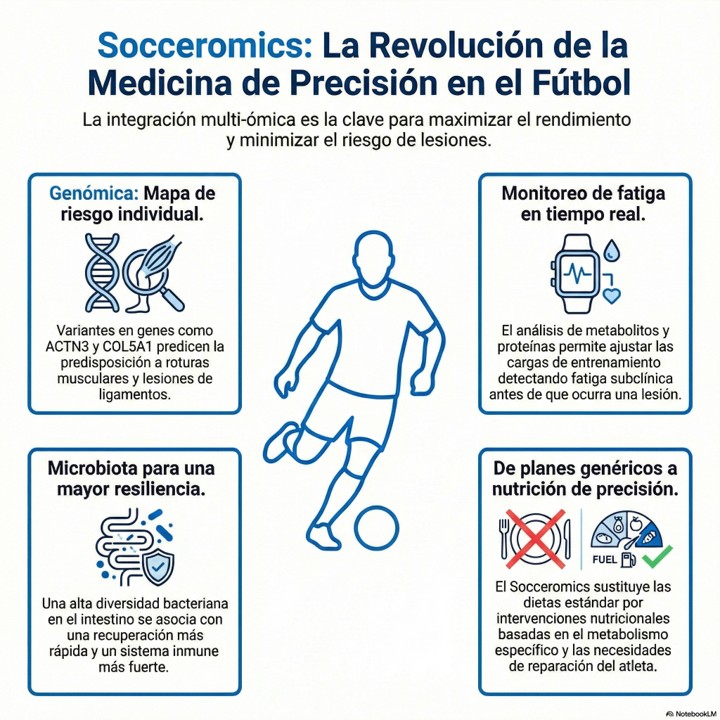
SOCCEROMICS: HACIA LA MEDICINA DE PRECISIÓN EN EL FÚTBOL La integración de genómica, metabolómica, proteómica y microbioma permite personalizar entrenamiento, nutrición, recuperación y prevención de lesiones en fútbol. La evidencia señala un modelo poligénico y multifactorial, donde la combinación de datos biológicos mejora la toma de decisiones en alto rendimiento. (lee el artículo completo en BLOG JL Chicharro en https://t.co/ghlyA0rsYU) https://t.co/T9UJaaUs0z
El topiramato inhibe anhidrasa carbónica (principalmente CA-II y CA-IV). En las papilas gustativas, la CA-IV convierte el CO₂ disuelto en ácido carbónico, generando protones que activan células gustativas ácido-sensibles (PKD2L1). Al inhibirse esta enzima, disminuye la acidificación local inducida por el CO₂ y se atenúa la percepción del “carbonation bite”. El resultado es que las bebidas carbonatadas se perciben como planas o con un perfil dulce desbalanceado.
Este mecanismo probablemente explica buena parte de la disgeusia asociada al fármaco, aunque pueden intervenir también efectos centrales sobre la neurotransmisión gustativa.
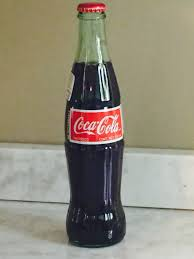
En bebidas con mayor carbonatación preservada —como aquellas en envase de vidrio— la alteración perceptiva puede resultar más evidente, al depender su perfil organoléptico en mayor medida del componente ácido-efervescente.