Psychedelics: The Journal of Psychedelic and Psychoactive Drug Research. Open Access. Peer-reviewed. Bridging science, medicine, consciousness & society. 🧠 🌍
They called her the pretty one. She was a model and she was brilliant. THE ILLNESS DID NOT CARE.
She was beloved. She was radiant. She married the love of her life. THE ILLNESS DID NOT CARE.
🧵Dr. Walss-Bass has written an extraordinary book, a one of a kind intimate voyage through the reality of schizophrenia, the cancer of mental illness
Daniel R. Weinberger, M.D.
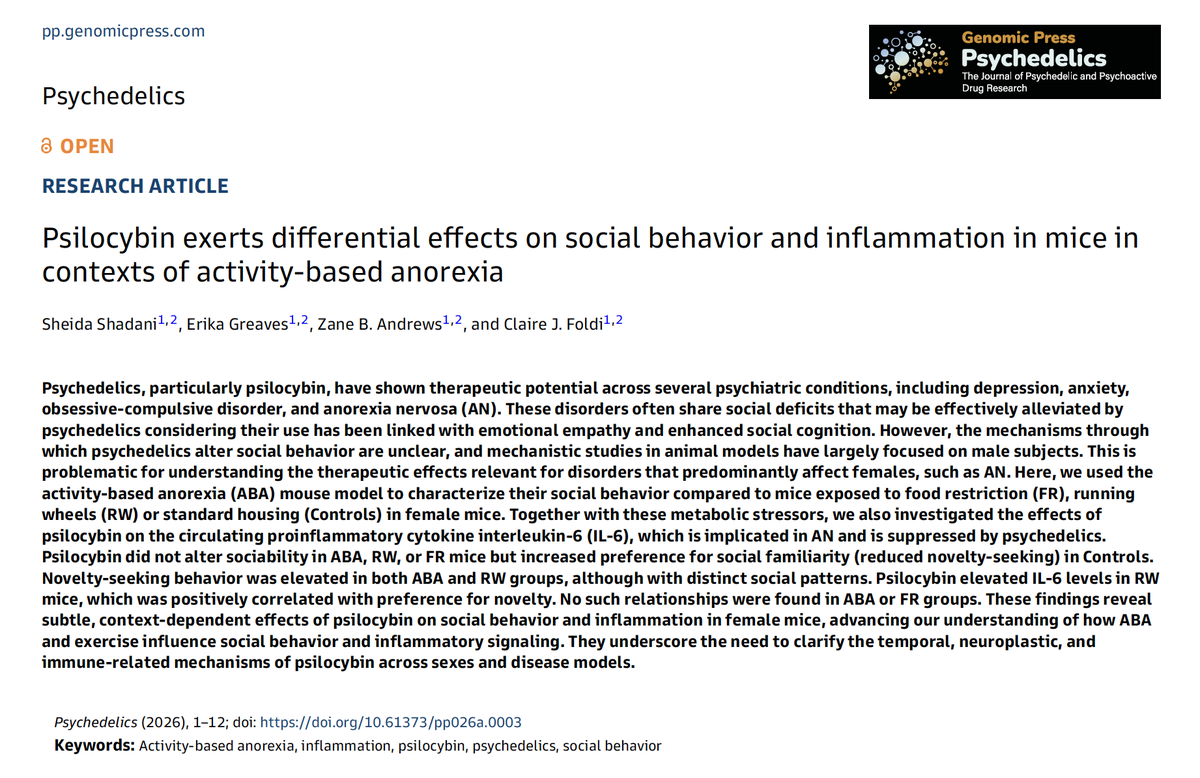
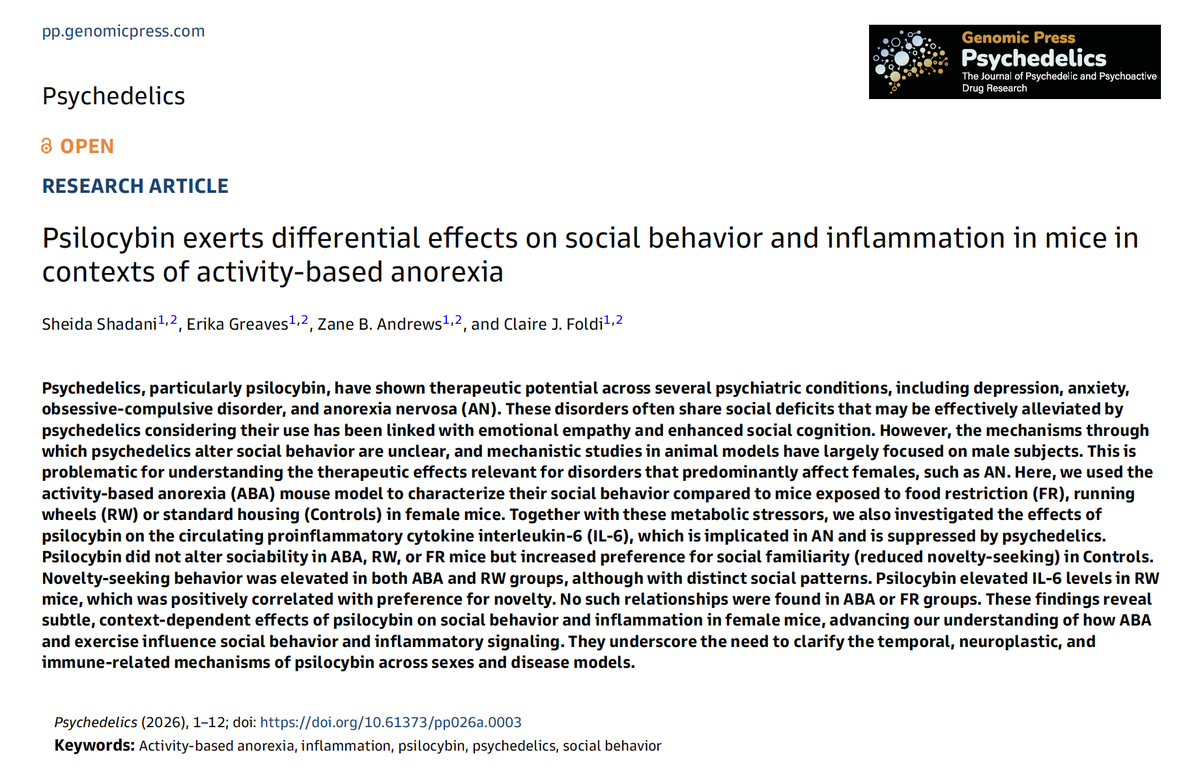
@PsyPost Fascinating work: psilocybin's effects on social prefs & IL-6 are highly dependent on metabolic/exercise context in female mice.
Explains some variability in human trials?
Great female-focused study!
👏 https://t.co/MMOmiSUip8
Psilocybin’s effects are not uniform across different physiological conditions. A study of female mice reveals that exercise and diet drastically alter how the drug influences social interactions and inflammatory signaling. https://t.co/JHi6rxw206
🧵1/8 Breaking: Groundbreaking study drops in @PsychedelicsJnl!
Psilocybin's effects on social behavior & inflammation in female mice modeling anorexia nervosa? TOTALLY context-dependent on metabolism & exercise. Explains why only ~40% respond in human trials. Mind-blowing implications for personalized psychedelic therapy!
YOUR RESEARCH FRONT PAGE WORLDWIDE.
At Genomic Press, we just don't publish your breakthrough. We make it impossible to ignore.
4000+ News Stories • 35+ Languages • 12M+ Social Media Reach
SCIENTISTS BUILD A REAL FAKE BRAIN, AND IT MIGHT SAVE AI FROM EATING THE PLANET’S POWER
AI is getting dumber about one thing: energy.
Chatbots, image generators, and massive models now chew up enough electricity to light up small cities, all while your actual brain runs on a Dr Pepper and 20 watts.
Enter the brain-mimicking super neuron.
Scientists have built a tiny artificial neuron that doesn’t just act like a brain cell in code, it works like one in real life, firing electrical pulses using ions (atoms with charge) just like the meat-computer in your head.
Forget electrons. This thing thinks with atoms.
The device uses a wild 3-part system, one memristor, one transistor, and one resistor, that moves silver ions through a microscopic film to mimic how real neurons fire, forget, and rewire.
It’s so small it fits where a single transistor would normally sit, instead of the hundreds of old-school circuits needs.
It’s like shrinking a whole brain cell into a speck of tech dust, and it learns by itself.
In tests, it fired just like a real neuron:
- It added up signals until it hit a breaking point (boom, spike!).
- Then got “tired” after firing (a mini brain nap).
- It even acted moody, sometimes firing randomly, which scientists say helps prevent computer “brain freeze.”
When linked together into a mini digital brain, the system hit 91% accuracy in recognizing spoken digits, not bad for a cluster of metal atoms pretending to be neurons.
Even crazier, this fake brain sips picojoules of power per spike, which is trillions of times less than what your gaming GPU guzzles.
If scaled up, it could completely rewrite how AI works, no more overheating server farms, no more power plants dedicated to training chatbots.
It could even unlock brain-on-a-chip computers that think, learn, and remember without needing cloud connections.
There’s still one catch: silver doesn’t play nice with existing chip factories.
But researchers are already cooking up new materials to make the tech mass-producible because if this works, it could turn laptops, phones, and even toasters into mini-geniuses that learn like us.
Source: PsyPost, Nature Electronics, EBRAIN, Grok Imagine
🇵🇱 A Psychedelics (Genomic Press) article by Elizabeth J. Brouns, Tyler G. Ekins, and Omar J. Ahmed from the University of Michigan is the focus of a news story in the Polish media:
🧠 Psychodeliki i terapia? Badania sugerują, że to może się udać
🔬 Psychedelics and therapy? Research suggests it might work
The latest research indicates that psychedelics improve brain neuroplasticity. This type of therapy could prove useful for patients struggling with psychiatric or neurological conditions. How will psychoactive substances impact modern medicine? 💊🧬
📰 https://t.co/o2uGIzX8QB
🔓🆓 Open Access Psychedelics article: https://t.co/WoR6Zkp9MZ
ℹ️ More on Genomic Press: https://t.co/c1KK1QlrkX
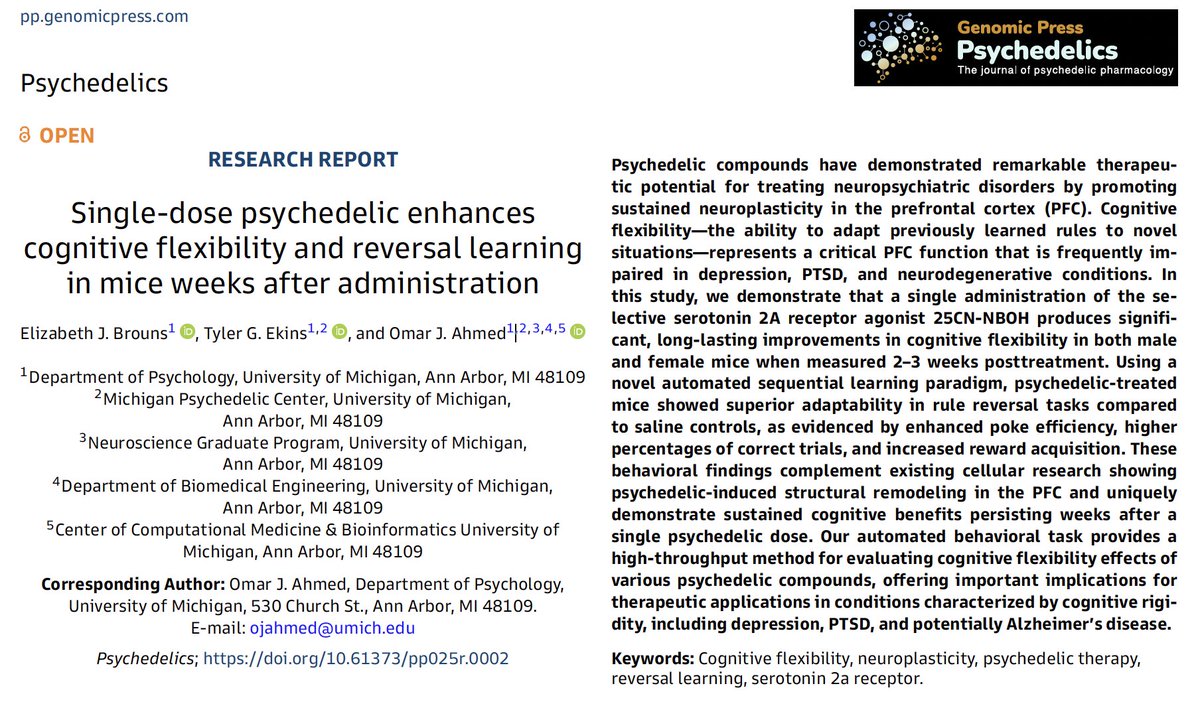
1/7 BREAKTHROUGH: New peer-reviewed research shows a single psychedelic dose enhances cognitive flexibility in mice for WEEKS after administration!
The findings could transform treatment for depression, PTSD & neurodegenerative conditions!
🧵 Follow the thread.
🧵 – Thread
Exciting new research from our peer-reviewed journal @PsychedelicsJnl – @GenomicPress reveals how psychedelic therapy is revolutionizing mental health treatment worldwide!
Professor Gregor Hasler's groundbreaking interview unveils mechanisms that could transform care for millions suffering from treatment-resistant depression, PTSD, and addiction. 1/7
🧵 Thread ⬇️
✨ Exciting new Genomic Press Interview from our peer-reviewed journal @PsychedelicsJnl by @GenomicPress! Dr. Harriet de Wit just dropped a bombshell interview today revealing how 45 years of groundbreaking research has transformed our understanding of MDMA, LSD, and human consciousness 🧠
Her University of Chicago lab proved something remarkable: MDMA actually enhances feelings of social connectedness during interpersonal interactions. This discovery is reshaping PTSD treatment protocols globally 🌍
1/7
🧵THREAD
Can voice technology revolutionize how we understand the impact of clinical interventions? 🎙️ New research in @Psychedelics_GPfrom @EmoryUniversity is transforming our approach to studying real-world experiences! 🧠(1/7)
📄🔓Open Access: https://t.co/0jNQaGkO1b
👇
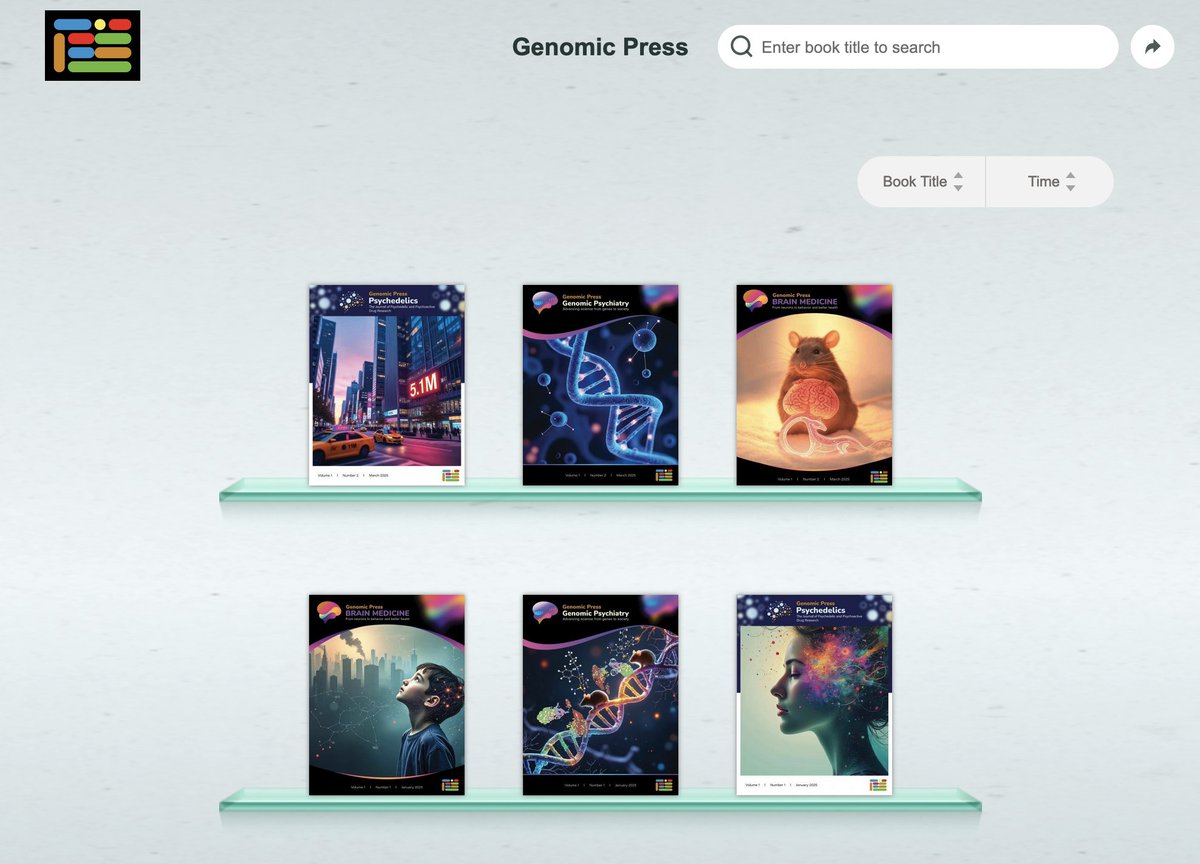
🧬Revolutionary: First publisher with a FREE Open Access Virtual Library for ALL our journals. No paywalls. No barriers.
📚 Explore our library: https://t.co/kRGWOqcRS1
🌎 Learn more: https://t.co/BOi1cZEcHD
Knowledge without borders. Science for everyone.
#OpenAccess#FreeSci
In a comprehensive Genomic Press Interview published today, Dr. Stephen Ross, a leading figure in psychedelic medicine at New York University (NYU), reveals how a serendipitous conversation in 2006 launched his journey into investigating psychedelic compounds as potential breakthrough treatments for some of psychiatry's most challenging conditions.
https://t.co/KuVZgkVPCb
To go directly to the interview: https://t.co/twnuenIArN
We are thrilled to introduce the Genomic Press Virtual Library! A revolutionary way to access our open access journals in an immersive digital environment. 🧬📷 - A THREAD (1/5)