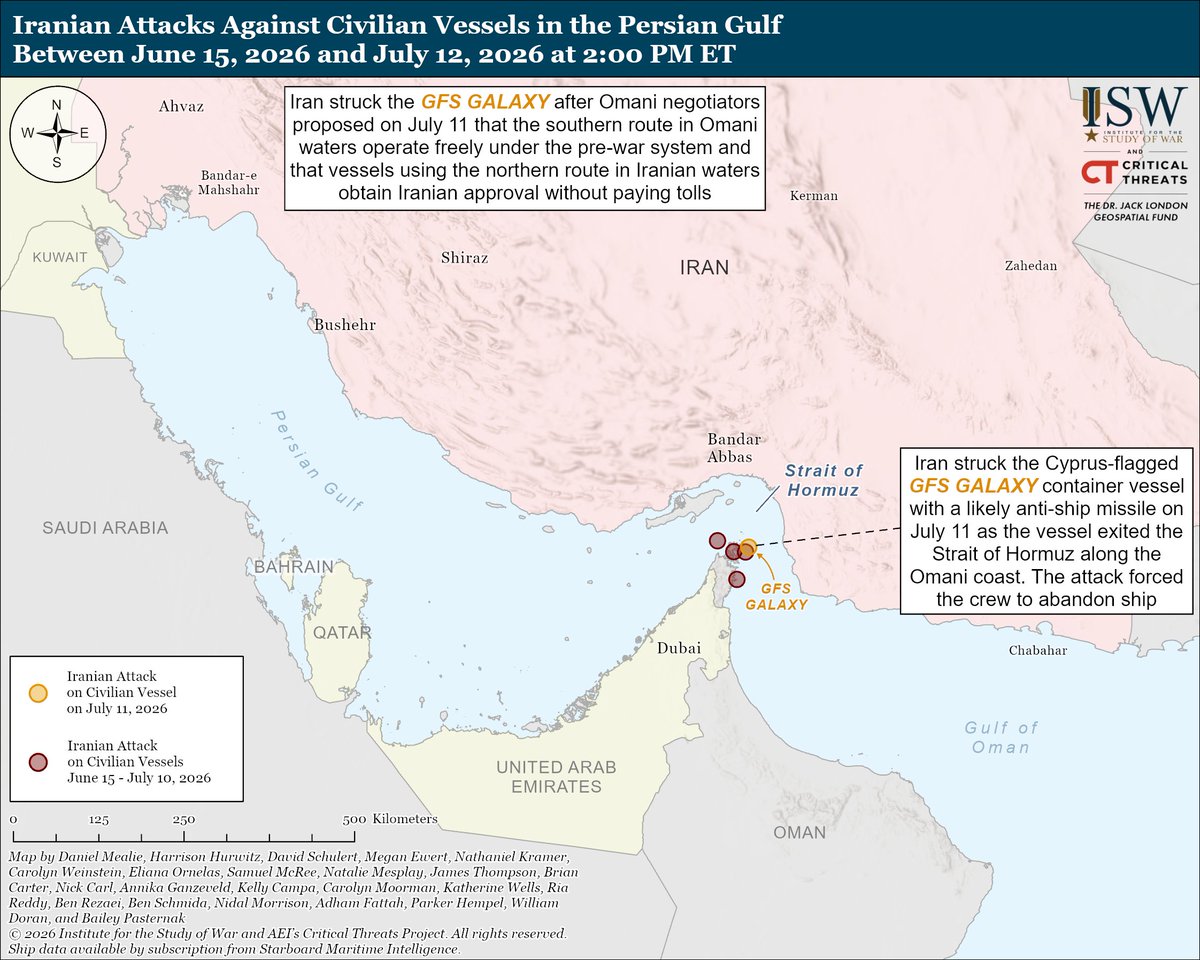
NEW: Iran is refusing any arrangement that undermines Iranian control over the Strait of Hormuz and is using force to maintain its control. Iran views control over the Strait of Hormuz as a major strategic objective, and its leaders believe that if Iran ends the war without control of the strait, it would be a serious strategic defeat. (1/2)
Other Key Takeaways:
Recent US strikes have attempted to degrade Iran’s ability to attack commercial shipping, but it remains unclear when Iran’s ability to attack commercial shipping will be degraded sufficiently to prevent individual attacks that disrupt shipping.
Iran is likely attacking Persian Gulf littoral states to deter them from supporting US- or Gulf-led efforts to limit Iranian control over the strait. Iran fired missiles and drones at US facilities in Bahrain, Kuwait, Jordan, Qatar, and Oman on July 12 in retaliation for the US strikes in Iran on July 11.
🇯🇵 Rice farmers in Niigata, one of Japan’s most important rice-producing regions, have taken to the streets.
On July 11, local farmers marched through Niigata City in a protest they called a “Peasant Uprising.”
Led by tractors, around 300 people joined the demonstration, according to the organizers.
Their message was simple:
“Protect Japan’s farmers.”
“Create conditions that allow us to keep producing rice sustainably.”
But why are Japanese farmers being pushed this far?
The cost of fertilizer, fuel, pesticides, machinery and other essential supplies has risen sharply. Some farmers say certain production costs have nearly doubled.
At the same time, when the supply of rice increases, the price paid to farmers falls.
In other words:
The cost of producing rice is rising.
The income farmers receive from rice is falling.
Farmers are being crushed from both sides.
Rice can usually be harvested only once a year. Maintaining farmland and agricultural machinery is extremely expensive, and production cannot simply be switched on and off like a factory.
If this continues, small-scale and elderly farmers will be forced out of business one after another.
And once rice fields are abandoned, farming communities disappear and generations of agricultural knowledge are lost, they cannot simply be restored when a food crisis begins.
This is not merely a protest asking for higher farmer incomes.
It is a warning.
Will Japan still be able to produce its own staple food in the future?
This is about food security, national survival, and whether a country should depend on others to feed its own people.
When farmers disappear, food sovereignty disappears with them.
#Japan #RiceFarmers #FoodSecurity #Agriculture #FarmersProtest #Niigata #FoodSovereignty