𝐂𝐨𝐧𝐠𝐫𝐞𝐬𝐬 𝐜𝐨𝐦𝐩𝐫𝐨𝐦𝐢𝐬𝐞𝐝 𝐨𝐧 𝐧𝐚𝐭𝐢𝐨𝐧𝐚𝐥 𝐬𝐞𝐜𝐮𝐫𝐢𝐭𝐲 𝐟𝐨𝐫 𝐝𝐞𝐜𝐚𝐝𝐞𝐬. 𝐈𝐧𝐝𝐢𝐚𝐧𝐬 𝐩𝐚𝐢𝐝 𝐭𝐡𝐞 𝐩𝐫𝐢𝐜𝐞. 🚨
On July 25, 2008, Bengaluru was rocked by eight coordinated bomb blasts across busy locations, including Madiwala, Richmond Town and Hosur Road. One person was killed and several others were injured.
Instead of treating the attacks as part of a larger terror conspiracy, the Congress-led UPA government responded reactively, failing to anticipate the broader threat. Just a day later, Ahmedabad was struck by a far deadlier series of bomb blasts, exposing serious questions over intelligence coordination and preparedness.
𝐅𝐨𝐫 𝐦𝐚𝐧𝐲, 𝐉𝐮𝐥𝐲 𝟐𝟓 𝐫𝐞𝐦𝐚𝐢𝐧𝐬 𝐚 𝐫𝐞𝐦𝐢𝐧𝐝𝐞𝐫 𝐨𝐟 𝐚𝐧 𝐞𝐫𝐚 𝐰𝐡𝐞𝐧 𝐞𝐚𝐫𝐥𝐲 𝐰𝐚𝐫𝐧𝐢𝐧𝐠 𝐬𝐢𝐠𝐧𝐬 𝐰𝐞𝐫𝐞 𝐦𝐢𝐬𝐬𝐞𝐝, 𝐩𝐫𝐞𝐯𝐞𝐧𝐭𝐢𝐯𝐞 𝐚𝐜𝐭𝐢𝐨𝐧 𝐟𝐞𝐥𝐥 𝐬𝐡𝐨𝐫𝐭, 𝐚𝐧𝐝 𝐈𝐧𝐝𝐢𝐚'𝐬 𝐧𝐚𝐭𝐢𝐨𝐧𝐚𝐥 𝐬𝐞𝐜𝐮𝐫𝐢𝐭𝐲 𝐩𝐚𝐢𝐝 𝐭𝐡𝐞 𝐩𝐫𝐢𝐜𝐞.
Scott Galloway just explained why China doesn’t need to build better AI than America. It only needs to make American AI worthless.
Galloway: “I think China is beginning to engage in what I’ll call AI dumping.”
Not competing. Dumping.
It’s the term economists use for flooding a foreign market with below-cost goods until the domestic industry collapses.
Galloway: “They’re going to have a series of open-weight models. About a third of corporations now are supposedly using Chinese lightweight open-weight models that are cheaper.”
Not better. Cheaper.
A third of corporations. Already.
China isn’t trying to out-innovate Silicon Valley. It’s trying to collapse the economics beneath it.
Price warfare at the infrastructure layer.
Galloway: “If I were Xi, I would just dump cheap AI into the US market.”
This playbook is old. China ran it with steel. Ran it with solar. Ran it with semiconductors.
Flood a market with a cheaper version until the domestic industry can’t sustain itself.
AI is next.
Galloway: “The moment large corporations start announcing they’re disengaging these multi-million dollar site licenses with Anthropic or OpenAI, they’re using these inexpensive Chinese models…”
One CFO after another decides the Chinese model at a fraction of the cost is good enough.
Not better. Good enough.
“Good enough” at a lower price has killed more market leaders than any superior product ever has.
Galloway: “…and the market realizes that there’s no way they can justify these incredible valuations, I think the US market crashes.”
Not because the technology failed.
Because the business model did.
American AI companies are valued on the assumption that corporations will pay premium prices for premium models.
China’s whole strategy is to make that assumption false.
Galloway: “40% of the S&P now is directly or tangentially related to this giant bet America’s making on AI.”
40% of the S&P. Tied to one sector.
Galloway: “The majority of GDP growth over the last two years has come from AI CapEx.”
The majority of GDP growth. From one source.
America didn’t diversify its future. It concentrated everything into a single bet, then left that bet undefended.
Galloway: “If that slows down, we are immediately in a recession.”
Immediately. Not gradually. Not over quarters.
The distance between AI boom and American recession is one procurement decision.
America built the most advanced AI on Earth and forgot to build an economy that survives someone selling it cheaper.
The threat to American AI was never that China would build something smarter.
It was that China would build something cheaper, and American corporations would choose the price.
China’s real weapon isn’t Chinese technology. It’s American capitalism.
The same rational self-interest that built the AI industry will dismantle it the moment a cheaper alternative appears. The market has no patriotism. Only price sensitivity.
The technology race was never the real race.
The real race was always whether America could turn its AI dominance into something that survives being undercut.
America hasn’t even started running it.
China already has.
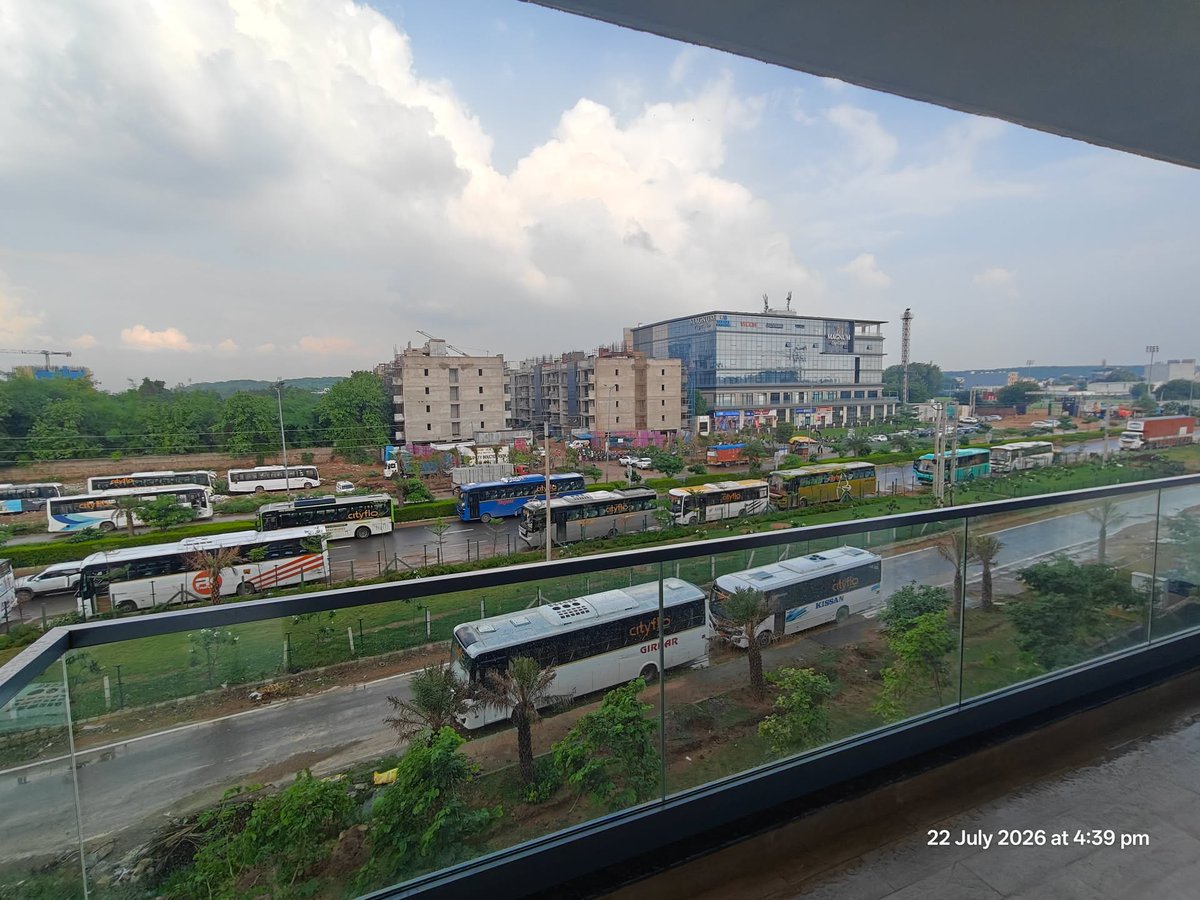
Hey @DC_Gurugram@gurgaonpolice@TrafficGGM
The whole Sector 63A (near Magnum City Centre) has been hijacked by @Cityflo_India and being used as parking area for these buses on daily basis.
They are even blocking the service lane and entrance to it. Solve this on priority!
India's rise was always going to invite resistance.
Not because India is weak - but because it is no longer willing to remain weak and meek.
Now that Sonam Wangchuk ended his fast and chose to place his trust in the Indian government, let's talk.
The people trying to manufacture unrest or anarchy or even talk about regime change in Delhi still don't understand how Indian democracy actually works.
Governments in India are not changed through street battles.
They are changed through elections.
But did all of this it all start a few months ago when US Deputy Secretary Christopher Landau candidly admitted that America would not "make the same mistake" with India that it made with China by allowing it to become a commercial competitor?
That one statement revealed an uncomfortable geopolitical truth: every major power understands that India's rise will fundamentally reshape the global balance.
Now look at what is happening in Delhi.
My reading is that these protests are not merely about examinations.
They are part of a much larger effort to weaken the Indian State at a politically sensitive moment.
Parliament has convened. The government is preparing to move politically significant legislation, including measures such as the FCRA amendments and delimitation. The Opposition knows the numbers inside Parliament are against it.
So is the battle now being shifted outside Parliament?
That is my reading.
If you cannot stop legislation through votes, create enough disorder that Parliament itself becomes the story.
That is the heinous conspiracy I believe India must recognise.
Every rising power faces attempts to weaken it from within.
Not through tanks.
Through narratives.
Through information warfare.
Through street mobilisation.
Through foreign influence.
Through ideological ecosystems.
Although anyone dreaming of a Bangladesh or Nepal-style regime-change script fundamentally misunderstands India.
Indian governments rise and fall through elections.
Not through street violence.
Not through organised anarchy.
Not through foreign-funded influence networks.
Not through deep-state operations.
The Indian voter - not the loudest mob - decides who governs India.
That is the strength of Indian democracy.
And anyone trying to replace the ballot with the barricade will ultimately lose.
I am not rage baiting but seriously asking . If you are the son of a rich sarkari parent in a tier 1 city, what legit disadvantage do you feel in competing in general category?
#BREAKING | Keralam Police use water cannons against BJP Yuva Morcha karyakartas protesting outside the official residence of Chief Minister V.D. Satheesan in Thiruvananthapuram.
The protest is over alleged irregularities in the Keralam PSC examination.
Can someone identify her? Let’s make her famous; make her parents famous. Let her neighbours' city know how talented she is. GenZ Icon.
Now you understand why I stress so much about parenting?
This is how these anarchist elements assaulted ACP Bhagat yesterday at 8.30 pm.
Watch carefully two students were shielding him; protecting him by covering his head with hands.
We need to stand with students; not with anarchist elements which has infiltrated!
DANGEROUS‼️
A protestor named Sabhyam is carrying a gun and bullets in “self-defence”
Just like Bangladesh, a fake murder can be orchestrated to later blame on security forces.
@DelhiPolice@CellDelhi@NIA_India@HMOIndia PLEASE TAKE ACTION‼️
ವಯಸ್ಸಾದ ಕಾಲದಲ್ಲಿ ಔಷಧಿ, ಆಹಾರ ಹಾಗೂ ಬದುಕಿನ ಆಸರೆಯಾಗಿದ್ದ ಪಿಂಚಣಿಯನ್ನೇ ಕಸಿದುಕೊಂಡಿರುವ @INCKarnataka ಸರ್ಕಾರದ ನಡೆ ಅತ್ಯಂತ ಖಂಡನೀಯ.
ಬರೋಬ್ಬರಿ 18.97 ಲಕ್ಷ ಫಲಾನುಭವಿಗಳ ಪಿಂಚಣಿ ಸ್ಥಗಿತಗೊಳಿಸಿರುವ ಪರಿಣಾಮ, ವೃದ್ಧರು ಮತ್ತು ವಿಕಲಚೇತನರು ನಾಡಕಚೇರಿ ಹಾಗೂ ತಾಲೂಕು ಕಚೇರಿಗಳ ಮುಂದೆ ಕಣ್ಣೀರಿಡುತ್ತಾ ಅಲೆದಾಡುವ ದುಸ್ಥಿತಿ ನಿರ್ಮಾಣವಾಗಿದೆ. ಸಮಾಜದ ಅತ್ಯಂತ ದುರ್ಬಲ ವರ್ಗದವರ ಬದುಕಿನ ಭದ್ರತೆಯನ್ನೇ ಕಸಿದುಕೊಳ್ಳುವುದು ಯಾವುದೇ ಸರ್ಕಾರಕ್ಕೂ ಶೋಭೆಯಲ್ಲ.
@DKShivakumar ಅವರೇ, ವೃದ್ಧರು, ಅಂಗವಿಕಲರ ಬದುಕಿಗೆ ಕತ್ತರಿ ಹಾಕುವುದನ್ನು ನಿಲ್ಲಿಸಿ, ಸ್ಥಗಿತಗೊಂಡಿರುವ ಎಲ್ಲ ಪಿಂಚಣಿಗಳನ್ನು ತಕ್ಷಣ ಬಿಡುಗಡೆ ಮಾಡಿ.
#CongressFailsKarnataka
#CongressLootsKarnataka
If you're talking about a "fair education system" but conveniently ignore 70% Reservations & negative NEET-PG cut-offs - then you have no idea what "fair" actually means.
Wanted to take a moment to thank someone who gave @SkyrootA its first real lift-off—Mukesh Bansal.
8 Years ago, we sent him a cold LinkedIn message.
He replied.
We met that very weekend.
Soon after, he became Skyroot’s first investor with a ₹10 crore cheque.
At the time, there was no space policy. No proof that we could build an orbital rocket. Immense technology risk. And every reason to say no.
Yet he looked beyond the uncertainty. He believed in our passion and saw possibility long before there was evidence.
But what stayed with me even more than the investment was the trust.
He gave us complete freedom to build, trusted us to make the right decisions, and was always there to mentor us whenever we needed him. More than capital, he helped shape our thinking with one piece of advice:
“Always do the right thing. This journey will be much longer and much harder than you imagine. Build two things with equal importance: the product and the organisation.”
This has guided us through every phase of the journey and continue to shape how we build Skyroot today.
The first cheque is never just capital. It is belief.
Every great startup needs someone willing to take that first leap of faith—when all they can really invest in is the founders’ conviction.
India needs many more such risk-takers backing ambitious deep-tech entrepreneurs long before success becomes obvious.
Thank you, Mukesh. 🙏
@mukeshbansal06
P.S. This picture was taken during one of Mukesh’s visits to our factory in Skyroot’s early days. We were showing him just how light Vikram-S’s carbon composite structures were—a small moment from a journey that has since come a long way. 🚀