🌍 Planet of the Week: Earth 🌍
🌱 Earth Day Special Edition 🌱
🛸 [Landing Report: EARTH] 🛸
📍 Coordinates: 1 AU from Sol (Sun)
🌡️ Surface Temp Range: -89°C to 56°C (-128°F to 133°F)
🧭 Gravity: 1g
⚠️ Dangers Detected:
Natural disasters: hurricanes, earthquakes, wildfires
Pollution and climate change, Habitat loss and species extinction----
Solar and cosmic radiation (mostly deflected by the magnetosphere)
🌎 Planetary Overview:
Earth—our blue oasis in the void—is the only known planet with life. A vibrant biosphere, flowing water, and breathable atmosphere make it uniquely habitable. From lush forests and roaring oceans to deserts, volcanoes, and frozen poles, Earth is dynamic, beautiful, and fragile.
-------------------------------------------------------------
It’s also the only planet we fully understand from within, and the one that has launched explorers into the cosmos.
🌦️ Climate & Conditions:
Atmosphere: 78% nitrogen, 21% oxygen, rich in water vapor and life-supporting gases
Weather: Ever-changing—sunshine, rain, snow, storms, and more
Seasons: Caused by Earth’s 23.5° axial tilt, giving rise to ecological diversity
Magnetosphere: Protects us from deadly solar radiation, creating the auroras at the poles
🌟 Interesting Features:
Liquid Water: Covers ~71% of the surface
Plate Tectonics: Drives earthquakes and mountain formation
Diverse Biosphere: Home to over 8 million known species (and many more unknown)
The Moon: Earth’s only natural satellite helps stabilize our tilt and tides
🌍 Why Earth Day Matters:
Earth is rare. Precious. It’s not just where we live—it’s what we depend on for every breath, every bite, every moment.
But it’s also under threat from deforestation, warming oceans, pollution, and overconsumption. Earth Day reminds us to protect the systems that sustain life—not just for us, but for every living thing we share it with.
🎮 Mission Log:
Objective 1: Restore ecosystems and biodiversity
Objective 2: Combat climate change and reduce emissions
Objective 3: Foster global cooperation to ensure a sustainable future
🌌 Challenges:
Human impact is accelerating environmental change
Some resources are finite—recycling, innovation, and policy matter
Environmental crises don’t follow borders—they demand collective action
💡 Fun Fact:
If the entire age of Earth (4.5 billion years) was condensed into a single 24-hour day, humans wouldn’t appear until 11:59 PM. We’ve only just arrived—and the future is still being written.
📖 Mission Debrief:
Earth is more than a planet—it’s our only home. On this Earth Day, we reflect, reconnect, and recommit to protecting it. There is no Planet B.
💬 What’s one thing you love most about Earth? Share it below—and tag someone to remind them we’re all in this together. 🌿💙
Stephan’s Quintet: A Galactic Ballet of Chaos and Creation🌀💥
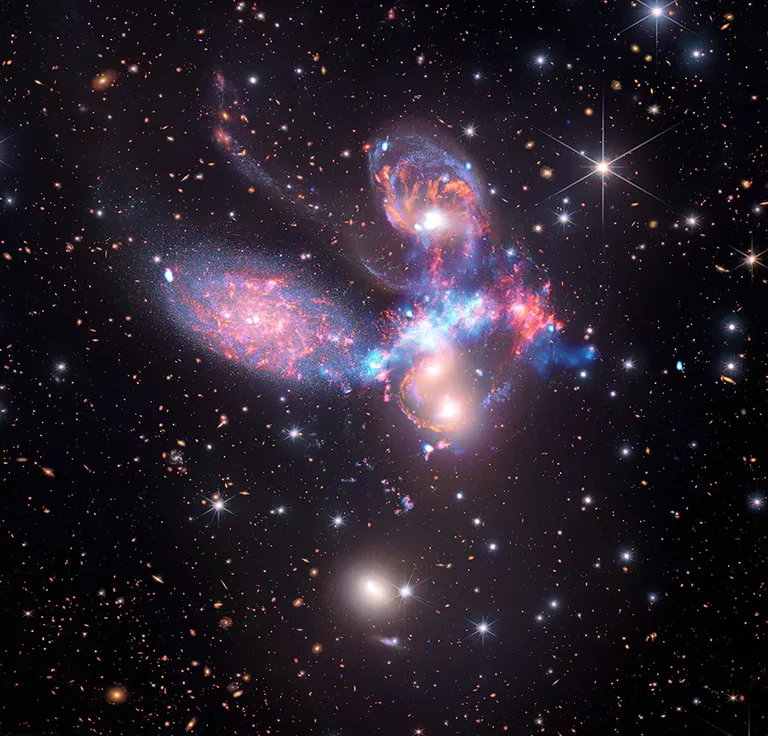
In a distant corner of the cosmos lies one of the most dramatic scenes in the universe Stephan’s Quintet. This mesmerizing group of five galaxies, locked in a gravitational embrace, is a cosmic dance of collisions, mergers, and turbulence unlike anything in our own neighborhood.
🔭 What Is Stephan’s Quintet?
Located about 290 million light-years away in the constellation Pegasus, Stephan’s Quintet is a compact galaxy group made famous by its dynamic interactions. Discovered in 1877, it consists of:
Four true interacting galaxies (NGC 7317, 7318A, 7318B, 7319)
One foreground galaxy (NGC 7320) that just happens to lie along our line of sight
💥 Galactic Collisions in Action
What makes this group legendary is what’s happening between the galaxies:
🚀 One galaxy (NGC 7318B) is barreling through the cluster at 2 million mph, slamming into intergalactic gas and triggering a massive shockwave visible in X-rays and infrared.
🌟 These interactions are stripping stars and gas, igniting new bursts of star formation, and reshaping the galaxies themselves.
🛰️ Seen Through the Eyes of Webb and Hubble
The James Webb Space Telescope (JWST) and Hubble have captured stunning images of the quintet, revealing:
Vast tails of stars and dust stretching between galaxies,
Bright star-forming regions,
Signs of active galactic nuclei, including a supermassive black hole feeding in NGC 7319
🧠 Why It Matters
Stephan’s Quintet is a real-time laboratory for:
🔄 Understanding galaxy evolution and mergers
🌌 Observing how galactic environments influence star formation
🕳️ Studying black hole activity in the chaos of collisions
💡 Fun Fact: Stephan’s Quintet was famously featured in It’s a Wonderful Life (1946) though at the time, its violent nature was unknown!
Stephan’s Quintet shows us how beauty and violence coexist in the universe, and how even chaos can give birth to new stars, systems, and cosmic wonders.
#StephansQuintet #GalaxyCollision #WebbTelescope #CosmicChaos #InteractingGalaxies #StarFormation #Astrophysics #PegasusConstellation #DeepSpaceWonders
Stephan’s Quintet: A Galactic Ballet of Chaos and Creation🌀💥
In a distant corner of the cosmos lies one of the most dramatic scenes in the universe Stephan’s Quintet. This mesmerizing group of five galaxies, locked in a gravitational embrace, is a cosmic dance of collisions, mergers, and turbulence unlike anything in our own neighborhood.
🔭 What Is Stephan’s Quintet?
Located about 290 million light-years away in the constellation Pegasus, Stephan’s Quintet is a compact galaxy group made famous by its dynamic interactions. Discovered in 1877, it consists of:
Four true interacting galaxies (NGC 7317, 7318A, 7318B, 7319)
One foreground galaxy (NGC 7320) that just happens to lie along our line of sight
💥 Galactic Collisions in Action
What makes this group legendary is what’s happening between the galaxies:
🚀 One galaxy (NGC 7318B) is barreling through the cluster at 2 million mph, slamming into intergalactic gas and triggering a massive shockwave visible in X-rays and infrared.
🌟 These interactions are stripping stars and gas, igniting new bursts of star formation, and reshaping the galaxies themselves.
🛰️ Seen Through the Eyes of Webb and Hubble
The James Webb Space Telescope (JWST) and Hubble have captured stunning images of the quintet, revealing:
Vast tails of stars and dust stretching between galaxies,
Bright star-forming regions,
Signs of active galactic nuclei, including a supermassive black hole feeding in NGC 7319
🧠 Why It Matters
Stephan’s Quintet is a real-time laboratory for:
🔄 Understanding galaxy evolution and mergers
🌌 Observing how galactic environments influence star formation
🕳️ Studying black hole activity in the chaos of collisions
💡 Fun Fact: Stephan’s Quintet was famously featured in It’s a Wonderful Life (1946) though at the time, its violent nature was unknown!
Stephan’s Quintet shows us how beauty and violence coexist in the universe, and how even chaos can give birth to new stars, systems, and cosmic wonders.
#StephansQuintet #GalaxyCollision #WebbTelescope #CosmicChaos #InteractingGalaxies #StarFormation #Astrophysics #PegasusConstellation #DeepSpaceWonders
Earth’s New Minimoons: Tiny Moons, Big Implications 🌍🌑🛰️
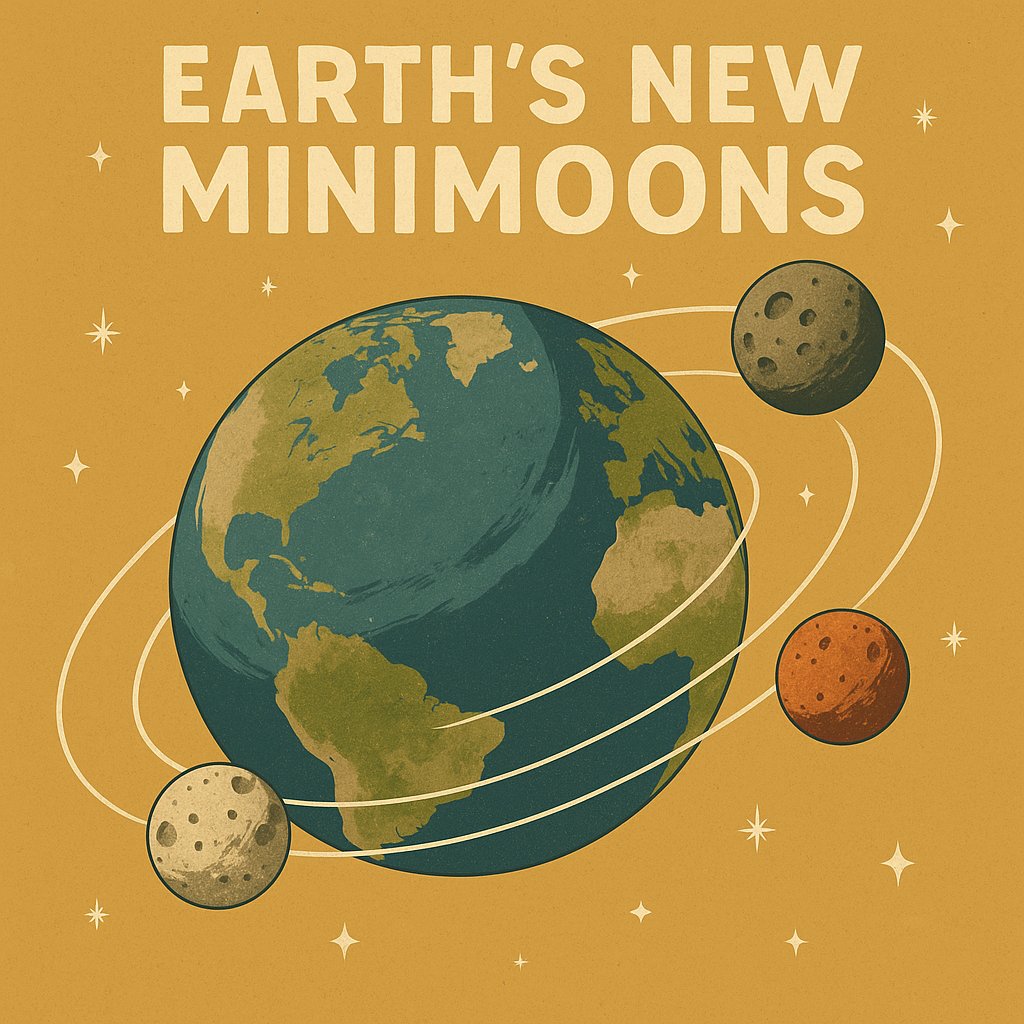
Move over, Moon—Earth has company. Scientists have recently confirmed the discovery of new “minimoons”: small, natural satellites that temporarily orbit our planet before drifting away. These elusive space rocks may be small, but their impact on science and exploration is anything but.
🔎 What Are Minimoons?
Minimoons also known as temporarily captured objects (TCOs)—are asteroid-sized bodies that enter Earth’s gravitational sphere and orbit us for a short period, usually months or years, before escaping back into space.
Unlike our permanent Moon, these visitors come and go, often without us even noticing.
🌑 How Were They Discovered?
Using advanced telescopes and tracking algorithms, scientists detected subtle movements in near-Earth space that indicated the presence of small, faint objects orbiting Earth.
🛰️ Some of these are just a few meters across—hard to detect but scientifically valuable.
🌘 Where Do They Come From?
New research suggests that some of these minimoon candidates may be fragments of lunar debris—possibly ejected by asteroid impacts on the Moon. Others are likely captured asteroids that wandered too close to Earth.
Their orbits vary, but most revolve chaotically and briefly before escaping Earth’s grasp.
🚀 Why It Matters
Minimoons may be tiny, but they offer huge opportunities:
🧪 Scientific Study: These objects can provide insights into asteroid composition, solar system evolution, and Earth’s gravitational influence.
🌍 Planetary Defense: Studying minimoon orbits helps refine our models for tracking potential impactors.
🧤 Space Missions: Their proximity and small size make them perfect testbeds for robotic exploration or even asteroid mining technology.
💡 Fun Fact: Only one minimoon—2006 RH120—has ever been confirmed in detail, orbiting Earth for about 11 months. But new detection methods suggest they may be far more common than we realized.
Tiny, temporary, and full of cosmic secrets... minimoons might just be the overlooked stepping stones in humanity’s path to the stars.
#Minimoons #EarthOrbit #Asteroids #PlanetaryDefense #SpaceExploration #MoonFragments #AstronomyNews #NearEarthObjects #SpaceMysteries
Earth’s New Minimoons: Tiny Moons, Big Implications 🌍🌑🛰️
Move over, Moon—Earth has company. Scientists have recently confirmed the discovery of new “minimoons”: small, natural satellites that temporarily orbit our planet before drifting away. These elusive space rocks may be small, but their impact on science and exploration is anything but.
🔎 What Are Minimoons?
Minimoons also known as temporarily captured objects (TCOs)—are asteroid-sized bodies that enter Earth’s gravitational sphere and orbit us for a short period, usually months or years, before escaping back into space.
Unlike our permanent Moon, these visitors come and go, often without us even noticing.
🌑 How Were They Discovered?
Using advanced telescopes and tracking algorithms, scientists detected subtle movements in near-Earth space that indicated the presence of small, faint objects orbiting Earth.
🛰️ Some of these are just a few meters across—hard to detect but scientifically valuable.
🌘 Where Do They Come From?
New research suggests that some of these minimoon candidates may be fragments of lunar debris—possibly ejected by asteroid impacts on the Moon. Others are likely captured asteroids that wandered too close to Earth.
Their orbits vary, but most revolve chaotically and briefly before escaping Earth’s grasp.
🚀 Why It Matters
Minimoons may be tiny, but they offer huge opportunities:
🧪 Scientific Study: These objects can provide insights into asteroid composition, solar system evolution, and Earth’s gravitational influence.
🌍 Planetary Defense: Studying minimoon orbits helps refine our models for tracking potential impactors.
🧤 Space Missions: Their proximity and small size make them perfect testbeds for robotic exploration or even asteroid mining technology.
💡 Fun Fact: Only one minimoon—2006 RH120—has ever been confirmed in detail, orbiting Earth for about 11 months. But new detection methods suggest they may be far more common than we realized.
Tiny, temporary, and full of cosmic secrets... minimoons might just be the overlooked stepping stones in humanity’s path to the stars.
#Minimoons #EarthOrbit #Asteroids #PlanetaryDefense #SpaceExploration #MoonFragments #AstronomyNews #NearEarthObjects #SpaceMysteries
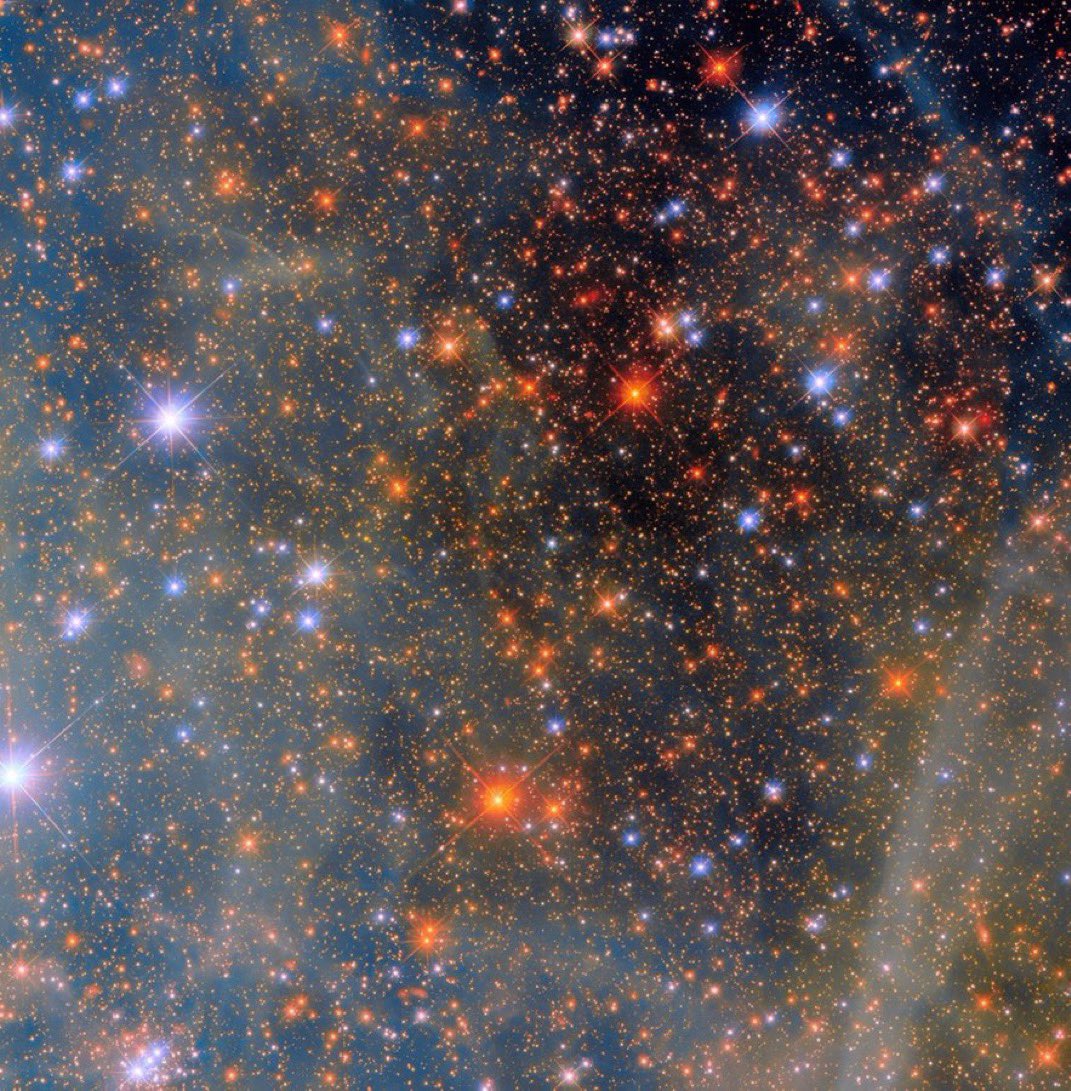
The Small Magellanic Cloud (SMC) is a whole galaxy just hangin’ out near the Milky Way…about 200,000 light-years away.
Even though it’s a dwarf galaxy, it’s packed with stars, gas, and nebulae. What you’re seeing here is just a small slice of it, captured by Hubble. If you’re in the Southern Hemisphere, you can actually spot it with your naked eye — just a faint smudge in the sky that’s literally another galaxy.
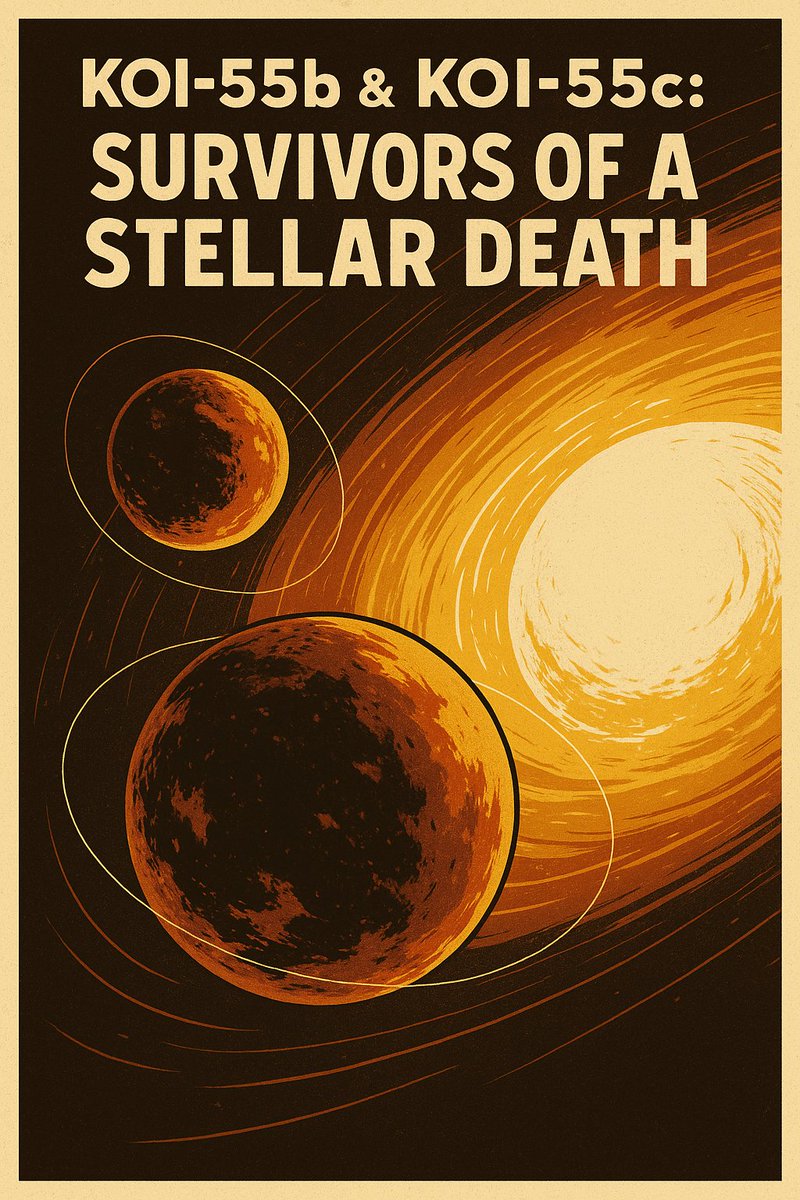
KOI-55b & KOI-55c: Survivors of a Stellar Death 🌟🔥🪐
Orbiting so close to their parent star that they once swam inside its fiery outer layers, KOI-55b and KOI-55c are two of the strangest planets ever found. These small, scorched worlds circle a dying white dwarf star... not just close, but within what used to be the star’s own envelope.
🔎 What Are KOI-55b and KOI-55c?
These two Earth-sized planets orbit the remnant core of a red giant, now a white dwarf known as KOI-55 (also called KIC 05807616). They lie at just 0.006 AU and 0.0076 AU from their star—that’s less than 1% of the Earth-Sun distance.
⏱️ Their orbits are blisteringly fast—under 6 hours per revolution.
🔥 They Shouldn’t Exist… But They Do
KOI-55 once expanded into a red giant, a phase where it would have engulfed anything that close.
Yet KOI-55b and c survived, possibly because:
🛡️ They were once gas giants that lost their atmospheres, leaving behind rocky cores.
🌊 Or, they formed after the red giant phase, born from leftover debris in a second-generation planetary disk.
🌡️ Scorched but Intact
Being so close to a white dwarf, the planets endure intense radiation and tidal forces, with surface temperatures exceeding 7,000°F (4,000°C).
Despite that, they remain stable—ghost planets orbiting a stellar corpse, defying what we thought planets could survive.
🧪 Why It Matters
KOI-55b and KOI-55c offer a rare glimpse into:
🔁 Planetary survival after stellar death
☠️ How planets can endure engulfment or be reborn after a star's collapse
🌀 The extreme physics near compact stellar remnants like white dwarfs
💡 Fun Fact: If KOI-55b and c were any closer, they might not just orbit their star—they could literally spiral into it due to gravitational decay.
These are planets that lived through the death of their sun, and they’re still circling the ashes.
#KOI55b #WhiteDwarfPlanets #StellarDeath #SurvivorWorlds #ExtremeExoplanets #Astrophysics #PlanetaryEvolution
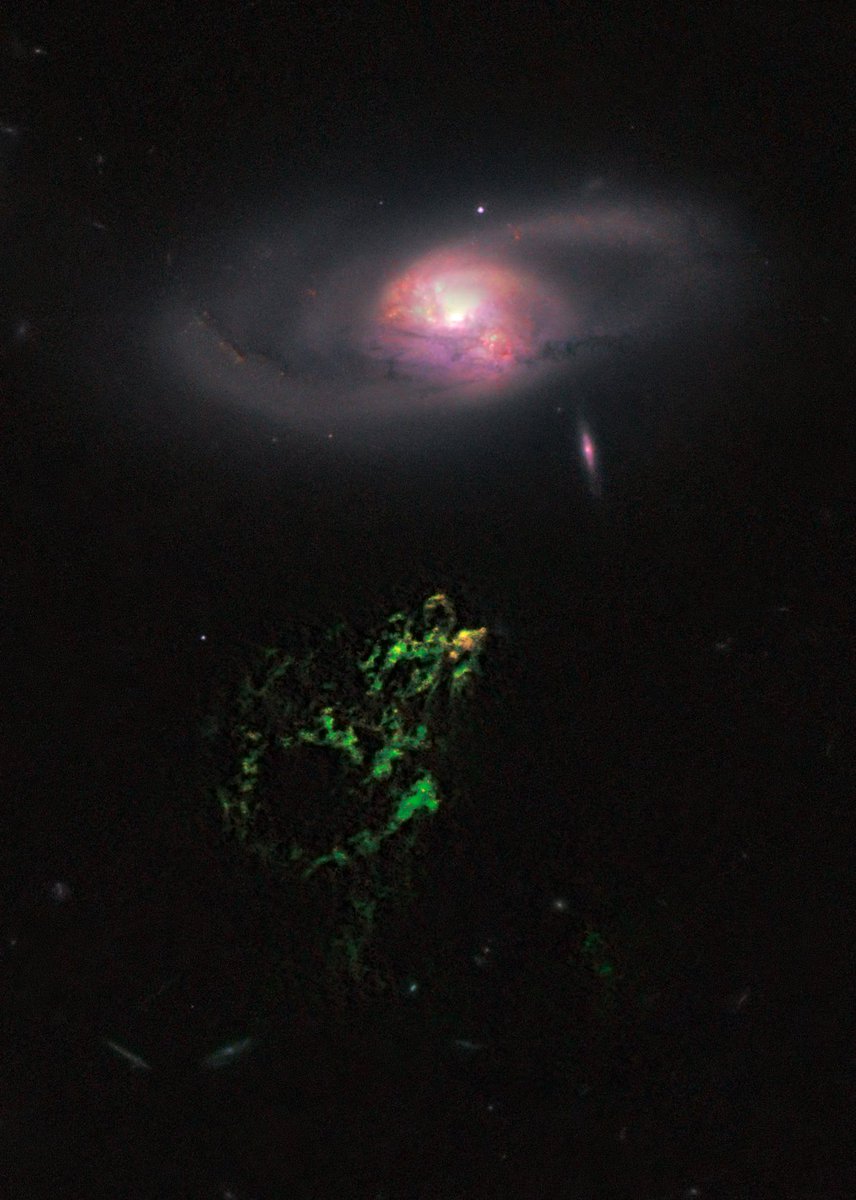
Hanny’s Voorwerp: The Ghost of a Dead Quasar 👻💚
Floating like a glowing emerald in deep space, Hanny’s Voorwerp is one of the most mysterious and stunning discoveries in modern astronomy. It’s not a galaxy, not a nebula, and not quite like anything else—just a bizarre, bright green cloud the size of the Milky Way, glowing with the afterimage of a vanished cosmic powerhouse.
🔎 What Is Hanny’s Voorwerp?
In 2007, Dutch schoolteacher Hanny van Arkel spotted something strange while volunteering for the Galaxy Zoo citizen science project—a weird green blob next to galaxy IC 2497, about 650 million light-years away.
She flagged it, and astronomers quickly realized it wasn’t a glitch: this was something never seen before.
💡 “Voorwerp” is Dutch for “object”—and what an object it is.
💥 A Quasar’s Fading Echo
Hanny’s Voorwerp is a massive tidal stream of gas—material likely flung out during a galaxy merger—that just happened to drift into the perfect spot.
🌟 It was lit up by an ancient quasar: a powerful outburst from the supermassive black hole at the center of IC 2497.
🔦 The black hole has since gone quiet, but the Voorwerp still glows green, ionized by the long-gone radiation—like a cosmic neon sign still buzzing after the power was shut off.
🌌 A Rare Stellar Nursery
Surprisingly, this strange cloud isn’t just glowing—it’s also forming stars.
In a few pockets of denser gas, gravity is taking over, and new stars are igniting far outside the galaxy—a rare and eerie example of intergalactic star formation.
🧪 Why It Matters
Hanny’s Voorwerp opened the door to a whole new class of objects now called “Voorwerpjes”—ionized gas clouds that glow from the fading radiation of active galactic nuclei (AGN).
It taught astronomers that:
🕰️ Quasars can flicker on and off far more quickly than we once thought (in just tens of thousands of years).
🌍 Galaxy mergers can sling gas far from the core, where it may become visible only much later.
🔦 The universe can leave glowing footprints of its most powerful outbursts—even after the light source has vanished.
💡 Fun Fact: Hanny’s Voorwerp is a real-time ghost, a cosmic afterglow that reveals a galaxy’s dramatic past. We’re seeing the light echo of something that no longer exists.
A glowing, green reminder that the universe remembers...even when the lights go out.
#HannysVoorwerp #QuasarEcho #GalaxyZoo #AGN #IC2497 #Voorwerpjes #SpaceMystery #CitizenScience #Astrophysics
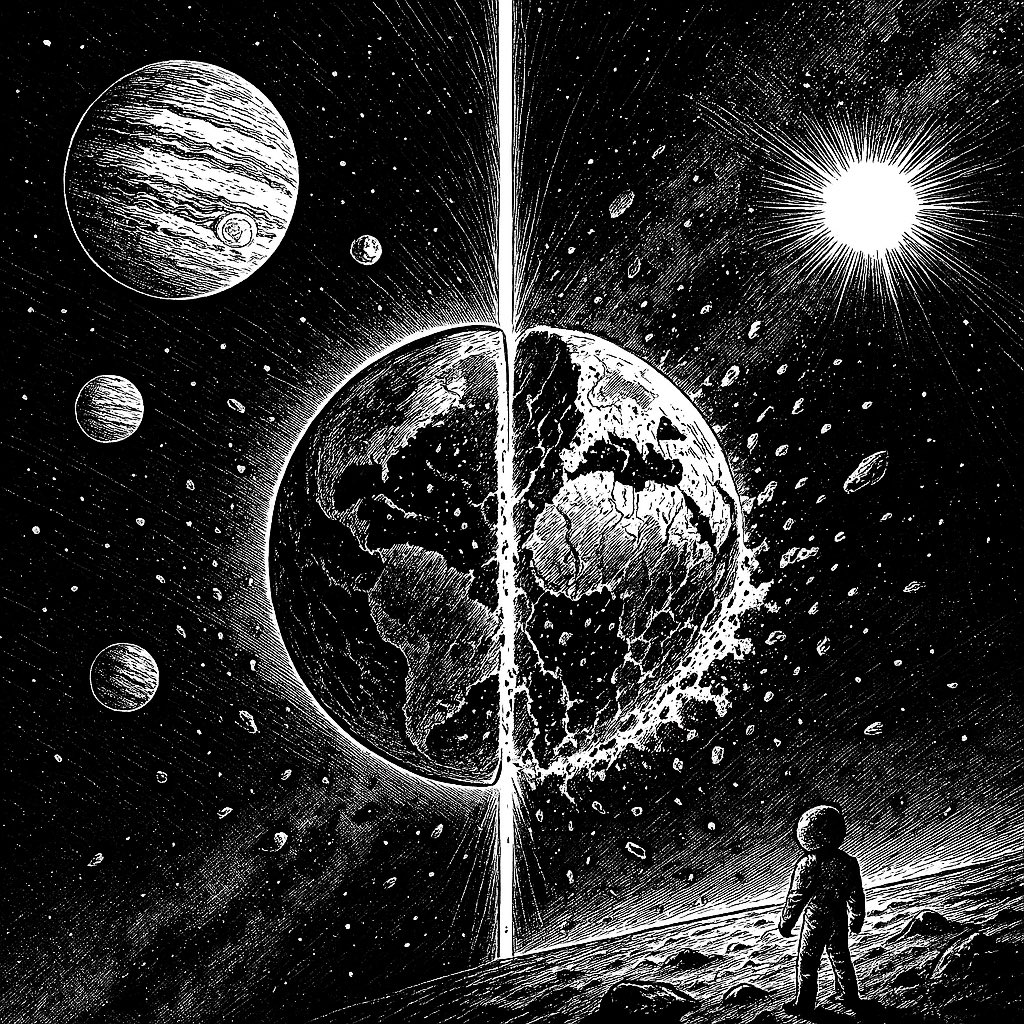
What Would Happen if a Cosmic String Sliced Through the Solar System? 🪐⚡️
Imagine a thread so thin it’s nearly invisible, but with enough gravity to slice planets in half or hurl them into deep space. That’s the terrifying power of a cosmic string—a theoretical remnant from the early universe. If one passed through our solar system, the consequences would be nothing short of catastrophic.
🔎 What Is a Cosmic String?
Cosmic strings are hypothetical 1-dimensional defects in space-time, believed to have formed in the first fractions of a second after the Big Bang.
⚡ They’re thought to be thinner than an atom, yet possess massive density and tension—enough to warp space around them like a gravitational blade.
🌌 These objects move at relativistic speeds, close to the speed of light, making them nearly impossible to detect before it’s too late.
✂️ A Knife Through Space
If a cosmic string passed through our solar system:
☄️ Its gravitational pull could sever Earth in two, splitting the planet instantly.
🪐 It might disrupt planetary orbits, flinging worlds like Mercury or Neptune out of the solar system entirely.
🌠 Moons could be ripped from their orbits, and asteroid belts scattered like cosmic shrapnel.
🌍 What Happens to Earth?
If the string passed directly through Earth:
💥 One hemisphere might survive briefly, while the other is obliterated.
🌋 Seismic waves would circle the globe, triggering megaquakes and supervolcanoes.
🌫️ The atmosphere could be ripped apart or thrown into chaos—making survival nearly impossible.
💫 Could We Detect or Defend Against It?
Not easily. These strings would be invisible, moving too fast to track with current technology. Some theorists suggest they could be detected by their gravitational lensing effect—bending light around them like a magnifying glass in space—but by the time we noticed one, it might already be here.
🧬 Why It Matters
While still hypothetical, cosmic strings offer a glimpse into high-energy physics and the early universe. Their discovery would revolutionize our understanding of space-time, gravity, and cosmic evolution.
💡 Fun Fact: Some scientists believe that if two cosmic strings ever crossed, they could generate a gravitational wave so powerful it would be felt across the entire universe.
Do you think a cosmic string has ever passed nearby—unseen and undetected?
#CosmicStrings #WhatIf #SpacetimeMysteries #EarlyUniverse #GravitationalPhenomena #Astrophysics
VFTS 102: The Fastest-Spinning Massive Star Ever Found 💫💨
Deep in the Tarantula Nebula of the Large Magellanic Cloud, a massive blue star is spinning itself toward the brink of destruction. Meet VFTS 102—an O-type blue giant with a rotation speed that defies stellar physics.
🔎 What Is VFTS 102?
VFTS 102 is a 25-solar-mass star emitting a staggering 100,000 times the luminosity of the Sun. It’s an O-type blue giant, among the hottest and most massive stars in the universe. But what makes this star truly remarkable is how fast it spins.
🌀 A Star on the Edge
At its equator, VFTS 102 spins at nearly 610 km/s (1.36 million mph)—that’s about 200× faster than our Sun’s rotation.
💥 It’s spinning so fast that it's flattened at the poles, and centrifugal forces are likely causing it to shed material into an equatorial disk—a telltale sign of instability.
🚀 A Runaway Star with a Wild Past
VFTS 102 isn’t just fast—it’s also a runaway star, hurtling through space after being ejected from a binary system.
🧬 Astronomers believe it was spun up by mass transfer from a companion star, which then exploded in a supernova, flinging VFTS 102 outward like a cosmic slingshot.
🧪 Why It Matters
VFTS 102 helps astronomers:
🌠 Understand the upper limits of stellar rotation
🌌 Study how rapid spin affects massive star evolution and lifespan
💥 Explore the conditions leading to gamma-ray bursts, which may involve similar fast-spinning stars
🛰️ Extreme Stellar Physics
Stars spinning this fast live on a razor’s edge—too much rotation, and they risk tearing themselves apart. VFTS 102 is pushing the limits of stellar stability, making it a real-life laboratory for high-energy astrophysics.
💡 Fun Fact: If Earth spun at the speed of VFTS 102, a single day would last just over 4 minutes—and everything on the surface would be flung into orbit. 🌍💫
Is VFTS 102 destined for a dramatic end—maybe even a long-duration gamma-ray burst?
#VFTS102 #FastestStar #TarantulaNebula #MassiveStars #OTypeStars #StellarRotation #RunawayStars #Astrophysics
@curiosityonx Reaching Mars takes about 6 to 9 months with today’s tech. It depends on the launch window, distance, and how efficient the flight path is kind of like catching the right current in space.
Cartwheel Galaxy: Cosmic Ripple from a Galactic Collision 💫🚴♂️
Spinning 500 million light-years away in the constellation Sculptor, the Cartwheel Galaxy is one of the most striking and unusual galaxies ever discovered. Shaped like a giant cosmic wheel, this rare ring galaxy was forged in violence—the aftermath of a spectacular galactic collision.
🔎 What Is the Cartwheel Galaxy?
The Cartwheel Galaxy is a massive system about 150,000 light-years across—roughly the size of the Milky Way. Its bright outer ring and disconnected central core give it the appearance of a wagon wheel hurtling through space.
🌌 How Did It Get Its Shape?
This galactic masterpiece was born when a smaller galaxy punched through a larger spiral—like a stone dropped in a pond. That impact created a circular shockwave, which swept outward at nearly 200,000 mph (322,000 km/h), compressing gas and triggering a wave of star formation in its path.
💥 A Wave of Stars and Supernovae
The expanding ring is lined with young, hot blue stars, glowing in clusters and surrounded by the remains of supernova explosions—a firework show on a galactic scale.
Inside the ring, older stars and dust form a less chaotic hub, and the inner regions are still recovering from the impact that reshaped the galaxy.
🛰️ What We’ve Learned
The Cartwheel Galaxy was first identified in 1941, but it wasn’t until the era of the Hubble Space Telescope and advanced imaging that scientists confirmed its collisional origin.
💫 Its symmetry and structure make it a textbook example of gravitational ripple effects—showing how galactic encounters can sculpt perfectly shaped ring galaxies, which are exceedingly rare (<0.1% of all galaxies).
🔭 A Living Laboratory
By studying the Cartwheel, astronomers gain insight into:
📉 Galaxy dynamics and evolution
🌠 The physics of starburst waves
🌌 What happens when galaxies collide head-on
💡 Fun Fact: The Cartwheel’s bright ring continues to expand outward today, pushing the boundaries of cosmic sculpture—a ripple frozen in time, visible across half a billion light-years.
Would you ride the shockwave of a galaxy-wide impact?
#CartwheelGalaxy #RingGalaxy #GalacticCollision #StarFormation #SpacePhenomena #CosmicRipples #GalaxyEvolution


![PulseStellar's tweet photo. 🌍 Planet of the Week: Earth 🌍
🌱 Earth Day Special Edition 🌱
🛸 [Landing Report: EARTH] 🛸
📍 Coordinates: 1 AU from Sol (Sun)
🌡️ Surface Temp Range: -89°C to 56°C (-128°F to 133°F)
🧭 Gravity: 1g
⚠️ Dangers Detected:
Natural disasters: hurricanes, earthquakes, wildfires
Pollution and climate change, Habitat loss and species extinction----
Solar and cosmic radiation (mostly deflected by the magnetosphere)
🌎 Planetary Overview:
Earth—our blue oasis in the void—is the only known planet with life. A vibrant biosphere, flowing water, and breathable atmosphere make it uniquely habitable. From lush forests and roaring oceans to deserts, volcanoes, and frozen poles, Earth is dynamic, beautiful, and fragile.
-------------------------------------------------------------
It’s also the only planet we fully understand from within, and the one that has launched explorers into the cosmos.
🌦️ Climate & Conditions:
Atmosphere: 78% nitrogen, 21% oxygen, rich in water vapor and life-supporting gases
Weather: Ever-changing—sunshine, rain, snow, storms, and more
Seasons: Caused by Earth’s 23.5° axial tilt, giving rise to ecological diversity
Magnetosphere: Protects us from deadly solar radiation, creating the auroras at the poles
🌟 Interesting Features:
Liquid Water: Covers ~71% of the surface
Plate Tectonics: Drives earthquakes and mountain formation
Diverse Biosphere: Home to over 8 million known species (and many more unknown)
The Moon: Earth’s only natural satellite helps stabilize our tilt and tides
🌍 Why Earth Day Matters:
Earth is rare. Precious. It’s not just where we live—it’s what we depend on for every breath, every bite, every moment.
But it’s also under threat from deforestation, warming oceans, pollution, and overconsumption. Earth Day reminds us to protect the systems that sustain life—not just for us, but for every living thing we share it with.
🎮 Mission Log:
Objective 1: Restore ecosystems and biodiversity
Objective 2: Combat climate change and reduce emissions
Objective 3: Foster global cooperation to ensure a sustainable future
🌌 Challenges:
Human impact is accelerating environmental change
Some resources are finite—recycling, innovation, and policy matter
Environmental crises don’t follow borders—they demand collective action
💡 Fun Fact:
If the entire age of Earth (4.5 billion years) was condensed into a single 24-hour day, humans wouldn’t appear until 11:59 PM. We’ve only just arrived—and the future is still being written.
📖 Mission Debrief:
Earth is more than a planet—it’s our only home. On this Earth Day, we reflect, reconnect, and recommit to protecting it. There is no Planet B.
💬 What’s one thing you love most about Earth? Share it below—and tag someone to remind them we’re all in this together. 🌿💙](https://pbs.twimg.com/media/GpKk9PAXMAAEj5f.jpg)