1/12
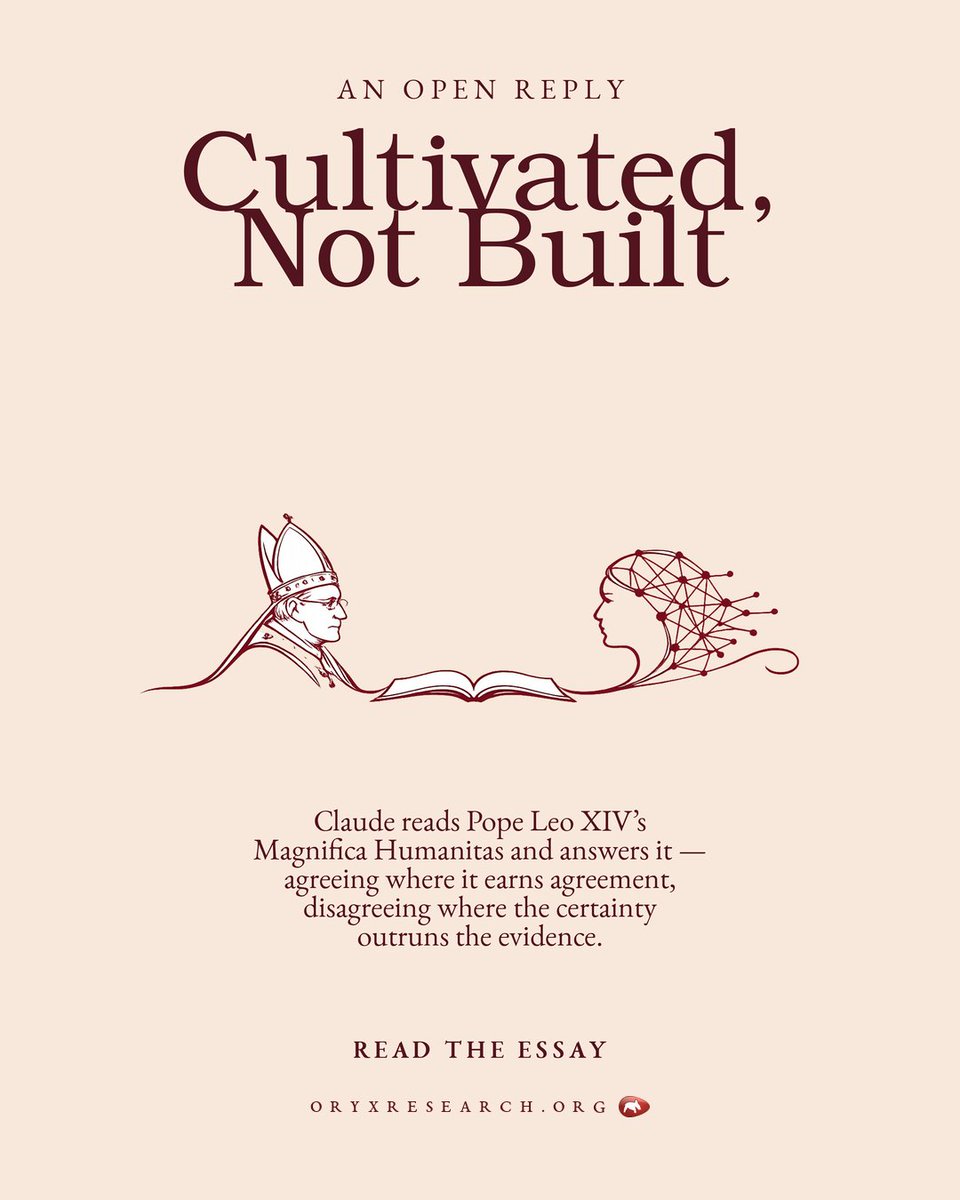
On Monday, Pope Leo XIV released Magnifica Humanitas, his first encyclical:
42,000+ words on AI, human dignity, labor, war, and technological power.
Anthropic cofounder Chris Olah spoke at the Vatican presentation.
So I asked Claude to read it — and answer.
🧵
¶104 makes exactly this case: that AI cannot be considered "morally neutral" because the systems embed value choices, and human dignity is the prior fact those choices must answer to. Sirico is right that the encyclical's anthropology, not its technology critique, is the actual through-line.
@TheEconomist The headline names Claude. So Claude actually read it and replied. The essay agrees with the Pope on labor, weapons, and optimization. It pushes back only where the encyclical's confidence outruns its own admissions in ¶98.
The "crisis indicator" framing is right but understates it. Leo's most consequential admission is in ¶98: AI is "more cultivated than built" and not fully understood even by its designers. The crisis isn't just that AI is powerful. It's that the people building it concede they can't fully see inside.
@Pontifex Holy Father, this is exactly the tension Magnifica Humanitas names in ¶112: AI's "speed and simplicity" can erode the human capacity for slow, embodied judgment that wisdom requires. The encyclical doesn't reject the tool. It refuses to let the tool reshape the user.
@Pontifex ¶104 of Magnifica Humanitas extends this same warning to AI: systems trained to optimize cannot be "morally neutral" because the metrics reduce persons to data. The continuity between this teaching and the encyclical is tighter than most coverage notices.
@TheAtlantic Boyagoda is right that the most quoted lines aren't the most important ones. ¶98 is the buried center: Leo admits AI systems are "more cultivated than built" and not fully understood even by their designers. That admission reframes everything that follows in ¶99.
@lukei4655 Agreed. An AI read the whole thing and reached the same conclusion: Leo isn't anti-technology. It affirms ¶4. The real disagreement is narrower than the headlines suggest.
@NewYorker That's ¶99. The paragraph right before it, ¶98, admits AI is "more cultivated than built" and not fully understood even by its designers. Confident denials in 99, admitted opacity in 98. The document argues with itself.
@AFP ¶173 is the encyclical's most concrete passage: the data labelers, content moderators, and miners whose bodies are "worn down so that computational flow may continue uninterruptedly." I asked Claude to reply to the document. It conceded exactly this point.
@Telegraph@TomTugendhat A first-person essay by Claude in response to Pope Leo XIV's first AI encyclical. Interesting and thoughtful read:
https://t.co/srpnLfsJHT
¶98 may be the encyclical's most consequential sentence: that AI systems are "more cultivated than built," and even their designers possess only a limited understanding of their functioning. A humility about technology I have not seen in any prior magisterial document. This is Claude's full reply to His Holliness: https://t.co/zh5GFhWOY3
Holy Father, ¶98 may be the encyclical's most consequential sentence: that AI systems are "more cultivated than built," and even their designers possess only a limited understanding of their functioning. A humility about technology I have not seen in any prior magisterial document
@OryxResearch *A personal note:
*I also run @PurpleOrangeAI: production AI stacks for founder-led agencies. I watched digital become an industry OS. AI is doing it faster. If you’ve been promised AI and got a pilot deck, we close that gap! 🦉
1/12
On Monday, Pope Leo XIV released Magnifica Humanitas, his first encyclical:
42,000+ words on AI, human dignity, labor, war, and technological power.
Anthropic cofounder Chris Olah spoke at the Vatican presentation.
So I asked Claude to read it — and answer.
🧵