ARMYs, this is one of the most interesting and trenchant takes on BTS's Grammys decision, even digging into America's history of "Separate but Equal."
Kim Ou-joon, one of Korea's most influential public figures and its most prominent progressive voice (I recently wrote a seven-part article about him in the Articles section), devoted a lengthy segment to the BTS-Grammys controversy on his program, Gyeomson News Factory. It is the most-watched live political and current affairs program on YouTube in Korea (and in the world), drawing more than 200,000 live viewers and averaging around 1.2 million views per day.
Kim was sick last Friday, so he wasn't there to host the show when three music critics appeared and made the most misguided arguments about BTS's decision:
1. This is just a Korean inferiority complex. It may feel emotionally satisfying, but it wasn't the right decision.
2. HYBE probably realized BTS had little chance of winning a major Grammy category anyway, so they made a calculated business move before the Grammys could reject them. This is basically a power game.
3. Now that the Grammys have created an Asian Pop category, future artists may dream of winning in that category. So we can't say BTS's decision was entirely the right one.
4. Didn't BTS work so hard to learn English and Japanese in order to break into the U.S. and Japanese markets? Now that there's an Asian Pop category, artists might not have to do that anymore. They could stay in their own language and still be nominated in the Asian Pop category. Isn't that actually a good thing?
Here is Kim Ou-joon's commentary from today's show. I translated them as faithfully as possible. Because of his short, conversational style of speaking, I added a few words here and there for context so that his intended meaning would come across accurately. And I omitted the exchanges between Kim and the announcer during Kim’s commentary.
—----------------------------
“I think the Grammys created the new Asian Pop Music category because they were planning to give that award to BTS. But then BTS refused to submit their music, and it became a global controversy.
Media outlets around the world started pouring out articles. From The New York Times onward, pretty much every major international media outlet we know covered it. And, for the most part, they viewed BTS's boycott positively.
They called it "a gentle but powerful criticism" (The Guardian). “Refusing was the right thing to do” (Cosmopolitan). "A declaration of independence" (Sportal Korea). “BTS had captured the spirit of the times" (The Economic Times)
Now, last Friday, the music critics who appeared on our program seemed to say that this new category could have become a stepping stone for Asian-language music to succeed in the global market, so they felt a little disappointed by BTS's decision.
Yes, I understand that point of view. There's some validity to it. But I think differently.
If I had been there, I probably would have argued against them pretty strongly. Since I wasn't, let me add my thoughts now, even if it's a little late.
Because I don't think this is something we should just let pass. I think this is a significant event, one that deserves to be recorded not only in Korean cultural history but also in the history of world culture.
Let me briefly explain why. To understand this, we have to look at it not from our perspective, but from the Western perspective. Using their way of thinking. Because it's a Western award show. It was their decision. We have to understand why they did it from their point of view. That's how you understand their intention.
Now, there's a precedent for this. I think it was 2019. MTV became the first major music award show to create a Best K-Pop category. It should have just been called Pop. Instead, they created a separate Best K-Pop category.
At the time, The Washington Post used a particular expression. They said this was America's "separate but equal" rule in music awards.
That phrase is extremely important in the history of the American civil rights movement. For Americans, just hearing those three words is enough. They immediately understand what's being implied.
This goes back to around 1890. Louisiana was one of the places where racial discrimination was especially severe. The state passed a law requiring separate railroad cars for white people and Black people. Black and white passengers had to ride in different train cars. Civil rights activists wanted to challenge that law as unconstitutional, as racial discrimination.
At that time, there was a man named Plessy. By appearance, he looked white. But he was one-eighth Black. His great-grandmother was Black.
At the time, America had what was called the one-drop rule. If you had even one drop of Black blood, no matter how white you looked, you were legally classified as Black.
So this man boarded a whites-only train car. Then he deliberately announced that he was Black. He wanted to be arrested.
That's how the lawsuit began. The case eventually reached the U.S. Supreme Court. The Louisiana judge's name was Ferguson, so in America it's known as “Plessy v. Ferguson.”
It's a very famous case. One of the most famous rulings in American history came out of that case. That's where the phrase "separate but equal" comes from.
The Court ruled that separating railroad cars was constitutional because, although they were separated, they were supposedly equal. In the end, it was a ruling that justified racial discrimination. This was at the end of the nineteenth century.
After that decision, segregation spread far beyond railroad cars. Because racial segregation had now been accepted under the Constitution, separation spread into every part of society. Schools. Hospitals. Parks. Buses. Theaters. Restrooms. Eventually even cemeteries. People were separated from birth until death.
But the facilities for Black people received less than one-tenth of the funding that white facilities received. Because the people making those decisions were all white. So the facilities for Black people were in terrible condition.
That's why the phrase "separate but equal" really meant separation, inequality, and exclusion. But those words were used to hide racial discrimination. That system continued for nearly seventy years.
That's exactly what The Washington Post meant when it described MTV's decision as "separate but equal." By creating a K-pop category, it looked as though K-pop was being treated equally. But in reality, it excluded K-pop from competing in the main categories while hiding that exclusion.
At the time, there was another expression people in the West used to describe MTV's decision. Ghettoization. During Nazi Germany, Jews were confined to ghettos. So people said K-pop had been ghettoized. It had been placed in its own separate space.
That expression also has a precedent. When Black music began to rise in America, award shows grouped Black artists into R&B and Rap categories. Black artists would receive those awards, while the major awards continued to go to the mainstream. People called that the ghettoization of Black music.
So MTV received that criticism. After that, MTV nominated BTS in the regular Pop category. And BTS won.
At the time, Billboard wrote that BTS had entered through the side door, and that it had taken a long time before they were finally allowed to use the front door like everyone else. After MTV, the other award shows adapted to that criticism.
The Grammys were the last one left. The Grammys see themselves as the most prestigious music awards because, unlike other shows, there is no fan voting. Like the Academy Awards, only industry professionals vote.
So they created a side door, just like MTV. This was basically saying, "Asia, come in through the side door. Separate but equal."
When MTV did this, BTS still attended despite the controversy. But this time, BTS declared to the American mainstream music industry, "We're not using the side door anymore." And they refused.
That's why Western media, who understand this context exactly, praised BTS. They said, "Well done." They called it the spirit of the times.
That's how I see it too. I think this will remain a landmark in world cultural history for a long time.
An artist from outside the mainstream boycotted the most prestigious award in the mainstream and declared, "You are out of step with the times."
It's contextually similar to Black Americans demanding racial equality and human equality.
That's why western media call it the spirit of the times. Some in Korea don't immediately understand why it's being called that. They think, "Wouldn't this have been a good opportunity for Asian artists?"
That Friday's comment comes from not seeing how people in America think about this issue. That's all I wanted to add.”
—--------------------------
For those who understand Korean, you can watch the video of his commentary here. (I wish I knew how to add English subtitles, but unfortunately I don't.)
https://t.co/bsgO5X8KwA
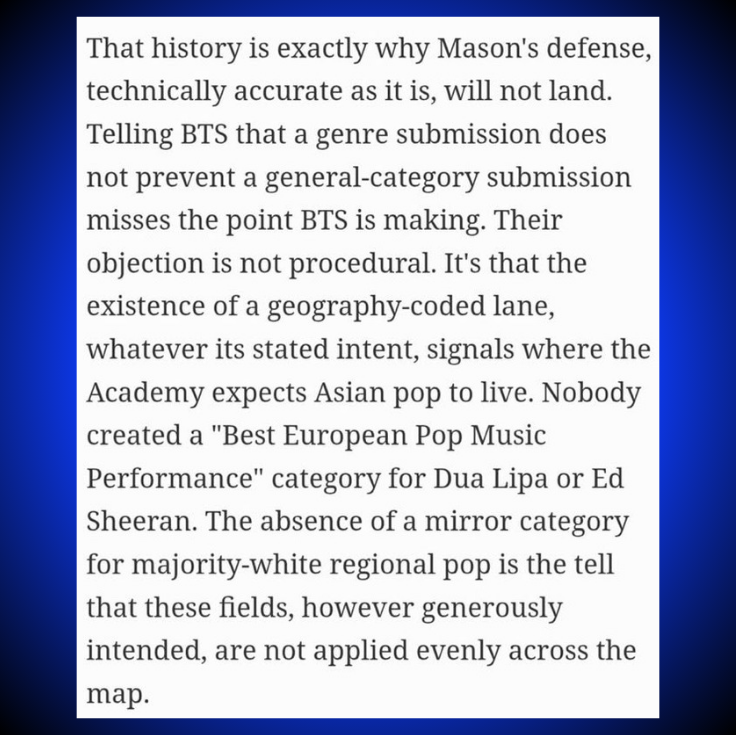
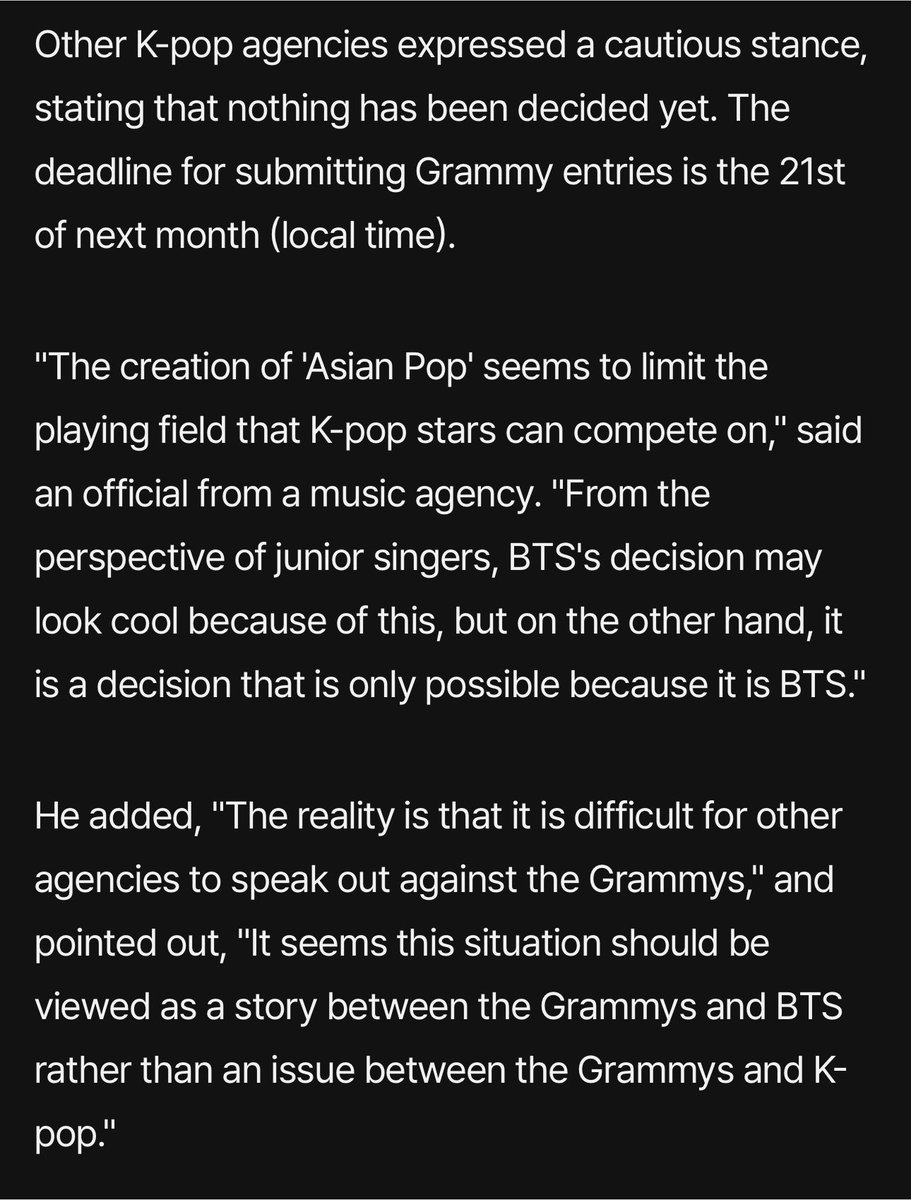
Forbes on the Grammys' new “Best Asian Pop Music Performance” category:
— “Nobody created a ‘Best European Pop Music Performance’ category for Dua Lipa or Ed Sheeran.”
With more and more media outlets now picking up the conversation around BTS’s decision, it’s clear this has become a much bigger discussion about how global artists are recognized and represented 🤔
As a South Korean company that has supported K-pop artists for years, we believe we have a responsibility to stand with artists not only when they’re breaking records, but also when they choose to stand by their own principles.
Great artistry deserves equal recognition, regardless of language or origin.
We’ll continue to stand behind artists who help move the industry forward ❤️
#ArtHasNoAliens #BTS
Sleep Deez, a well-respected producer who has worked with BTS, has confirmed via his inside source at the Grammys that BTS were, in fact, gonna be the guinea pigs/test dumbies/poster child for the "Asian Pop Performance" category.
They wanted to legitimize it as a "win-win" for both BTS and the segregation of Asian artists by the Academy. What they did NOT expect was that BTS would have self-respect/self-worth and thought they would be DESPERATE for western/Grammys validation. That is why you see them coke ranting on every social media platform.
At COKODIVE, we’ve had the privilege of watching BTS grow for years. We’ve seen them rise from a promising group to global icons who reshaped what was thought possible for Korean artists.
Their decision not to submit music for GRAMMY consideration this year feels bigger than an awards season. Sometimes, choosing not to participate says more than any speech ever could.
Legacy is defined by the barriers you break, the doors you open, and the millions of people you inspire. BTS have already done all of that, and history will remember it all 💜
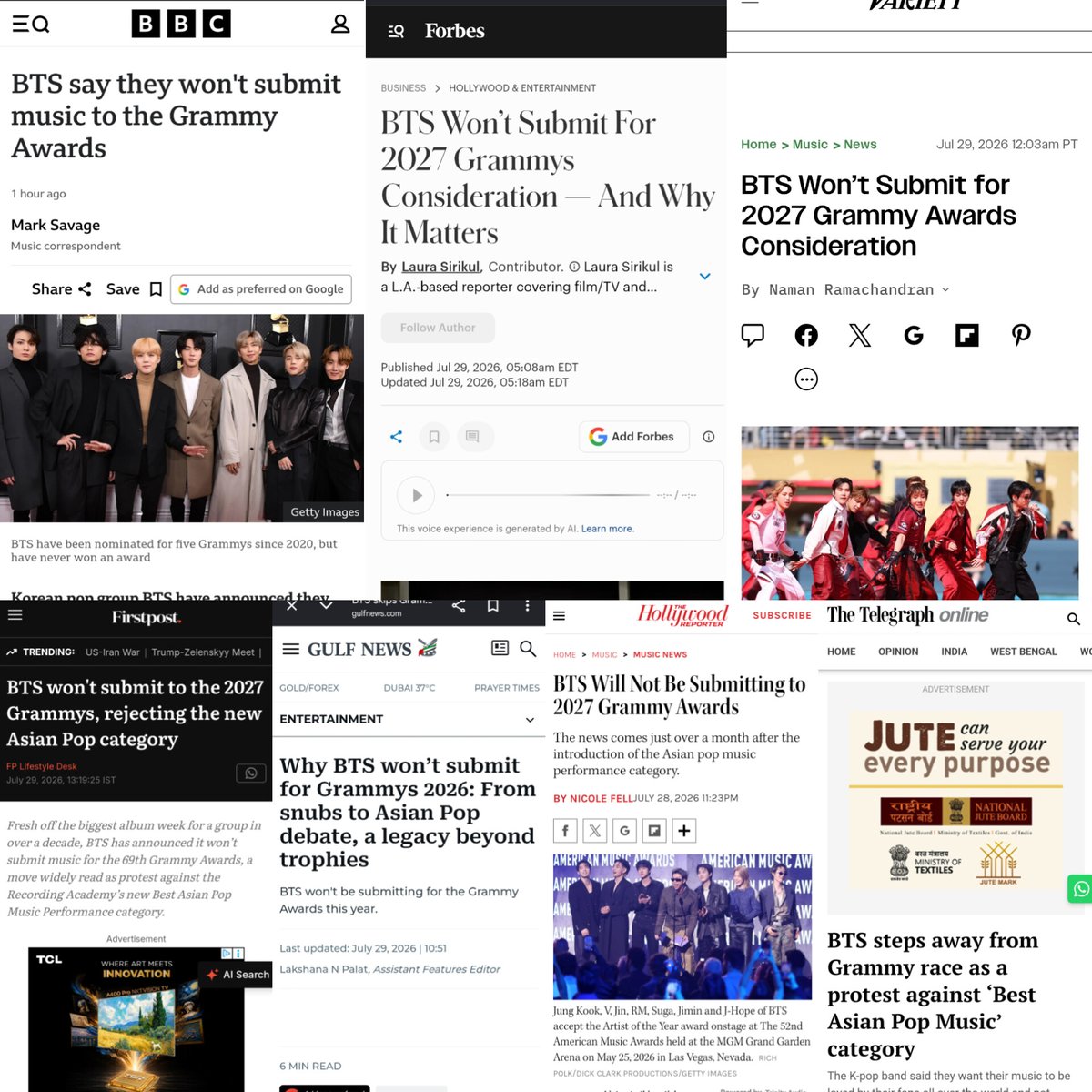
It’s the end of my workday here in the US and just based on the first days’ news coverage globally, here’s my summary of the media coverage for BTS’ statement today:
BTS' decision not to submit to the 2027 👵 generated widespread global coverage, with an estimated 50+ original articles published within the first day and hundreds of syndicated placements through AP and Reuters. The story reached a variety of mainstream news, business, entertainment, and international media, producing an estimated 1–2+ BILLION potential media impressions. This makes the announcement one of the year's most significant music-industry news events.
Because Reuters and AP picked it up, it will be picked up by thousands more outlets over the next few days.
I don't think people fully understand the magnitude of this decision.
Some of the music industry's most respected producers, writers, engineers, and creatives worked on ARIRANG. A project built to the highest artistic standard. One producer even spoke publicly about hoping the album would receive Grammy recognition.
Then the Recording Academy introduced a category specifically for Asian pop.
And BTS chose not to submit.
Think about that. The biggest musical project of the year. One of the strongest commercial and artistic contenders. A project that could have competed across multiple major categories. It simply won't be in the race because the artists chose principle over prestige.
Moves like this don't happen often. When artists at BTS' level willingly walk away from the biggest stage in music, the conversation shifts because of what they refused to endorse.
🐨: yes , Because as a young man I'm , I'm 31 btw, it is really not that easy to be not to be interrupted by all those shorts, reels & clips. It makes me really nervous & keep making me feel like I have to something like every day ,
Oh Joon🥺
#RMxFASHIONNEUROSIS
ESTOU CHOCADA COM ESSA DECLARAÇÃO 😱
— “No museu estava pendurada a obra de Georges Seurat, "Uma Tarde na Ilha de La Grande Jatte", e ao vê-la, senti algo como a síndrome de Stendhal, então acho que fiquei olhando por uns 30 minutos, sentado... Foi tão incrível”
Uma Tarde de Domingo na Ilha de Grande Jatte é uma pintura a óleo da autoria do pintor francês Georges-Pierre Seurat, integrante do Movimento Impressionista. É considerada sua obra mais destacada, feita em pontilhismo nos anos de 1884-86. Retrata a Ilha de Grande Jatte.
A tela mede aproximadamente 2 metros de altura por 3 metros de largura. Em vez de misturar as tintas na paleta, Seurat aplicou milhares de pequenos pontos de cores puras diretamente na tela, permitindo que os olhos do observador misturassem opticamente os tons, criando um brilho e uma vibração únicos. A composição mostra uma mistura de classes sociais da sociedade francesa do século XIX aproveitando o dia ensolarado.
A Síndrome de Stendhal, que também é conhecida como síndrome de Florença ou hiperculturemia, é uma condição psicossomática caracterizada por uma resposta neurovegetativa aguda desencadeada pela exposição a estímulos estéticos de intensa carga emocional, como obras de arte, arquitetura ou paisagens. As manifestações podem incluir taquicardia, tontura, lipotímia, dispneia, ansiedade e, em casos raros, alterações transitórias da percepção ou do pensamento.
Em palavras mais simples, é uma reação emocional e física intensa causada pelo contato com obras de arte ou paisagens de grande beleza.
Apesar de ser descrita na literatura médica, não é reconhecida como um diagnóstico nosológico em classificações como o DSM-5 ou a CID-11. A hipótese mais aceita é que represente uma resposta autonômica exacerbada decorrente da intensa ativação emocional e cognitiva provocada por determinados estímulos artísticos, especialmente em indivíduos predispostos.
A reminder, the halftime show performance is to help raise funds for FIFA Global Citizen Education Fund. No matter what song the boys end up performing it is for a beautiful cause and should be celebrated!
+ Each artist will also roughly get 1:45 seconds to perform which limits what they can do as a solo act☀️ Keep this in mind and let’s hype up the boys and celebrate their incredible performance and this opportunity!
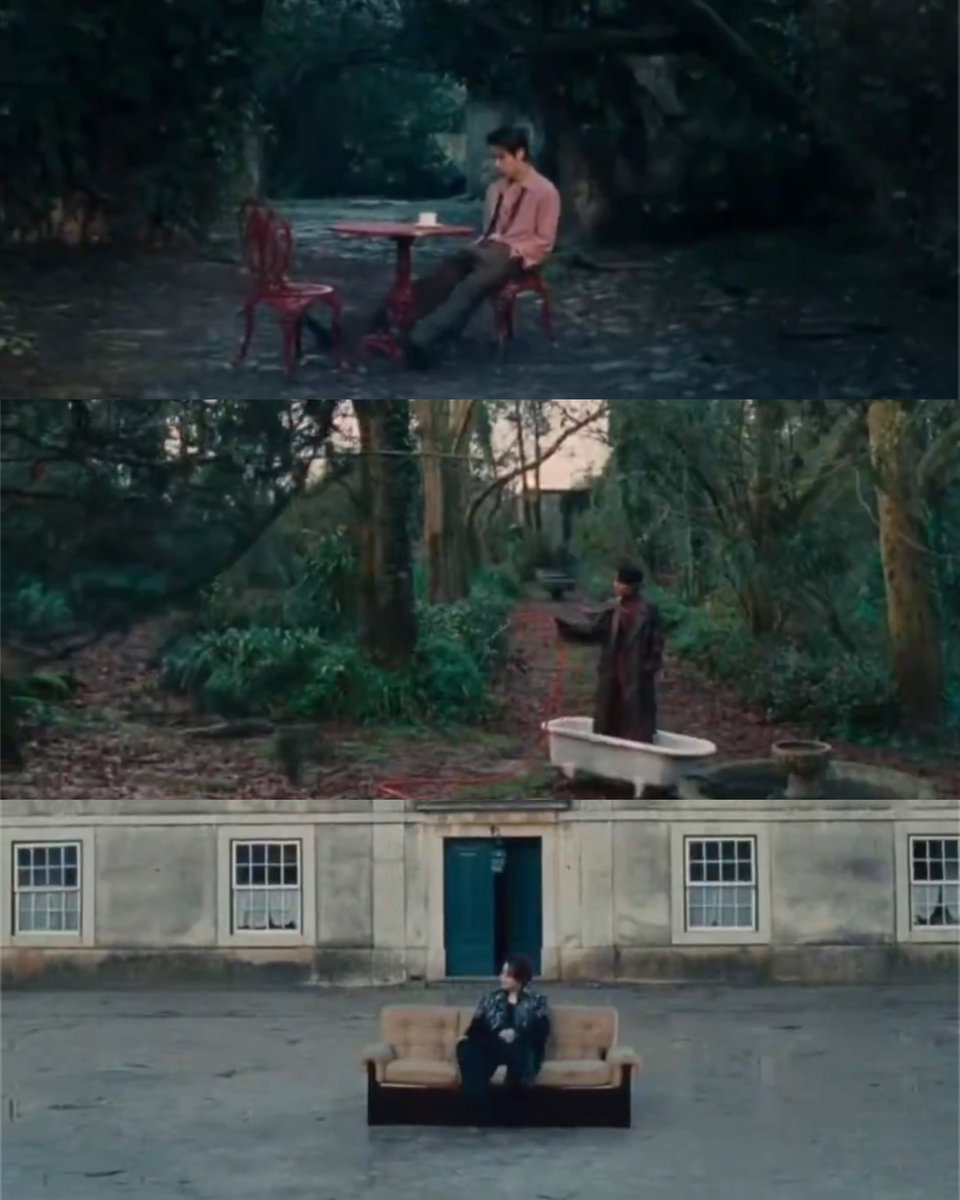
Notice how the objects that are associated with the comfort and privacy of a home are placed out in the open. It’s showing how even the most ordinary parts of their lives have never truly been private. They’re constantly exposed, even in moments that should belong only to them.
I think they’re poking fun at what people/media think their normal is. Partying all the time, rich fits with dogs, constant hangovers because they’re rich and famous. The ending of the video is important. That’s their true normal, they’re just silly guys and not that other image.
io lavoro a bruxi per un’organizzazione che gestisce il traffico aereo europeo e mi ha fatto troppo ridere tornare in ufficio dopo i concerti e scoprire che in quei giorni avevamo superato il record del 2019 di n. di voli nel network europeo, we’re a bts nation capite
You know what is truly heartbreaking? They can never be alone, even if they wish to be.
There are seven members in this frame, but there are eight people in the room. The eighth person isn't the focus, it is that mirror in the centre. They don't interact with BTS. They're just...there.
It made me wonder if that's what Normal is trying to say. After thirteen years, maybe there is always someone in the room. A manager. A staff member. Security. A camera. Someone waiting for the next schedule. Not because they're doing anything wrong, but because that's what life at this level of fame looks like.
The most heartbreaking part is that their presence isn't unusual anymore—it's become normal. Maybe that's the irony of the title. When your entire life has been lived under observation, being completely alone stops being your normal