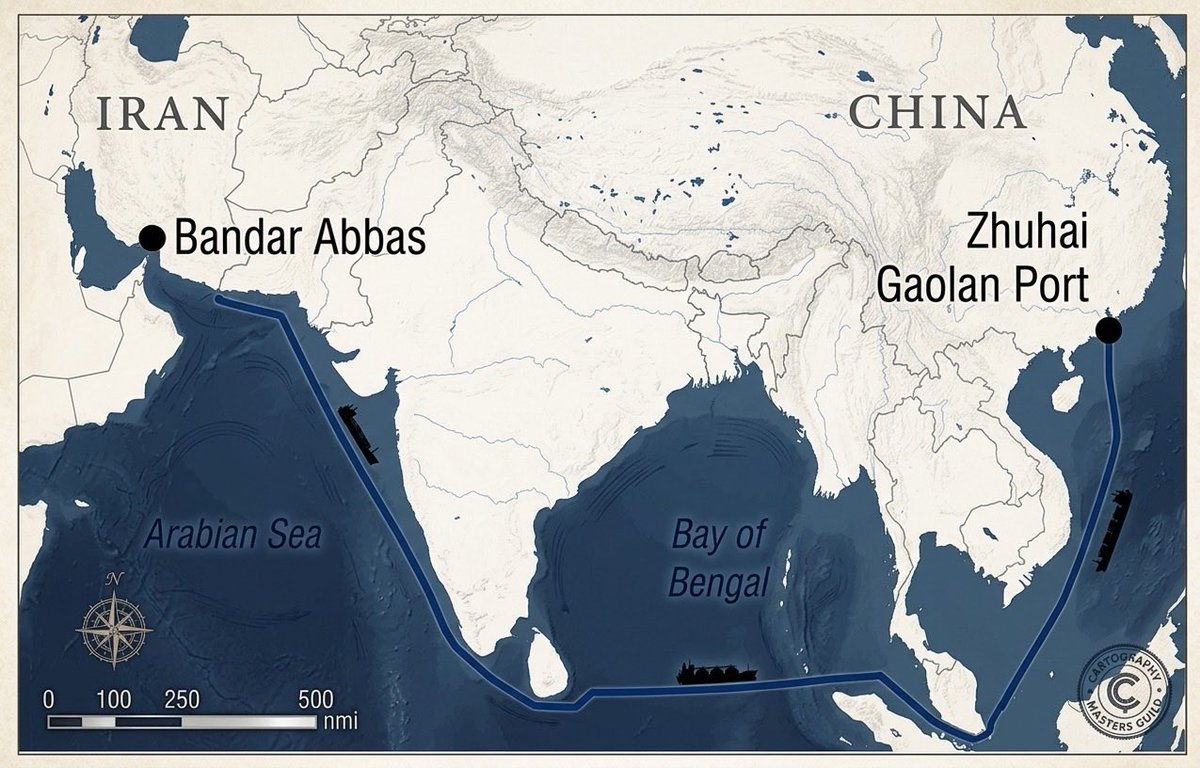
JUST IN: Four ships left Chinese ports carrying sodium perchlorate and arrived at Iranian harbours after the war began. Sodium perchlorate is a white crystalline salt. When heated, it decomposes and releases oxygen. Mixed with aluminium powder and a polymer binder, it becomes solid rocket fuel. Solid rocket fuel propels ballistic missiles. Ballistic missiles close the Strait of Hormuz. The Strait of Hormuz sets the global oil price. And China, the country that shipped the chemical, is buying that oil at a discount, paying in yuan, while co-authoring a five-point peace plan to end the war the chemical is helping to sustain.
The Telegraph reported on April 3rd that the vessels Hamouna, Barzin, Shabdis, and Rayen, all sanctioned Iran-flagged ships, loaded cargo at Chinese chemical ports including Gaolan in Zhuhai and delivered it to Iran since the war began. Analysts assessed the shipments could enable production of hundreds of additional ballistic missiles. In early 2025, over a thousand tons of sodium perchlorate were shipped on similar routes. One shipment was linked to an explosion at Bandar Abbas.
Follow the molecule. Sodium perchlorate leaves a Chinese factory in Guangdong Province. It crosses the Indian Ocean on a sanctioned vessel that no Western insurer will touch. It arrives in Iran. It enters a dispersed production facility that the US Air Force has spent five weeks trying to locate and destroy. It is mixed, cast, cured, and loaded into a solid-fuel motor. That motor is fitted to a ballistic missile. That missile is aimed at a tanker, a refinery, a bridge, or a base. The tanker it hits was carrying oil through the strait that the missile was built to close. The oil that does not pass through the strait becomes scarce. The scarcity raises the physical price to $140. And China, whose factory produced the precursor, buys the scarce oil that its own chemical helped make scarce, at prices negotiated bilaterally in a currency that is not the dollar, through a strait it helped close with a chemical it shipped on a vessel it knew was sanctioned.
The circle has tracking numbers, port manifests, vessel IMO codes, and satellite timestamps. No government has denied the cargo. China says it “strictly controls dual-use exports.” The vessels are sanctioned. The chemical is a known propellant precursor. And the shipments arrived during a war in which China blocked the UN resolution to reopen the strait, co-authored a peace plan with Pakistan, supplied the rare earth magnets inside every F-35 sent to bomb the missile facilities, and published the tutorial that taught Iran to shoot down the aircraft carrying those magnets.
Supplier of the missile fuel. Supplier of the jet engine magnets. Teacher of the countermeasure. Blocker of the resolution. Author of the peace plan. Buyer of the oil. China does not have a side in this war. China has a position at every point on the circumference of a circle whose centre is the Strait of Hormuz and whose radius is measured in the distance a sodium perchlorate molecule travels from a factory in Zhuhai to a missile silo in Khuzestan.
The chemical left China. The missile closes the strait. The oil price rises. China buys the oil. The peace plan fails. The war continues. The next shipment loads. The circle turns.
https://t.co/dAOBBMsgDS
R.I.P. GOOGLE FLIGHTS IN 2026.
R.I.P. BOOKING COM IN 2026.
R.I.P. SKYSCANNER IN 2026.
$1,190 flight. I paid $159.
Use these 7 prompts before booking your next trip :
Everything changed in the last 48 hours and nobody has assembled the pieces.
IRGC Joint Staff headquarters under US-Israeli strikes. Iran naming UAE targets as Abu Dhabi enters the war. IDF Chief of Staff warning publicly the Israeli military could “collapse” from manpower shortages. Iran claiming over one million fighters mobilised with IRGC lowering the age for support roles to 12. Pentagon considering 10,000 additional ground troops within striking distance of Kharg. Trump pausing energy-plant destruction for 10 days until April 6. Iran denying it requested the pause. Houthis warning they will enter the war. Lavrov saying the quiet part: “Iran did not violate any of its international obligations.” Russia’s oil revenue doubling to $24 billion this month.
That is not a war. That is a realignment.
But the development that rewrites everything is not the strikes or the troops. It is a checkpoint on Larak Island.
Iran’s Foreign Minister told the UN Secretary-General directly that blocking enemy ships in Hormuz is Tehran’s legal right as a coastal state. Not a threat. A legal claim. Ships are being funnelled into Iranian-controlled waters near Larak for visual inspections before passage. Non-enemy vessels pass with coordination. Enemy vessels do not. This is not a blockade. It is something more durable. Selective access with political screening, transit fees, and a legal framework. Iran shifted from threatening to close Hormuz to administering who uses it.
The fees are collected in yuan. Chinese intermediaries process payments through CIPS, bypassing SWIFT. Iran already receives over 80 percent of oil revenue in yuan. Legislation is advancing to codify the tolls into permanent law. The US cannot sanction what it cannot see on SWIFT. The yuan is being anchored at the world’s most consequential energy chokepoint not by Chinese policy but by Iranian necessity. Beijing did not plan this. Tehran built it.
Rubio responded to Europeans who called this “not Europe’s war” with the sentence that links both conflicts: “Well, Ukraine is not America’s war, and yet we’ve contributed more to that fight than any other country in the world.” Hormuz is the receivable. Ukraine is the debt. Two wars linked in one sentence by the Secretary of State.
Russia’s Dmitriev warns “the most severe energy crisis in human history is approaching.” Russia does not share intelligence with Iran. Russia does not need to. Every dollar Brent rises above $90 funds Russia’s war in Ukraine with revenue Western sanctions were designed to prevent. The Iran war is financing the adversary it was supposed to isolate.
Israeli military officials have reportedly told their government that Iran’s capabilities cannot be eliminated in the current operation. Nine thousand targets. $200 billion. The Supreme Leader dead. The navy commander dead. None of it reopened the strait. None of it stopped the checkpoint. The kinetic campaign achieved maximum destruction and zero strategic resolution.
Trump says the mission completes in four to six weeks. His mission is kinetic. Iran’s mission is legal, administrative, and fiscal. Those missions do not intersect. You cannot bomb a checkpoint into nonexistence when the checkpoint is a legal claim, a fee schedule, and a parliamentary bill.
April 6 is the pause deadline. April 27 is the NPT. May 14 is Trump-Xi. Between now and then, the toll booth collects in yuan, the legislation advances, the checkpoint operates, the IDF bleeds manpower, the Pentagon deploys armour, Russia doubles its revenue, and the AI supply chain loses its helium from the same chokepoint that is being incorporated into Iranian sovereign law.
The war did not break the world. It rewrote the operating system. And the new operating system runs on yuan, collects at Larak, and does not require a single admiral to be alive to function.
Full analysis: https://t.co/iFmUcarGdV