The @_ZeroPointSec Black Friday sale is now up. Both RTO and RTO II courses are 40% off. The bundles are discounted too. These are the biggest discounts of the year, so it's definitely the best time to pickup some courses if they're on your radar.
Microsoft: memberOf is deprecated
Everyone: Will there be a replacement?
Microsoft: Yes, but you need a new license
Everyone: Wait, what?!? Why?
Microsoft: Well, it's a new feature you see. We rewrote the backend. The old one was no good, this one is better.
Everyone: 🤬
Without IT professionals, the world would be in a much worse place. So much of our critical systems rest on the backs of dedicated, hard working and selfless people. IT admins, network engineers, help desk, DBAs, and so many other roles help keep this duct-taped ship afloat. IT pros are my heros.
Wow SAP's 100k Windows 11 devices are all Entra Joined and no longer joined to Active Directory.
Are your company laptops still joined to AD? Be free.
Do what SAP does 👏👏
Nice work @young_robbo
Time to patch VMware!
"VMware vCenter contains an authentication bypass vulnerability in the VMware Directory Service. Broadcom has evaluated the severity of this issue to be in the Critical severity range with a maximum CVSSv3 base score of 9.8."
‼️ ALERT -- PHP warns of CRITICAL security flaws affecting ALL supported versions.
Security fixes are scheduled for TODAY, November 19.
One expected fix addresses another RCE flaw under specific configurations.
Details here ↓ https://t.co/2XCvPkX5KD
This is actually kinda insane
1. initial access to UPS web console (running on a DC)
2. code exec as SYSTEM
3. ntdsutil to dump hashes from the DC
Dang...
https://t.co/iQnBJZTsbg
What an awesome technique against firmware TPM!
The longer term solution is still file level encryption so that FDE matters less
But the quickest solution for this flaw is to increase your minimum BitLocker PIN length to 8, or just don't lose devices :p
Want to know something promising about this whole 2shell thing and other exposures?
Most of our safeguards, memory protection, and hardening of systems is actually holding up surprisingly well.
There hasn't been a mass MS08-067 type situation, even as these modules are extremely good at finding critical exposures.
We're doing alright.
Oh neat! I missed that the "Require identity verification" grant control can now be used to apply granular controls to onboarding and account recovery 🥳
This finally lets you enforce enrollment or recovery from a trusted network or other conditions :)
nginx2root / CVE-2026-123007: our take after reading the Xint and Wiz writeups
Two teams independently built working unauthenticated RCE exploits against nginx. F5 confirms the bugs, and fixes are out (1.31.9 / 1.30.7). This is a serious one. Patch.
But the version number alone doesn't tell you whether a server is exposed.
The widely quoted "98.9% of nginx hosts are in the affected range" counts version strings. The two critical bugs (CVE-2026-123007, CVE-2026-123633) sit in the HTTP/2 code. They can only be reached if HTTP/2 is enabled, and nginx doesn't enable it by default.
A server is exposed to them when all of this is true:
- nginx 1.9.5 to 1.31.8 (stable branch: up to 1.30.6), without a vendor backport
- HTTP/2 module compiled in (true for most distro packages)
- HTTP/2 enabled on a listener an attacker can reach
Check from outside:
curl -sI --http2 -o /dev/null -w '%{http_version}\n' https://HOST/
"2" means HTTP/2 is on, "1.1" means it's off. Test the nginx itself, not a CDN in front of it.
Check on the server:
nginx -v
nginx -V 2>&1 | grep -o with-http_v2_module
nginx -T 2>/dev/null | grep -E 'listen.*http2|http2 +on'
No output from the last command means HTTP/2 is not enabled.
How common is HTTP/2 on nginx? We spot-checked a few hundred nginx HTTPS endpoints listed on Shodan: roughly two thirds negotiate it. So not 99%, but still millions of servers.
What to do:
- Update to 1.31.9 / 1.30.7 or your distro's fixed package. Distros backport, so check the advisory, not just nginx -v.
- Can't patch yet? Turn HTTP/2 off until you can.
- The same release fixes three more RCE bugs that need other features (resolver with a variable proxy_pass, HTTP/3, mail proxy). Patching covers those too.
Xint: https://t.co/ZI1JczxDR2
Wiz: https://t.co/tgVoxoVngG
F5: https://t.co/VtkQlNHymO
‼️ BREAKING: A 10-year-old flaw in #NGINX could let attackers execute code on servers — no login required.
Dubbed #nginx2root (CVE-2026-123007), the critical HTTP/2 vulnerability scores 9.2/10.
Public PoC available. Patches released.
Full details ↓ https://t.co/kNq60Lv5zx
This means you can now do Face Check before accessing PAWs, activating privileged roles, accessing sensitive information
Excited to finally see Verified ID used in more things :)
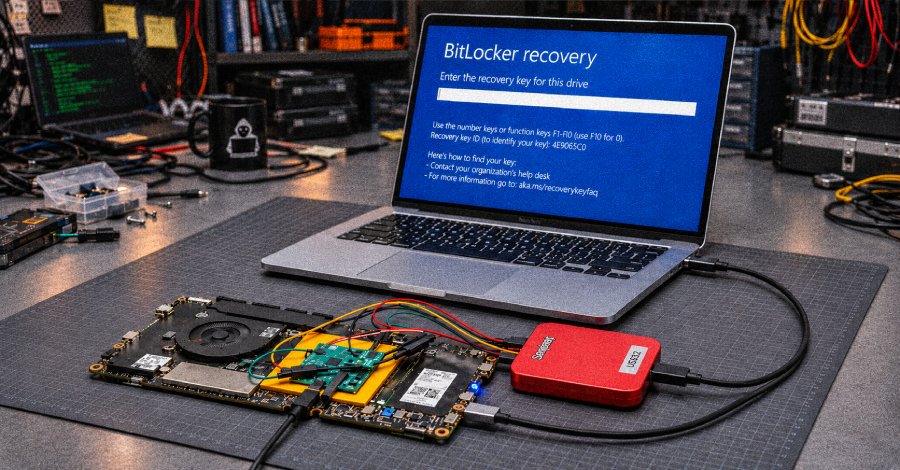
‼️ BREAKING - Researchers bypassed TPM lockout protections to Windows Hello and BitLocker PINs.
A flash-chip attack cuts brute-force times from YEARS to DAYS on affected AMD and Intel PCs.
Here's how it works → https://t.co/eQ3yEBGnpQ
In response to my #BHUSA talk on Pass-the-Passkey attacks, Microsoft changed Hyper-V enhanced session mode UI and defaults: since the October 2026 update, WebAuthn passthrough to VMs is now disabled.
🔐 Research: https://t.co/bp5sriMB5z
🪟 Update details: https://t.co/s0h9HiPNOu