Today's positioning and flow[1/2]:
Both rebound days lifted what positioning had stretched furthest, and neither drew confirming flows. Monday bounced the AI names hedge funds had sold while the desk stayed a small tech seller. Tuesday squeezed the shorts, the most-short basket up 258bp, while the desk's hedge funds kept selling and their short-sale share rose to 53% from 40%
[2/2] Sponsorship is thin: long-only buying fell to 2.4% better to buy from 15% on Monday, and top-of-book liquidity is 18–19% below average. Monday's gain faded to an implied SPX close of about 7,691, below the 7,715 short-term CTA pivot, which Tuesday's 11:30 level of 7,718 only just regained.
Today's positioning and flow[1/2]:
Both rebound days lifted what positioning had stretched furthest, and neither drew confirming flows. Monday bounced the AI names hedge funds had sold while the desk stayed a small tech seller. Tuesday squeezed the shorts, the most-short basket up 258bp, while the desk's hedge funds kept selling and their short-sale share rose to 53% from 40%
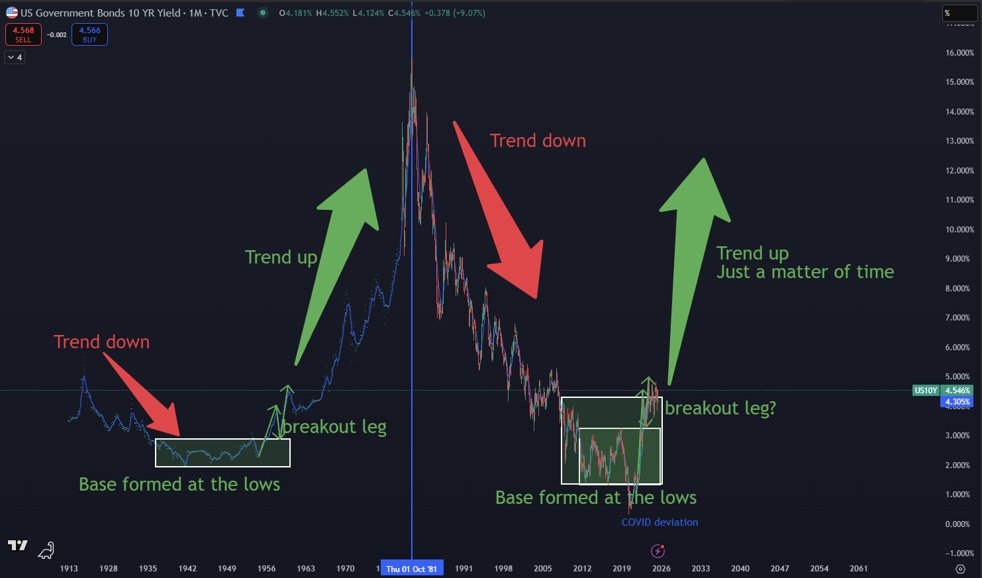
And a big warning: a significant wave of debt refinancing is projected for late 2026 through 2028. Corporations that issued debt in 2020 and 2021 when FED rates are lower than 2%, are facing a maturity cliff, which will tighten liquidity and place upward pressure on bond yields.
5. The evidence supports examining exposure to that systematic supply and to a short squeeze; it does not show the selling is over, since risk appetite fell much further in two of three earlier drops this deep. CLO ETF inflows near their highest since early 2025 suggest the stress sits in equity positioning, not credit
A thread about current market positioning [1/5]:
Discretionary investors have hedged or sold; systematic money has not. Hedge funds cut net leverage to its lowest in nearly five years by adding shorts, Friday's index-put volume was the highest in data back to 2015 , and momentum ETFs' September outflow was about three times any since 2023. CTAs, still long US equities, are modelled to sell them next week in every scenario
4. Friday was a burst of macro hedging, not single-stock panic: VIX futures volume ran 3.6 times its 20-day average while equity puts ranked only 12th, and the monthly expiry and years of growth flatter the index-put record
Just a quick note about IR vol:
HFs running repo-financed basis trades hold more than 9% of marketable Treasuries and act as marginal buyers of the long end. And basis trade is essentially a levered, short-vol carry trade, which means the buyer base now depends on bond volatility staying low. More context: Interest rates MMs are a quarter of their 2007 size against record issuance.
Hence, from a structural perspective, more to the yield trending up in higher time frame.
And some notes on option structures:
SPX 3m implied correlation is 0.15, two sd below its 20-year average and just above this year's 0.11 low. Index options are priced on dispersion, which is cheap relative to single-stock vol. Mag7 downside vol is low too, 33.6 against a 38.4 average.
The question I would watch: when a common factor other than idiosyncratic ones that cause the dispersion becomes dominant, do single-stock vol and correlation rise together? Correlation's own history says it jumps rather than drifts.
Seems like dumping my mostly tech long exposure on Oct 2 was a good call based on a combination of uncorrelated timing measures. Will closely evaluate for the coming days to try to get in on the final year end rally train.
Just a quick note about IR vol:
HFs running repo-financed basis trades hold more than 9% of marketable Treasuries and act as marginal buyers of the long end. And basis trade is essentially a levered, short-vol carry trade, which means the buyer base now depends on bond volatility staying low. More context: Interest rates MMs are a quarter of their 2007 size against record issuance.
Hence, from a structural perspective, more to the yield trending up in higher time frame.
@ShanghaoJin And look at asset performance during such periods, upward trending high rates exert way more effects on prices than downward trending high rates
Inflation is systemic emergence, people shouldn't view inflation through a posteriori and linear lens. Trying to determine what factors were the culprit for untamed inflation this time around is no different from blaming recession on the incumbent Fed Chair and president.