Physics PhD analyzing quantum technology for investors & curious minds.
Follow if you want to understand quantum tech without the hype.
Not financial advice.
What is quantum sensing?
It can share technology with quantum computing, but serves a different purpose.
Both use quantum physics. While computing gets attention, sensing has decades of real-world use, with $INFQ building a sensing business and $IONQ entering through Vector Atomic.
The field spans very different levels of maturity. The first atomic clock was demonstrated in 1949, and quantum magnetometers followed in the 1950s. Some other technologies are only now moving from laboratories toward real-world deployment.
That uneven maturity is what makes the field interesting from an investor perspective.
So for this deep dive, I want to understand the technology, separate what is established from what is emerging, and see where the frontier actually sits today.
@ReadFuturist@XanaduAI The $10M won't fix a SPAC drop, but staying in DARPA's program is one of the few outside technical checks these companies get, and that matters for the whole field.
@NITIAayog Good to see regulators move early on this, the hard part will be getting banks to actually swap out their encryption before the deadlines hit.
Sources:
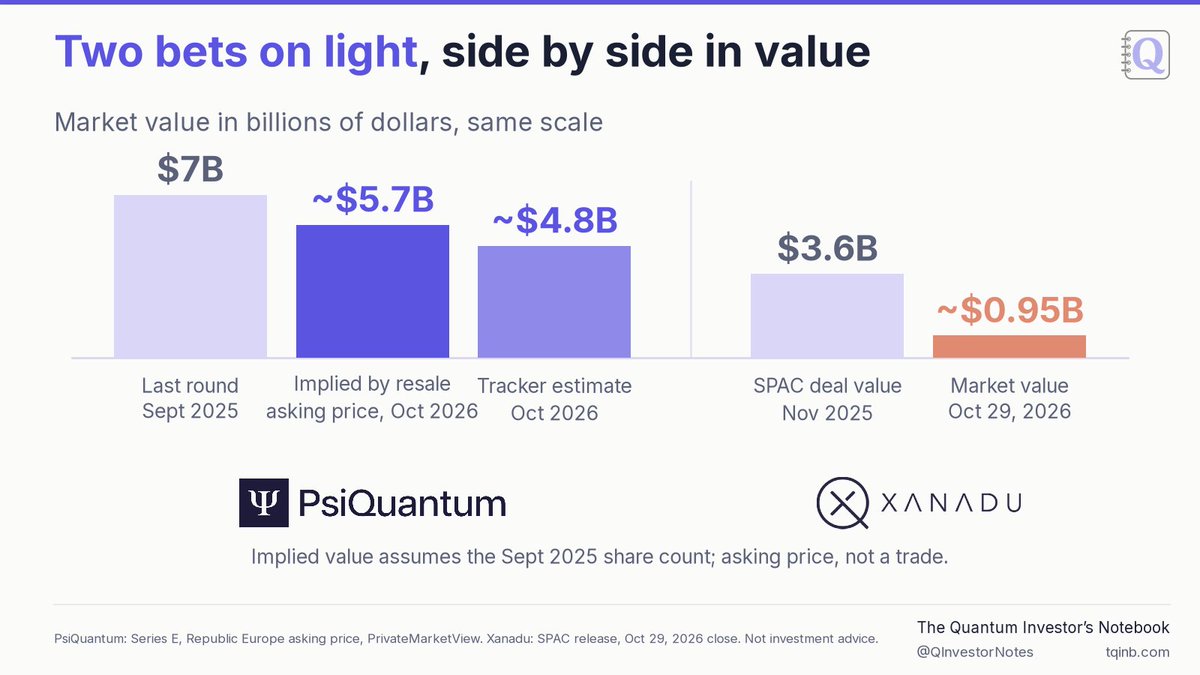
PsiQuantum Series E, Sept 2025, $1B at $7B: https://t.co/YcsBZ5N7XU
Resale asking price, $33.35 a share vs $41.13 in the round (Republic Europe): https://t.co/DjEO7HgM85
Tracker estimate, about $4.8B (PrivateMarketView): https://t.co/wg1CrmBmeH
Xanadu SPAC and $10 PIPE: https://t.co/ICBMNS8Shu
Is Xanadu ($XNDU) too cheap, or is PsiQuantum too expensive?
Both bet on light to build quantum computers. @XanaduAI is public, worth about $0.95B. @PsiQuantum is private, last valued at $7B in Sept 2025.
A private price can fall too. It just does it quietly.
Some PsiQuantum shares sit on a resale site at a price implying about $5.7B. That's still 6x Xanadu, at least if you count the asking price.
Either the market is underpricing Xanadu, or PsiQuantum's last round priced it above what it's worth.
So which one is right?
Paper, Guo et al. (Cardiff, Politecnico di Milano and partners), Nano Letters 2025 https://t.co/r76TE5se52
arXiv https://t.co/XlBX9TiOBx
Image: Fig. 1(a,b), Guo et al., Nano Lett. 2025, 25, 8096, CC BY 4.0
Diamond quantum sensors have a weak signal. Researchers in Cardiff and Milan estimate they got a 10x gain in sensitivity.
The signal is weak because a microscope lights only a tiny spot of NV centers and catches little of their glow. The researchers burned a light pipe through a 2.8 mm chip, which carries the light along the whole chip, so it reaches far more of them.
Burning tracks into diamond sounds like a good way to wreck the sensors.
Interestingly, the laser actually writes two walls of damaged carbon about 18 µm down, and the light travels through the clean diamond between them.
The NVs kept their coherence about as well as untouched diamond.
But that is not the whole story.
The other side of the equation is noise. The 10x is calculated as if photon shot noise were the only noise, and the paper never measures the real noise floor.
But the part they did measure, on an off-the-shelf commercial diamond, is real. So the gain comes from processing rather than a new material.
Part of my deep dive into quantum sensing:
What is quantum sensing?
It can share technology with quantum computing, but serves a different purpose.
Both use quantum physics. While computing gets attention, sensing has decades of real-world use, with $INFQ building a sensing business and $IONQ entering through Vector Atomic.
The field spans very different levels of maturity. The first atomic clock was demonstrated in 1949, and quantum magnetometers followed in the 1950s. Some other technologies are only now moving from laboratories toward real-world deployment.
That uneven maturity is what makes the field interesting from an investor perspective.
So for this deep dive, I want to understand the technology, separate what is established from what is emerging, and see where the frontier actually sits today.
Loading data into a quantum computer can cost more than the math itself.
Xanadu ($XNDU) and Rolls-Royce automated cheaper ways to load it and read the answer, and estimate a fluid-flow job gets about 10,000x cheaper.
At least in theory.
And for a good reason. Even after the cut, the job still comes to about 9 quadrillion T gates, the expensive operations of an error-corrected machine.
A 10,000x discount on a bill no machine can pay yet.
It is a peer-reviewed estimate on one 20-qubit benchmark, compared with a generic method.
Earlier this month I covered one cheaper loading trick. This time software picks the method, and the saving is counted on a whole job.
I unpacked the paper in the Note linked in the replies.
$XNDU has found another way to cut the work quantum computers need to load data.
The value is reducing the demands placed on future fault-tolerant machines.
Many quantum algorithms repeatedly look up numbers from a classical table, a step called QROM.
The new design handles twice as many table entries per loading pass with the same borrowed qubits, then restores those qubits unchanged.
Combined with Xanadu's earlier method, it uses about one-quarter as many costly Toffoli operations in the main loading step as SelectSwap, for large tables of 32-bit entries when spare qubits are limited.
This is not a measured runtime gain.
Future machines could spend fewer expensive operations on loading data, leaving more resources for the calculation itself.
Google's ($GOOGL) Willow chip checks for errors every 1.1 µs, but can the decoder reading them keep up?
Yonsei researchers rebuilt AlphaQubit's design on Mamba so its cost grows more slowly as chips get bigger.
For now, one block of it takes about nine Willow cycles on a GPU.
The real-time edge at today's sizes exists only in a simulation.
Ions have it easier. IonQ ($IONQ) ran a decoder for a simulated 408-logical-qubit ion machine on one laptop CPU, and it kept pace with an assumed 1 to 5 ms cycle.
Cheaper at scale, on paper. Fast enough, not shown yet.
I unpacked the full paper in the Note linked in the replies.
Google cut errors 40x in one key quantum ingredient, and the $GOOGL Q3 call gave it only half a sentence.
So I let the Science paper provide the numbers.
The ingredient is magic states, which a quantum computer needs for its hardest steps.
The 40x was on real hardware against plain injection, but only in a small code, as noise washed the gain out in the larger one.
It puts Google on par with Quantinuum's ($QNT) trapped-ion magic states, but at superconducting speed.
I covered the experiment in more detail below.
Sources:
NIST IR 8547 (final, Oct 2026), Transition to Post-Quantum Cryptography Standards: https://t.co/2EVsJOD9ji
2024 draft for comparison: https://t.co/cvI9zdYNz0
Image: Table 2, NIST IR 8547, p. 15 (US government work)
NIST (the National Institute of Standards and Technology) made its quantum deadline final this week.
The US government just put a date on the signatures that protect $BTC and $ETH wallets.
ECDSA, the signature family crypto uses, is deprecated after 2030 and disallowed after 2035 under NIST rules.
Why? A large enough quantum computer running Shor's algorithm could recover a private key from its public key. Today's machines are far from that, but NIST isn't waiting for them.
The final report moves every quantum-vulnerable signature, including the 128-bit curves crypto uses, to deprecation after 2030, up from only the weakest 112-bit keys in the 2024 draft.
NIST notes that past switches took 10 to 20 years. Read backward, a 2035 cutoff means the migration had to start about now.