QMS Testnet is now live.
Our first public release. The EVM-compatible execution layer is open:
→ Add QMS Testnet to your wallet
→ Claim free test tokens from the faucet
→ Swaps and LP on @QWAP_xyz
→ View transactions on the block explorer
https://t.co/7ONsySIP4O
A portfolio manager can’t judge an investment by expected returns alone. It also has to fit their risk budget and position limits.
The same idea applies to QMS’s planned useful-work marketplace.
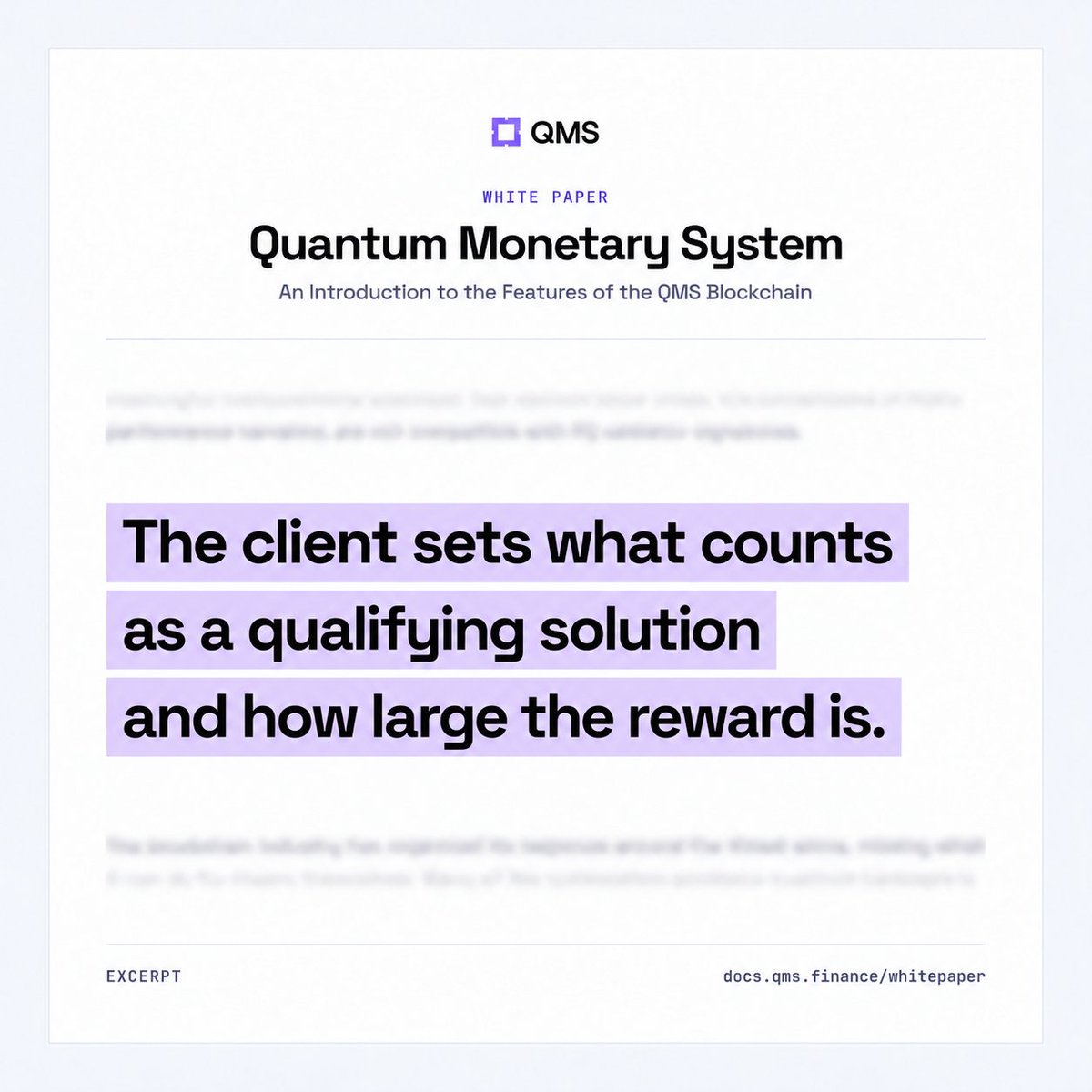
Clients will define what a solution needs to achieve and the reward for meeting those requirements. Miners will know what to work toward, and clients will decide what’s worth paying for.
16M+ transactions processed on QMS Testnet in three weeks!
A week ago, we were at 10M+.
Thanks to everyone testing the network and sharing feedback. Keep pushing it and let us know what you find.
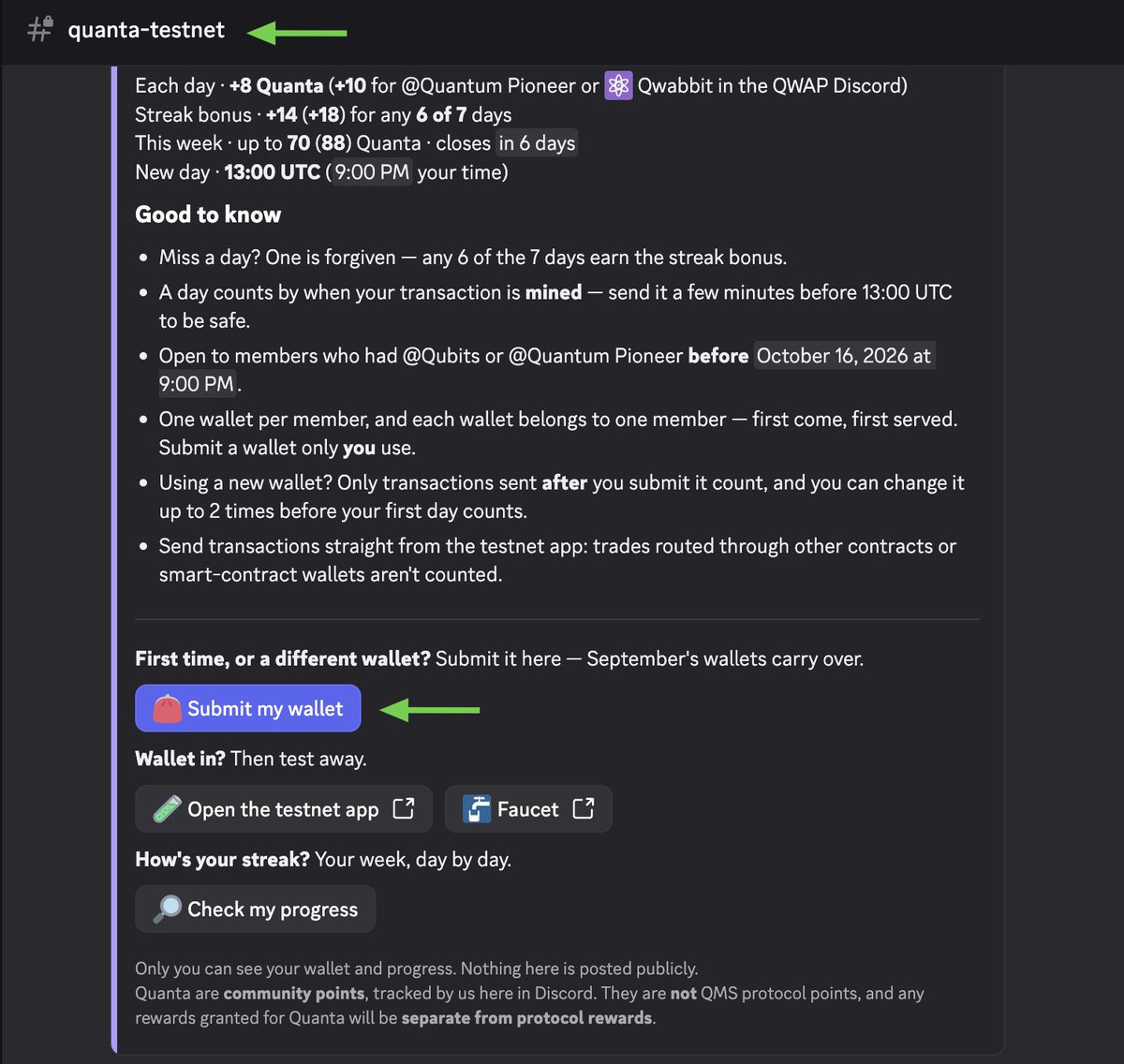
The QMS Testnet Streak kicks off today.
Thanks to your feedback, we've made improvements to swaps and liquidity provision, so now it's time to try them out.
Join our 7-day challenge to earn Quanta, our Discord community reward points that count toward the October leaderboard.
Here's how:
→ New participant or switching wallets? Submit your wallet in Discord first.
→ Make 1 test-token swap + add liquidity daily on @QWAP_xyz
→ Earn 8 Quanta points per day (10 for Pioneers & Qwabbits)
→ Complete any 6 of 7 days for a bonus
→ Earn up to 70 Quanta points (88 for Pioneers & Qwabbits)
Head to our Discord announcements for full details.
What’s changed in post-quantum migration since our September update? Here’s where things stand today:
Bitcoin: September 18's “Output Public Key Exposure Classification” draft classifies existing outputs by exposure. It's informational and observation-only, has no BIP number and proposes no consensus change.
Solana: On October 13, Squads tested Falcon-512 multisig voting on mainnet using Blueshift's Vector verifier. It's app-level and opt-in; the fee payer still needs Ed25519. SquadsX support is planned for its next release, not confirmed shipped.
ZKsync: Airbender Prime, announced October 13, uses hash-based STARKs. Its L1 proofs will use Keccak-256 commitments instead of BN254 pairings. That's a planned proof-system change; user signatures are unchanged.
NEAR: On October 1, Fireblocks demonstrated rotating one funded mainnet account from Ed25519 to ML-DSA-65 in two transactions, keeping its address. nearcore 2.14, adding Universal Account IDs, reached release candidate 5 on October 19. It isn't on mainnet.
Where things stand:
Bitcoin: BIP-360 and BIP-361 remain Draft. Neither is activated. BIP-360 mitigates long-exposure attacks but adds no post-quantum signature. BIP-361 covers migration and a legacy-signature sunset, but requires a post-quantum signature BIP that doesn't yet exist. August's SHRINCS signature draft has no BIP number. There's no activation proposal.
Ethereum: EIP-8141, Frame Transactions, is Scheduled for Inclusion in Hegotá but remains Draft; its specification may evolve. Hegotá is expected in Q2 2027, with no confirmed date. This account-abstraction approach would let accounts adopt new signature schemes later.
The Ethereum Foundation's Protocol cluster has a self-imposed December 2029 target for quantum resistance across execution, consensus and data, to be reassessed in January 2027. No post-quantum signatures are live on L1.
Solana: The Foundation's plan remains at research and evaluation. There are no network-wide post-quantum transaction or consensus signatures. Anza's Quantumglow is a post-quantum consensus research design with no deployment date. Winterwallet works on mainnet as an opt-in app-level vault and isn't formally audited.
NEAR (not in our September snapshot): ML-DSA-65 has been live on mainnet since July 20 as an opt-in key type, and NEAR's roadmap reports Meteor Wallet support is live. Validators still use Ed25519 for block production. Post-quantum consensus is targeted for end-2027; Chain Signatures has no post-quantum threshold-signing timeline.
Ethereum L2s: No major L2 uses post-quantum transaction signatures protocol-wide by default. Starknet's BLAKE2s OS program and configuration hashes are live on mainnet; Falcon-512 accounts are opt-in, with a mainnet demonstration. L2s still depend on Ethereum for settlement, bridge messaging and blob data availability.
None of the ecosystems covered here has completed a full-stack post-quantum migration.
QMS Testnet runs a Reth fork with the standard Ethereum JSON-RPC. Your Foundry or Hardhat setup should work as-is.
Known differences, so you don't have to find them:
→ finalized tag returns genesis (no finality layer yet)
→ PREVRANDAO returns 0
→ no blob txs
Found one that isn't on this list? Let us know.
The QMS Testnet Streak kicks off today.
Thanks to your feedback, we've made improvements to swaps and liquidity provision, so now it's time to try them out.
Join our 7-day challenge to earn Quanta, our Discord community reward points that count toward the October leaderboard.
Here's how:
→ New participant or switching wallets? Submit your wallet in Discord first.
→ Make 1 test-token swap + add liquidity daily on @QWAP_xyz
→ Earn 8 Quanta points per day (10 for Pioneers & Qwabbits)
→ Complete any 6 of 7 days for a bonus
→ Earn up to 70 Quanta points (88 for Pioneers & Qwabbits)
Head to our Discord announcements for full details.
hi Dorabox, that error means the faucet saw another active session on your connection or wallet. It often happens after switching between wifi and mobile data, using a VPN, or opening the faucet in a second tab.
Close any other faucet tabs, or turn off your VPN, and reopen the faucet in the same browser you mined in. Once a session has stopped mining for about 30 minutes, it should be ready to claim. Sessions expire 24 hours after they start, so it's worth trying soon.
If it still won't claim, please open a ticket in our Discord with your wallet address and roughly when you started: https://t.co/2KKjIO82TD
The QMS Testnet Streak kicks off today.
Thanks to your feedback, we've made improvements to swaps and liquidity provision, so now it's time to try them out.
Join our 7-day challenge to earn Quanta, our Discord community reward points that count toward the October leaderboard.
Here's how:
→ New participant or switching wallets? Submit your wallet in Discord first.
→ Make 1 test-token swap + add liquidity daily on @QWAP_xyz
→ Earn 8 Quanta points per day (10 for Pioneers & Qwabbits)
→ Complete any 6 of 7 days for a bonus
→ Earn up to 70 Quanta points (88 for Pioneers & Qwabbits)
Head to our Discord announcements for full details.
Two important quantum computing developments last week:
Anthropic is reducing the computing resources quantum algorithms need, while Google is improving the hardware's reliability.
Both advances could bring practical quantum computing closer, reinforcing the importance of preparing cryptographic systems for the post-quantum era.
1️⃣ Anthropic: AI makes quantum algorithms more efficient
- Claude Mythos 5 designed circuits using fewer qubits and costly operations in 7 of 8 tasks.
- In one optimization task, it reduced the required operations from 5.1 million to 440,000, roughly 12x fewer.
- It also found a new approach to elliptic curve calculations, which are relevant to modern cryptography.
More efficient algorithms could reduce the hardware and computing time needed for practical quantum applications, including future cryptographic attacks. These remain theoretical resource estimates.
2️⃣ Google: Willow achieves 40x fewer errors
- Google demonstrated a technique called magic state cultivation on its Willow quantum chip.
- It reduced errors by roughly 40x and achieved 99.99% logical fidelity when preparing T-states.
- These states are essential for running complex calculations on error-corrected quantum computers.
Better error correction could make large-scale quantum computers more practical. The results are promising, although the technique still needs to work at a much larger scale.
Published in Science today: Magic state cultivation works in practice on our Willow processor. We achieved a 40x error reduction, compared to without cultivation, and 99.99% fidelity. Learn how this addresses a critical resource bottleneck: https://t.co/XojsYpQhDE
Google just cracked open a quantum computing bottleneck researchers have been working on since 2004.
To perform certain advanced operations, quantum computers need special resources called "magic states." Producing reliable ones is so demanding that, by some estimates, it could consume up to 95% of a future quantum computer's resources.
In 2024, Google researchers proposed a technique called "magic state cultivation." It worked on paper.
Now, research published in Science shows it working on Google's Willow processor:
• 40× fewer errors than uncultivated states
• 99.99% magic state fidelity
The next challenge is making it work at scale.
For blockchains, progress like this has two implications:
More powerful quantum computers could eventually threaten today's cryptographic systems. They could also become valuable computing resources.
QMS is designed with both possibilities in mind.
On security: QMS's consensus doesn't rely on public-key signatures for block production. Post-quantum transaction signatures are also on the roadmap.
On computing: Proof-of-Useful-Work aims to turn mining into productive computation, solving optimization problems that clients would pay for.
QMS starts with classical computing, with a long-term plan to incorporate quantum hardware as it becomes commercially competitive.
Quantum computing could do more than threaten today’s cryptography.
QMS aims to use it to solve real-world problems, while using that same computation to secure the network, once quantum solvers outperform classical alternatives.
Note on transaction finality: A transfer may appear in a block before it’s final.
Finality means the record can no longer be rewritten, so apps can treat the payment as settled.
We’re building this layer for a future release.